India, New Zealand Elevate Ties in First PM Visit in 40 Years


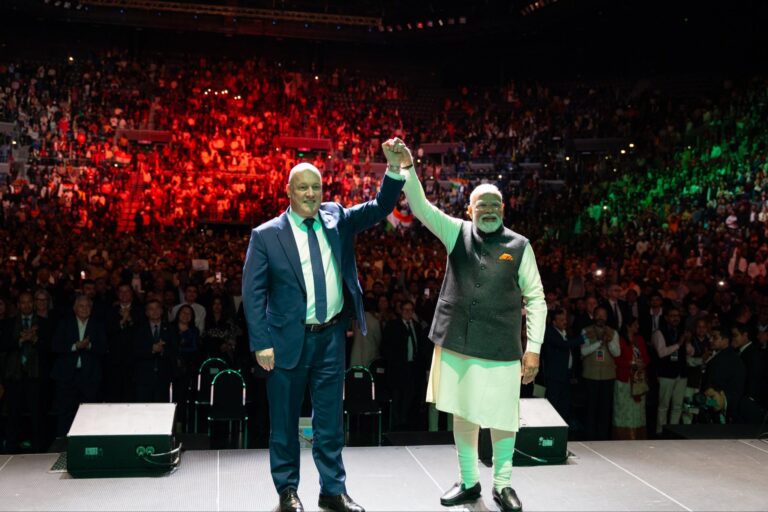
Prime Minister Narendra Modi departed New Zealand on July 11, concluding a two-day visit that saw India and New Zealand elevate their relationship to a Strategic Partnership, the first visit by an Indian prime minister to the country since 1986. New Zealand Prime Minister Christopher Luxon came to the airport to see Modi off.

The visit included delegation level talks, a business event, and an address to the Indian community in Auckland. “New Zealand and India have agreed a new deal that builds on our free trade agreement,” Luxon said. “With Prime Minister Narendra Modi here in New Zealand, we’ve lifted our relationship to a Strategic Partnership, with a plan to double trade between our countries by 2030, meaning more money flowing back into Kiwi communities, creating jobs and boosting wages here at home.”

The Airport Welcome

Modi arrived in Auckland on the evening of July 10. The next morning, opening delegation level talks with Luxon, he called the airport reception “a very significant gesture” and thanked Luxon personally, adding that he was grateful “your Minister stayed with me throughout the night.” At a special MEA press briefing that night, Secretary (East) Rudrendra Tandon echoed the moment from the Indian side, calling it “a very special gesture” that was “much appreciated by the Indian Prime Minister.”

Modi also thanked Luxon for the free trade agreement (FTA) process that followed his own visit to India, calling its swift conclusion “perhaps a rare achievement in the world.” He recalled Luxon’s visit to India last year during Holi, saying it had “added new colors to our relationship,” and called the Strategic Partnership a milestone that would “inspire us to move forward with even greater energy and deeper trust.”

A Launchpad for Global Growth

Addressing a business event in Auckland, Modi told investors India was ready to be seen differently. “India is not only a market; India is a launchpad for global growth,” he said, pointing to the Production Linked Incentive Scheme, which provides nearly $20 billion in support across 14 sectors from food processing to textiles.

He floated joint work on cargo corridors and tourism packages, suggesting perishable cargo solutions for kiwi, apples, honey and seafood, and pairing New Zealand’s expertise in horticulture and dairy with India’s consumer market and agri-tech talent. He also pitched cooperation in fintech, India’s space startup sector, and urban infrastructure, welcomed Maori business leaders in the room directly, noting the FTA gives specific emphasis to Maori business opportunities, and proposed a joint Business Roadmap with at least five flagship projects, alongside an exchange of business leaders under 35 from both countries.

Luxon, addressing the trade relationship separately, said the two countries “bookend the Indo-Pacific,” and that the agreement would “eliminate tariffs on 57 percent of everything we sell to India on day one.”

Outcomes: What Trade Deal, What Money, What’s Still Pending

At the same MEA briefing, Tandon walked through what the visit delivered, and where the fine print sat. The two countries will pursue their Strategic Partnership through a roadmap covering the next several years, he said, with foreign ministers meeting more regularly and closer coordination between the two foreign offices.

An MoU was signed to begin joint work on counterterrorism, violent extremism and transnational crime. Asked whether the new working group was a response to New Zealand having been used for anti-India activities, including a Khalistan referendum event held there in November 2024, Tandon said. “India’s position on counter terrorism and violent extremism is very well known,” he said. “We work with partners to tackle this scourge.” He added that India and New Zealand were “fairly like-minded and tough” on the issue, saying “there can be no double standards when you are tackling such a grave threat.”

Building on an existing defense cooperation MoU, the two sides signed a new maritime cooperation arrangement covering naval exercises, logistics support and hydrography in the Indo-Pacific.

On the free trade agreement, Tandon said New Zealand’s ratification has already begun, with one of three required parliamentary readings completed, and that Luxon had conveyed bipartisan support for a quick process, though no fixed timeline was committed to. On New Zealand’s $20 billion investment pledge, Tandon was direct that it is a facilitation, not a guarantee, with no penalty attached if it falls short. “It is really going to be facilitated,” he said.

A tourism MoU was also signed, though direct flight connectivity still depends on airline business decisions, Tandon said, with no concrete plans yet in place. Asked about New Zealand’s high visa rejection rate for Indian applicants, he called it a sovereign New Zealand matter, while acknowledging it was “a loss of opportunity for the speed at which we can build up the relationship.”

Address to the Indian Community

Addressing the Indian community in Auckland, Modi recalled a visit he made to New Zealand 25 to 30 years earlier, before he held any government position, when he was given a scarf, a cap and gloves because of the cold weather. He had brought the scarf back with him this time, he said, adding that he had kept it carefully over the years “the way I keep your love safe.”

Modi invoked the Maori word waka, saying it was not simply a canoe but a symbol of a shared journey, and told the community spread from Auckland to Wellington, Christchurch to Queenstown, that they were the real navigators of that journey. He named Air New Zealand chief executive Nikhil Ravishankar, former Governor General Anand Satyanand, and cricketers Rachin Ravindra, Ish Sodhi and Ajaz Patel as examples of the community’s reach.

He drew on the Maori concepts of manaakitanga, hospitality and care, comparing it to the Indian principle of atithi devo bhava, or “the guest is God,” and kaitiakitanga, guardianship of the land rather than ownership of it, which he compared to the Sanskrit description of the earth as mother. On community concerns, he said his government had resolved issues related to the Foreign Contribution Regulation Act affecting seva at the Golden Temple in Amritsar, and that a ropeway was being built to Hemkund Sahib for elderly pilgrims. He also referenced the return of relics associated with Guru Gobind Singh to Patna Sahib, and the government’s introduction of Veer Baal Diwas.

Modi closed by telling the community it would not take another 40 years for an Indian prime minister to return to New Zealand, calling it “a guarantee.” 


Source link