
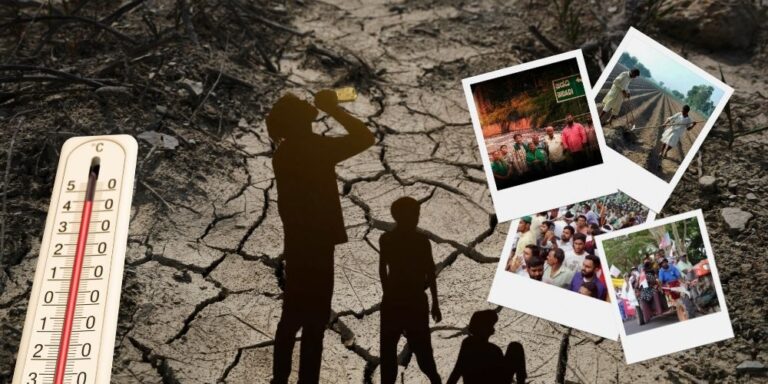
Given the volume of important developments in South Asia this month, and their relevance for La Via Campesina readers around the world, we’re sharing a summarized digest.
Prolonged Heatwaves and Delayed Monsoons
Countries including India, Pakistan, and Bangladesh have seen temperatures soar well above seasonal averages, with some areas approaching or exceeding 45°C in June. Although this region is not new to heatwaves, the intensity, duration, and geographical spread of this year’s heatwave have brought unprecedented disruption to the agricultural sector. From peasants to farm labourers, farm vendors to consumers, everyone is bearing the brunt.
Crops such as mango have failed due to unpredictable weather patterns. As blossoms turned into tender young mangoes, extreme heat caused farmers to lose more than half their expected yield. Compounding the crisis, freak pre-monsoon hailstorms battered the region, knocking the remaining fruit from the branches.
Crop failure, price drops, and fuel price hikes have been common across crops grown in the region. Now, with predictions of a weak monsoon – a region where 60% of the total cultivated area is rain-fed agriculture – and an extended heatwave warning until mid-July, the region faces a serious threat to food security.
Major cities such as Karachi, Delhi, Bengaluru, and Kathmandu depend on peri-urban farmers for their daily food supply. They are now facing significant price increases as harvests shrink and supply chains strain under the heat.
Landless farm labourers – especially women – are working in unimaginably harsh conditions. They are being hospitalised for sunburn, cardiovascular strain, kidney injury, and respiratory illnesses. Daily wages are reduced due to fewer working hours. This has a downstream effect on people’s ability to access nutrition and medication.
The article also cites anecdotally that farmers practising natural farming methods have seen their land withstand the heat. The organizations have put forth a set of demands that include: compensation at the prevailing rates of price support, direct income support for farmworkers and daily wage workers, full or partial waiver of outstanding agricultural loans for farmers who have suffered crop failure, alongside a moratorium on loan recovery during the crisis period.
Farmers Protest Land Acquisition for an “AI City”
Last month, the provincial government in India’s southern state of Karnataka issued a final notification to acquire 518 acres across three villages in the first phase of the proposed 9,600-acre Greater Bengaluru Integrated Township (GBIT) in Bidadi, falling on the peripheries of Bengaluru city. According to available information, this larger acquisition plan covers nine revenue villages and 16 non-revenue villages. The government is pitching the project as India’s first AI-powered city.
Karnataka’s largest peasant organization, the Karnataka Rajya Raitha Sangha (KRRS), has thrown its weight behind protesting farmers in Bidadi, who refuse to give up their fertile agricultural land, irrespective of the compensation.
Speaking to the media, many cited past experiences with land acquisition in the area and the looming threat to their way of life, livelihood, ecosystem, and biodiversity. Farmers are also warning that the takeover of fertile farmland poses a severe threat to the state’s food security. They are further denouncing state land-use policies that prioritize the interests of the city of Bengaluru over investing in mechanisms to improve farming conditions in rural areas.
According to media reports, more than 400 acres of ragi cultivation will be lost if the project is implemented. In dairy terms, farmers across the 26 villages proposed for acquisition collectively produce 6 lakh litres of milk every day. Coconut, paddy, and fruits such as banana and mango would also be affected.
As tensions escalate, the KRRS has decided to hold a massive demonstration on 11 July, under the banner “Bidadi Chalo” (“Let’s go to Bidadi”).
Farmers Alarmed Over India–US Free Trade Agreement Negotiations
The Indian Coordination Committee of Farmers Movements (ICCFM), a coalition of farmers’ organizations from 13 states, has appealed to India’s Prime Minister to keep agriculture out of the proposed India–US trade agreement, expressing concern that any concessions in the farm sector could adversely affect the livelihoods of millions of Indian farmers.
According to the letter, publicly available information suggests India may reduce import tariffs on several US agricultural products, including cotton, red sorghum, soybean oil, and processed fruits. The committee argued that Indian farmers cultivating these crops would struggle to compete against heavily subsidised imports from the United States if tariff protection is reduced.
The farmers’ body also expressed concern that the agreement could facilitate increased imports of subsidised US dairy and poultry products and potentially allow the entry of genetically modified maize into India. It further claimed that the United States has been pressing India at the World Trade Organization (WTO) to modify its Minimum Support Price (MSP) system. The committee warned that any commitment on MSP under the proposed agreement – or through any related understanding – could adversely affect millions of rice and wheat farmers.
The letter also raised concerns over seed sovereignty, alleging that intellectual property provisions commonly included in US trade agreements could restrict farmers’ traditional rights to save and exchange seeds while strengthening the market position of multinational seed companies.
The ICCFM urged the Prime Minister not to include agriculture in any free trade agreement with the United States and instead focus on addressing agricultural subsidy issues at the WTO. It argued that India should challenge US farm subsidies to it’s big farms, which it said undermine India’s domestic support framework while allowing American agribusiness contractors to benefit from substantial government assistance.
Pakistan Peasant Organizations Are Protesting Eviction Notices
More than 50 organizations representing farmers, workers, women, youth, civil society, and human rights groups on Wednesday urged the Punjab government to immediately withdraw eviction notices issued to tenant farmers in Sahiwal, grant them ownership rights over the land they have cultivated for generations, and halt what they termed attempts to displace farming communities in the name of corporate farming and development projects.
Addressing a joint press conference at the Lahore Press Club, leaders of the Pakistan Kissan Rabta Committee (PKRC), Anjuman Mazareen Punjab (AMP), Women Action Forum, and several allied organizations demanded the immediate cancellation of the notices, legal recognition of tenant farmers’ ownership rights, and an end to land acquisition for corporate farming and housing schemes.
Around 250 acres of land had been cultivated continuously by local families since 1914, with the settlement expanding from 20 families to about 105 families comprising nearly 3,000 people whose livelihoods depend entirely on the land. The organizations jointly demanded the immediate withdrawal of all eviction notices issued to tenant farmers, the suspension of all forced evictions and land acquisitions under the Green Pakistan Initiative, the Ashiana Housing Scheme, or any similar project until farmers’ rights are protected; permanent ownership rights for tenant farmers; formal recognition of their historical claims; and intervention by the Chief of Army Staff, the Prime Minister, and the Punjab Chief Minister to prevent forced evictions.
Srilanka’s Farmers Put Forth a 14-point Demand to the Government:
Sri Lanka’s compounding crises accentuated by five years of economic turmoil, the COVID-19 pandemic, Cyclone Ditwah, and political instability have pushed rural communities to the brink. Globally, escalating wars and a widening food crisis are placing enormous pressure on smallholder farmers everywhere. Against this reality, the Kekirawa Declaration – by the peasant unions in Srilanka – is calling for a structural transformation, benefitting small-scale producers
The 14 proposals inlcude call for guaranteed prices for agricultural commodities by ending market monopolies that prevent farmers from setting fair prices, with decisive government intervention including strengthening institutions like the Rice Marketing Board so farmers receive a just return for their labor.
The movements also demand an immediate halt to projects fuelling human–elephant conflict, particularly harmful and illegal schemes that destroy ecosystems, alongside strong measures to network forests and prevent further deforestation. They have also called for stopping the privatization of public commons promoted under “public-private partnership” models directed by the International Monetary Fund, replacing them with people-oriented cooperative economic models.
The groups have also demanded urgent fulfillment of promised post-disaster relief to help farming communities rebuild their food baskets, and the development of a long-term inclusive plan for systemic change with all relevant parties. They insist on protecting commons and territories from “green” privatization and call for a people-centered agricultural policy that addresses rural ill-health, livelihood disruption, and poverty and genuinely protects the futures of farming communities.
The proposals also demand immediate action to fulfill the rights and land claims of marginalized communities, including Hill Country (Malayaha) Tamil communities and people in the Northern and Eastern provinces, while protecting the right to dissent by reversing laws and actions that deny free expression and dissent as inseparable from farmers’ rights. A full list of demands can be accessed here.
