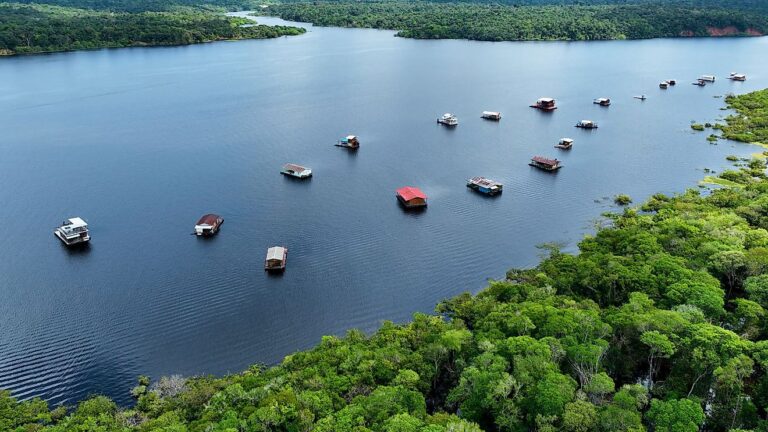
Which Country Has the Most Fresh Water?


Less than 3% of Earth’s water is fresh. Most of that is locked in ice or buried deep underground. The rest moves through rivers, lakes, and aquifers that a handful of countries happen to hold in staggering amounts. Brazil sits at the top of that list by a wide margin. The Amazon Basin alone gathers more renewable water each year than most continents. Yet a giant national total says surprisingly little about whether a tap runs clean in a given town.

The ranking below measures long-term average annual renewable water resources. It does not measure drinking-water quality or reservoir levels during a drought. One cubic kilometer equals one billion cubic meters.

1. Brazil – 8,650 Cubic Kilometers

The Amazon River winding through dense rainforest in Brazil.
The Amazon River flowing through the rainforest in Brazil.

Brazil’s first-place position begins with the Amazon. The country contains much of the Amazon Basin, where extraordinary rainfall feeds an immense network of rivers, wetlands, floodplains, and groundwater systems. Water from this region supports globally important ecosystems while also contributing to transportation, agriculture, hydropower, and local livelihoods. Yet Brazil’s national abundance conceals major regional differences. The water-rich north is comparatively sparsely populated, while major cities, farming districts, and parts of the semiarid northeast can experience shortages. Brazil therefore demonstrates that possessing the world’s largest renewable water supply does not automatically guarantee dependable water service everywhere.

2. Russia – 4,530 Cubic Kilometers

Lake Baikal in Siberia, the deepest lake on Earth.
Lake Baikal in Siberia holds roughly a fifth of the world’s unfrozen freshwater.

Russia’s freshwater wealth is spread across a continental-scale landscape, but Lake Baikal gives it a feature no other country can match. Located in Siberia, Baikal is the world’s deepest lake and holds approximately 20% of the planet’s unfrozen freshwater reserves. Russia also contains enormous river systems, including the Lena, Ob, Yenisei, and Amur. Much of this water, however, lies far from the country’s largest population and industrial centers. Distance, frozen conditions, pollution, and the cost of infrastructure can all limit practical access, making Russia’s water story as much about geography as volume.

3. United States – 3,070 Cubic Kilometers

The Mississippi River flowing past La Crosse, Wisconsin.
The Mississippi River near La Crosse, Wisconsin.

No single body of water explains the United States’ third-place ranking. Its supply is assembled from the Great Lakes, the Mississippi River system, Alaska’s rivers and glaciers, mountain snowpack, reservoirs, wetlands, and extensive aquifers. Shared with Canada, the Great Lakes contain roughly 21% of the world’s surface freshwater. Conditions vary dramatically across the country: eastern states generally receive more regular precipitation, while much of the West depends on winter snow, reservoirs, and heavily used rivers such as the Colorado. Groundwater depletion, drought, aging infrastructure, contamination, and competition among cities, farms, industries, and ecosystems remain significant concerns.

4. Canada – 2,900 Cubic Kilometers

Ice at Churchill, Hudson Bay, Manitoba, Canada, North America

Why does a country famous for its countless lakes rank fourth rather than first? The answer is the difference between stored water and renewable water. Canada’s renewable supply comes mostly from rain and snow, with spring snowmelt feeding runoff into its rivers each year. Canada contains about 20% of the world’s freshwater reserves but approximately 7% of its annually renewable supply. It has major watersheds flowing toward the Atlantic, Pacific, Arctic, and Hudson Bay, yet much of the water drains northward, away from the heavily populated southern corridor. Some prairie and interior regions can therefore face drought or seasonal pressure even while the national total remains exceptionally large. Canada’s challenge is not a lack of water overall, but where and when that water is available.

5. China – 2,840 Cubic Kilometers

The Yangtze River passing through a steep gorge in China.
The Yangtze River winding through one of its gorges.

China’s total appears enormous, but it must support one of the world’s largest populations and a vast agricultural and industrial economy. Water is also distributed unevenly: the humid south has far greater supplies than the more densely farmed and water-stressed north. Rivers such as the Yangtze carry tremendous volumes, while the Yellow River Basin frequently faces tighter limits. China has responded through conservation programs, reservoirs, groundwater controls, and the massive South-to-North Water Diversion Project. The country’s position shows why total national volume can be impressive while per-person availability and regional water security remain comparatively constrained.

6. Colombia – 2,360 Cubic Kilometers

Colombia, South America, Orinoco river, the third largest river in the world

Rain is Colombia’s great freshwater advantage. It is also one of the country’s greatest sources of uncertainty. Moist air from the Caribbean, Pacific, and Amazon regions meets the Andes, producing heavy rainfall and creating numerous rivers across several distinct drainage basins. The Magdalena-Cauca system is especially important to the country’s population and economy, while eastern and southern waterways connect with the Orinoco and Amazon systems. Abundance does not remove risk: El Niño can intensify drought, La Niña can bring destructive flooding, and pollution reduces the usefulness of some supplies. For Colombia, effective management requires preparing for both too little water and far too much.

7. Indonesia – 2,020 Cubic Kilometers

Progo river in Yogyakarta, Indonesia

Across Indonesia’s thousands of islands, freshwater is renewed by tropical rainfall, volcanic watersheds, rivers, lakes, peatlands, and aquifers. The archipelago receives abundant water overall, but distributing it is exceptionally complicated. A surplus on one island cannot easily solve a shortage on another, and intense wet seasons can alternate with dry periods influenced by monsoon patterns and El Niño. Rapid urban growth places additional pressure on groundwater and water-treatment systems, particularly in densely populated areas. Indonesia’s ranking is therefore rooted in its tropical climate, while its water-security challenge is shaped by island geography, flooding, pollution, land subsidence, and uneven infrastructure.

8. India – 1,910 Cubic Kilometers

Stunning sunset view of the riven Brahmaputra in Kaziranga national park, Assam, India

India’s renewable supply is tied closely to the rhythm of the monsoon. Seasonal rains replenish rivers, reservoirs, soils, and aquifers, while Himalayan snow and glaciers help feed major northern river systems. The Ganges-Brahmaputra-Meghna network contributes substantial flows, including water entering from neighboring countries. Demand is equally immense. Agriculture, cities, industry, and electricity generation all depend on reliable supplies, and India is the world’s largest user of groundwater. A high national ranking consequently exists alongside falling water tables, polluted rivers, unpredictable rainfall, and severe local shortages. India’s central task is to store, distribute, clean, and conserve water between highly concentrated rainy seasons.

9. Peru – 1,880 Cubic Kilometers

Tourists swimming and relaxing in turquoise natural river pool surrounded by rocky cliffs and tropical mountains in Pozuzo Peru.
Tourists swimming and relaxing in turquoise natural river pool surrounded by rocky cliffs and tropical mountains in Pozuzo Peru, Editorial credit: Arthurs perspective / Shutterstock.com

Peru offers perhaps the clearest warning against judging water security by a national total alone. Most of its renewable water flows east from the Andes into the Amazon Basin, while a large share of the population and economic activity is concentrated along the much drier Pacific coast. Lima and other coastal communities consequently depend on Andean rivers, reservoirs, groundwater, and high-elevation ecosystems. Retreating glaciers, climate variability, pollution, inefficient irrigation, and growing urban demand add to the pressure. Peru possesses one of the world’s largest renewable supplies, but the mountains place much of that water on the opposite side of the country from its greatest demand.

10. Democratic Republic of the Congo – 1,290 Cubic Kilometers

The Congo River flowing past a riverside village in the Democratic Republic of the Congo.
The Congo River passing a village in the Democratic Republic of the Congo.

The Democratic Republic of the Congo closes the top ten with one of the world’s starkest water paradoxes. The Congo River and its vast tributary system drain an enormous equatorial basin, creating extraordinary hydropower potential and supporting rainforests, fisheries, transportation, and biodiversity. Nevertheless, a large proportion of the population still lacks basic access to safe water. Treatment facilities, pipelines, pumps, electricity, roads, and maintenance services remain inadequate in many urban and rural communities, with conflict creating further disruption in some areas. The DRC proves that natural water wealth and household water security are separate measurements: rivers may be plentiful while safe taps remain scarce.

What Does a High Freshwater Ranking Mean?

A large renewable water supply can support food production, freshwater ecosystems, fisheries, navigation, industrial development, and hydroelectric power. It can also give a country greater flexibility during periods of irregular rainfall.

However, volume alone does not determine whether people have reliable access to clean water. Supplies may be located far from population centers, arrive during only part of the year, cross international borders, or be too polluted for safe use without treatment. Climate change, deforestation, excessive groundwater pumping, damaged watersheds, weak infrastructure, and unequal distribution can create shortages even in countries near the top of the ranking.

Countries With the Most Renewable Freshwater Resources

Rank Country Total Renewable Freshwater Resources
1 Brazil 8,650 km³
2 Russia 4,530 km³
3 United States 3,070 km³
4 Canada 2,900 km³
5 China 2,840 km³
6 Colombia 2,360 km³
7 Indonesia 2,020 km³
8 India 1,910 km³
9 Peru 1,880 km³
10 Democratic Republic of the Congo 1,290 km³

Note: Figures are long-term average estimates of total renewable water resources and mostly carry a 2020 reference year. They should not be interpreted as current reservoir volumes, drinking-water supplies, or the amount of water available during any individual year.


Source link