The Clearest Lakes in the World Ranked by Visibility


Clarity is less about what a lake contains than what it manages to keep out. Cold water starves the algae and plankton that cloud most lakes, and undisturbed watersheds keep sediment from ever reaching the surface. That is why the list gathers volcanic calderas in Oregon and Japan alongside deep Asian and East African rift valleys. Scientists measure the payoff with a Secchi disk lowered until it disappears. The ten lakes below rank by their highest credible readings.

The 10 Clearest Lakes in the World Ranked by Visibility

1. Rotomairewhenua / Blue Lake, New Zealand – Up to 262 ft (80 m)

Blue Lake, NZ
Blue Lake, NZ

No natural freshwater yet studied is clearer than New Zealand’s Blue Lake, known in Māori as Rotomairewhenua. Researchers from New Zealand’s National Institute of Water and Atmospheric Research recorded a horizontal underwater visual range reaching 262 ft (80 m). Its average visibility sits near 243 ft (74 m), close to the optical clarity of distilled water.

That purity starts at nearby Lake Constance. Its water travels toward Blue Lake through underground passages and natural debris dams, a route that strains out most of the suspended material that would otherwise scatter light. Cold, nutrient-poor alpine conditions add to the effect by limiting the algae and microorganisms that cloud most lakes.

Rotomairewhenua lies within Nelson Lakes National Park on the South Island. Reaching it takes a demanding backcountry trek, and visitors must follow strict rules that protect its ecological and cultural value. Swimming, bathing, washing gear, and touching the water are all prohibited. Ngāti Apa ki te Rā Tō, the Māori iwi with ancestral ties to the area, regard the lake as sacred.

2. Waldo Lake, Oregon, USA – Up to 157 ft (47.9 m)

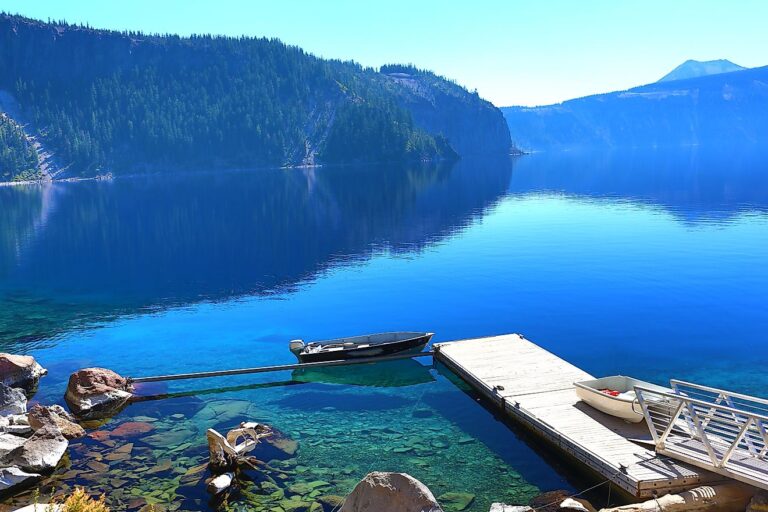
Crystal clear waters of Waldo Lake, Oregon

A record Secchi reading of 157 ft (47.9 m), logged in 1938, ranks Waldo Lake among the clearest lakes ever measured. The lake sits in Oregon’s Cascade Range, and on optimal days its modern transparency still averages well over 100 ft (30 m). Oregon environmental officials have compared its chemical makeup to distilled water.

Its forested watershed feeds in very few nutrients or suspended sediments, which keeps the water exceptionally clear. Waldo Lake has no permanent incoming streams, and its nutrient-poor water supports little algae. Much of the surrounding watershed falls within the Willamette National Forest and adjacent wilderness areas.

Covering roughly 10 mi² (26 km²) and reaching a maximum depth near 420 ft (128 m), Waldo Lake draws kayakers, canoeists, swimmers, hikers, and campers. Regulations restrict motorized boating to protect the lake’s quiet character and water quality. In 2021, Oregon designated Waldo Lake an Outstanding Resource Water, the state’s highest level of water-quality protection, in the same action that covered Crater Lake.

3. Crater Lake, Oregon, USA – Up to 144 ft (44 m)

A person fishing in Crater Lake, Oregon

Crater Lake, the deepest lake in the United States, has produced a maximum recorded Secchi reading near 144 ft (44 m). Annual readings commonly top 100 ft (30 m), though visibility shifts with weather, season, surface conditions, and the type of disk used during measurement.

The basin dates to a massive eruption roughly 7,700 years ago, when Mount Mazama collapsed and left a volcanic caldera that rain and snow slowly filled. No rivers flow into it, so comparatively little sediment, agricultural runoff, or other material reaches the water. Low nutrient levels also hold down surface algae.

At a maximum depth of 1,943 ft (592 m), Crater Lake ranks among the deepest lakes in the world and the deepest in the United States. Its depth and purity produce the famous sapphire-blue color. Water absorbs longer red, orange, and yellow wavelengths, while shorter blue wavelengths scatter back toward the surface.

Crater Lake National Park averages roughly 42 ft (13 m) of snow a year. Despite that, the surface has frozen completely only rarely, most recently in 1949.

4. Lake Mashū, Japan – Up to 136 ft (41.6 m)

Lake Mashu in Hokkaido, Japan

In 1931, observers on the Japanese island of Hokkaido lowered a Secchi disk into Lake Mashū and lost sight of it at 136 ft (41.6 m). It stood among the deepest visibility readings ever documented. Later measurements have generally come in lower, yet that historic figure still places Lake Mashū among the clearest lakes on record.

Like Crater Lake, Mashū fills a volcanic caldera and has no major river flowing into it. Precipitation supplies most of its water, and the steep forested walls around it limit how much sediment reaches the surface. Low nutrient content also suppresses large algal blooms.

Lake Mashū spans about 7.5 mi² (19.6 km²) and reaches a maximum depth near 695 ft (212 m). Dense fog often fills the caldera in summer, at times hiding the lake entirely. When the sky clears, observation points along the rim reveal the intensely blue water below.

Shoreline access is heavily restricted, which shields the lake from pollution, invasive species, and erosion. Mashū sits within Akan-Mashu National Park and holds cultural importance for the Indigenous Ainu people.

5. Lake Baikal, Russia – Up to 131 ft (40 m)

Lake Baikal, Russia
Lake Baikal, Russia

Seasonal visibility at Lake Baikal in southeastern Siberia can reach about 131 ft (40 m). The clearest conditions tend to arrive in spring or late autumn, when biological activity runs low and currents redistribute suspended material. Clarity drops during periods of heavier plankton growth.

Baikal is the oldest and deepest lake on Earth. Estimated at 25 million years old, it plunges to roughly 5,387 ft (1,642 m) and holds about 20% of the world’s unfrozen surface freshwater by volume, more than all five North American Great Lakes combined.

Low sediment concentrations and an unusual biological community keep the water clear. The endemic copepod Epischura baikalensis feeds on algae, bacteria, and organic particles suspended throughout the lake. Sponges and other filter feeders add to the nutrient cycling that maintains water quality.

Thousands of plant and animal species live in and around Baikal, many of them found nowhere else. The most famous is the Baikal seal, the only seal species that lives exclusively in freshwater. In winter, thick ice forms over the surface and can turn remarkably transparent where it holds few bubbles or fractures.

6. Lake Tahoe, California-Nevada, USA – Historically Up to 108 ft (33 m)

Lake Tahoe's rocky shoreline on a sunny day.
Lake Tahoe’s rocky shoreline on a sunny day.

Lake Tahoe ranks among North America’s clearest and largest alpine lakes. A historic reading near 108 ft (33 m) dates to 1873, though that observer used a white dinner plate rather than the standardized Secchi disks scientists rely on today.

Clarity has slipped since regular monitoring began in the late 1960s. The 2025 annual average Secchi depth measured 69.2 ft (21.1 m), up from 62.3 ft (19 m) in 2024 but still far below historic conditions. Scientists caution that one year’s gain does not amount to a recovery, especially with summer clarity still a concern.

Straddling the California-Nevada border in the Sierra Nevada, Tahoe covers about 191 mi² (495 km²), carries 72 miles (116 km) of shoreline, and reaches a maximum depth of 1,645 ft (501 m). Only Crater Lake runs deeper among lakes in the United States.

The forested watershed filters some sediment naturally, but urban development, road runoff, erosion, fine particles, invasive species, wildfire smoke, and climate-related changes all press on water quality. Government agencies, scientists, nonprofit groups, and local communities are working to cut pollution and rebuild clarity.

7. Lake Matano, Indonesia – Up to 77 ft (23.4 m)

Lake Matano Tropical Lake in East Luwu Regency, South Sulawesi
Lake Matano Tropical Lake in East Luwu Regency, South Sulawesi. Via Shutterstock / Fardi Bestari.

On the Indonesian island of Sulawesi, Lake Matano has produced measured Secchi depths reaching about 77 ft (23.4 m). Scientific surveys across 2015 and 2016 recorded visibility ranging from roughly 24 ft to 77 ft (7.4 to 23.4 m), a spread that shows how much clarity depends on location, season, and biological conditions.

Matano fills a tectonic basin and counts among the deepest lakes in the world. It reaches a maximum depth near 1,936 ft (590 m), with much of the basin extending below sea level. Its deep water holds very little oxygen and stays largely separated from the oxygenated surface layer, which makes Matano a permanently stratified, or meromictic, lake.

The clear upper waters carry relatively few nutrients and little phytoplankton. Matano also supports a distinctive ecosystem of endemic fish, shrimp, snails, and other species that evolved in isolation. Several occur nowhere outside the ancient lakes of Sulawesi.

Mining, shoreline development, invasive species, and nutrient pollution all threaten this unusual environment. Guarding water quality matters especially here, because many native organisms occupy extremely limited habitats.

8. Gun Lake, British Columbia, Canada – Up to 72 ft (21.8 m)

Reflected mountains viewed from the shore of Gun Lake, British Columbia, Canada

A 2025 community-monitoring survey recorded a Secchi depth near 72 ft (21.8 m) at Gun Lake in British Columbia’s South Chilcotin region. The figure ranks among the deepest recently reported Secchi readings in North America, though it comes from a local monitoring effort rather than a standardized international comparison.

A remote mountain setting, a small local population, and a largely undeveloped watershed all support the clarity. Low nutrient and sediment concentrations let sunlight travel deep into the water. As with other exceptionally clear lakes, visibility can still change with rainfall, runoff, algae, wildfire effects, and recreational use.

Gun Lake sits amid the rugged terrain of British Columbia’s Coast Mountains. Its clear water and mountain backdrop draw paddlers, swimmers, and anglers to the shore. Community-led monitoring plays a real role here, catching environmental shifts before they turn severe.

9. Lake Khövsgöl, Mongolia – Approximately 66 ft (20 m)

Lake Khövsgöl
Lake Khövsgöl, Mongolia

Open-water transparency at Lake Khövsgöl in northern Mongolia reaches about 66 ft (20 m). Scientific observations commonly place its clearest pelagic waters near or above 59 ft (18 m), with readings that vary by season and location.

Sometimes called the “Blue Pearl of Mongolia,” Khövsgöl ranks among Asia’s largest freshwater lakes by volume. It runs roughly 85 miles (136 km) long, reaches a maximum depth near 860 ft (262 m), and holds close to 70% of Mongolia’s freshwater.

The lake is young in geological terms next to nearby Lake Baikal, yet the two belong to the same broad rift system and connect through the Egiin Gol and Selenga river network. A cold climate, low nutrient levels, a sparse local population, and a mostly forested and mountainous watershed all feed Khövsgöl’s clarity.

The lake and its surroundings support fish, waterbirds, elk, Siberian ibex, argali sheep, brown bears, and other wildlife. Tourism has grown over recent decades, which makes responsible waste management, shoreline protection, and pollution limits increasingly important.

10. Lake Malawi, East Africa – Up to 66 ft (20 m)

Lake Malawi in Nkhata Bay, Malawi, Africa.
Lake Malawi in Nkhata Bay, Malawi, Africa. Image Credits: LMspencer via Shutterstock

Lake Malawi, also known as Lake Nyasa or Lago Niassa, has recorded Secchi depths reaching about 66 ft (20 m) in its clearest offshore areas. Visibility runs lower near river mouths, populated shorelines, and spots affected by sediment or nutrient runoff.

Bordered by Malawi, Mozambique, and Tanzania, the lake forms part of the East African Rift system. It covers roughly 11,430 mi² (29,600 km²) and reaches a maximum depth near 2,316 ft (706 m), which places it among the world’s largest and deepest freshwater lakes.

Malawi is permanently stratified, so its oxygen-rich upper water rarely mixes fully with the deep, oxygen-poor layers below. Clear offshore conditions come partly from low sediment and plankton near the surface during certain seasons. The lake’s biological diversity also shapes how algae and nutrients move through the ecosystem.

More than 1,000 species of cichlid fish may live in Lake Malawi, giving it one of the greatest concentrations of freshwater-fish diversity on Earth. Many graze on algae attached to rocks, while others feed on plankton, invertebrates, fish, or organic material. Their vivid colors and varied behaviors make the lake a renowned destination for snorkeling and scuba diving.

The lake also supports African fish eagles, hippopotamuses, crocodiles, spotted-necked otters, and many waterbirds. Lake Malawi National Park, a UNESCO World Heritage Site, protects part of the southern shoreline, its islands, and exceptionally diverse fish habitats.

Understanding the Ranking

Comparing lake visibility is harder than lining up one set of identical measurements. Secchi depth responds to disk size and color, sunlight, cloud cover, waves, viewing angle, observer eyesight, season, plankton growth, and recent rainfall. Horizontal underwater visual range, the method used at Rotomairewhenua, is also not directly equivalent to a vertical Secchi reading.

Several figures here are record measurements rather than long-term averages. Lake Mashū’s 136-ft reading dates to 1931, and Lake Tahoe’s highest figure rests on a historic 1873 observation. Lake Baikal’s clearest conditions are seasonal, and Gun Lake’s result comes from a recent community-monitoring program. Waldo Lake and Crater Lake, by contrast, carry extensive modern Secchi records.

For those reasons, read the ranking as a comparison of the highest credible published visibility figures. It is not a claim that each lake holds that clarity throughout the year.

Final Thoughts

The world’s clearest lakes owe their visibility to different mixes of geology, climate, biology, and watershed protection. Rotomairewhenua takes in water filtered through underground material. Waldo Lake and Crater Lake carry very few nutrients or suspended particles. Baikal’s unusual organisms process enormous quantities of organic matter, and remote watersheds preserve the clarity of Khövsgöl and Gun Lake.

Exceptional clarity does not make any of these lakes invulnerable. Fine sediment, nutrient pollution, invasive species, shoreline development, wildfire, tourism, and climate change can alter even the purest water. Lake Tahoe’s long decline shows how fast a celebrated resource can change, and the strict rules at Rotomairewhenua show the effort clarity sometimes demands.

Protecting these lakes safeguards far more than a striking view. Clear water sustains aquatic plants, shapes food webs, shelters rare species, supports recreation, and carries deep cultural meaning for communities around the world.


Source link