
June 22, 2026
JAKARTA – Amid a growing cancer burden in Indonesia, doctors are increasingly turning to multidisciplinary teams and genetic testing to tailor treatment plans, marking a shift away from the traditional model in which individual physicians make decisions in isolation.
According to the World Health Organization (WHO), cancer caused nearly 10 million deaths worldwide in 2020, making it one of the leading causes of death globally, with lung, breast, colorectal and prostate cancers among the most common types.
Recent Health Ministry data shows around 400,000 new cancer cases are detected annually in the country, with deaths reaching approximately 240,000 each year. Without stronger prevention and early detection, the country’s cancer burden is projected to rise by more than 70 percent by 2050.
In Jakarta alone, the city’s health agency recorded more than 625,000 outpatients and nearly 110,000 inpatient cancer visits in 2025, with deaths in the capital rising by 33 percent from last year.
To tackle such cases, doctors begin with genetic testing to identify specific tumor mutations.
“Doctors examine the tumor’s genetic expression first to determine which treatment is most suitable,” said Adityawati Ganggaiswari, director of Mochtar Riady Comprehensive Cancer Center (MRCCC) Siloam Hospitals, during the 6th Siloam Oncology Summit 2026 in late May at Shangri-La Hotel in Central Jakarta.
These findings are then brought to a multidisciplinary team (MDT), comprising specialists from various fields who will jointly review patient cases before any treatment begins.
According to Banu Arun, a professor in the Department of Breast Medical Oncology at The University of Texas MD Anderson Cancer Center, multidisciplinary team discussions typically involve medical oncologists, surgeons, radiation oncologists and supporting disciplines such as molecular pathology, pharmacy, genetics and medical imaging.
This integrated care system, Arun said, has been standard practice at MD Anderson for around 30 years, improving patient survival outcomes and patient safety by 20 to 40 percent.
She noted that developing countries like Indonesia could adopt this approach despite infrastructure gaps by leveraging technology and strategic partnerships.
“If an institution lacks certain specialists, they can collaborate with other hospitals that have the expertise and technology to hold joint clinical conferences,” Arun said at the summit.
Hospitals in Indonesia have gradually begun adopting these multidisciplinary systems, despite facing limitations in human resources.
The national cancer referral center, Dharmais Cancer Hospital, was among the earliest institutions to implement multidisciplinary care, while MRCCC established its own MDT-based centers in 2021.
Initially, the specialized center focused on breast, gynecological and gastrointestinal cancers. With time, the MRCCC Siloam Hospitals expanded the approach to handle hematological malignancies and lung cancer, with the MDT that meets weekly to cross-examine cases.
“Cancer is far too complex for a single doctor to handle in isolation,” Adityawati said.
This precision reshapes how treatment plans are formulated, moving away from a standard, one-size-fits-all diagnosis.
“The two patients may both have stage 2 breast cancer, for example. One patient may receive chemotherapy first while another receives a different set of treatment because the genetic profiles are different,” Adityawati said.
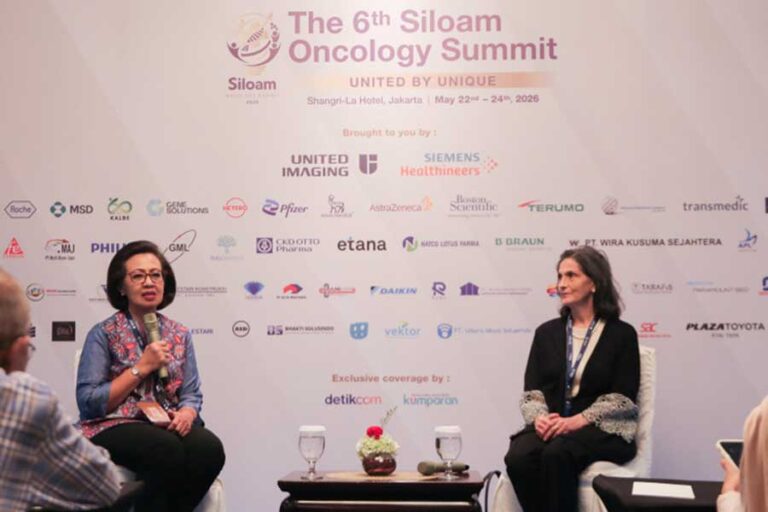
Expert exchange: Mochtar Riady Comprehensive Cancer Center (MRCCC) Siloam Hospitals director Adityawati Ganggaiswari (left) and University of Texas MD Anderson Cancer Center professor Banu Arun speak during the Siloam Oncology Summit 2026 in Jakarta on May 23, 2026, discussing multidisciplinary approaches and personalized cancer treatment. (Courtesy of Siloam International Hospitals/-)
Race against time
Besides clinical precision, the multidisciplinary approach also reduces administrative and diagnostic delays that often plague conventional, fragmented healthcare.
“Previously, everyone worked in silos. That made the process incredibly slow and exhausting for patients,” Adityawati said.
Without structural coordination, Adityawati said, a patient may spend weeks waiting for a single biopsy result from a pathology lab, only to schedule another separate consultation weeks later, followed by additional rounds of imaging. In oncology, such delays can be fatal, as aggressive tumors continue to progress unchecked during the waiting period.
“By the time the actual treatment starts, the cancer may already have spread to other organs,” Adityawati warned.
In a coordinated MDT framework, this timeline is significantly compressed. Instead of a patient hopping from one clinic to another over several months, all relevant specialists sit in the same room to map out the entire trajectory, deciding whether a patient should undergo chemotherapy first, followed by surgery and subsequent radiation.
Adityawati went on to say that this rapid turnaround is crucial because cancer treatment is highly time-sensitive. Therapies must target the tumor before it mutates further or spreads. Some targeted drugs, for instance, are engineered to block specific genetic pathways driving tumor growth while minimizing damage to healthy tissue.
Similarly, immunotherapy functions by reinforcing the body’s natural defenses to recognize and eliminate malignant cells that would otherwise evade detection.
“Cancer cells are remarkably intelligent. They constantly mutate to escape and hide from the human immune system. Patients cannot afford the delays of moving from one isolated consultation to another. We have to address it as a team from day one,” Adityawati said.
