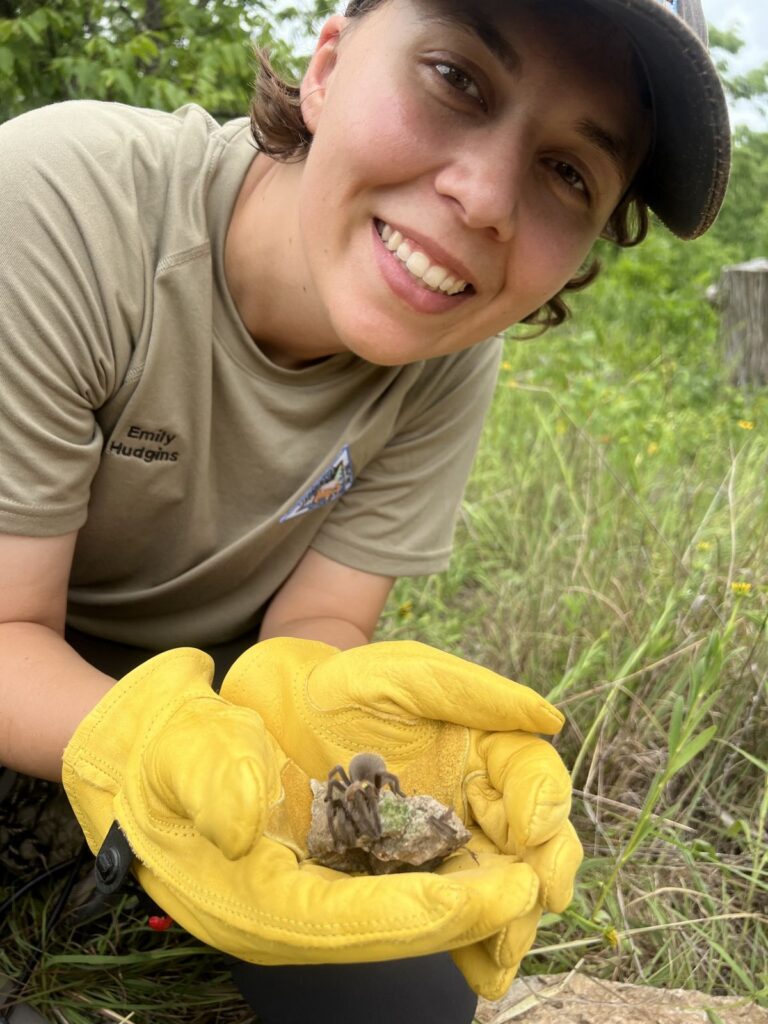
Graduate biology student wins Fulbright Award; prepares to c…


Graduate student Emily Hudgins, pursuing a master’s degree in biology, was in the lab one day when she received news that she had won an award for a project she had worked on for over a year that would allow her to study her greatest passion and contribute to real-world conservation efforts on the island of Nusa Penida in Indonesia.

Hudgins opened her portal to learn she was the recipient of the Fulbright Award and would be one of 13 winners nationwide going to Indonesia.

“I opened my portal, and I was pretty shaky, and I honestly couldn’t read when I opened it, so I had to sit there a second, with it open, and I noticed that it said ‘congratulations’, so I was like, ‘okay, it’s got to be somewhat positive,’ but I had to actually wait a little while to like be able to read it, and I called my grandma,” Hudgins said.

This was Hudgins’ second time applying for the Fulbright Award and first time winning. This time, she would get an all-expenses-paid trip for up to 10 months to study the effects of sediment runoff on macroinvertebrates, which are organisms without a backbone that can be seen without a microscope, such as insects, worms and crustaceans.

The Fulbright Program was founded in 1946 by Senator J. William Fulbright of Arkansas with the goal to “increase mutual understanding and support friendly and peaceful relations between the people of the United States and the people of other countries,” after World War II. Currently, the Fulbright program has fellowships and partnerships with over 160 countries, grants about 9,000 scholarships worldwide, and is overseen and funded by the US government.

Hudgins said her project began with her reaching out to locals in Indonesia to learn more about their environmental problems, and then she drafted a project based on their concerns. She was chosen by an American selection committee as a semifinalist in February and then picked as a winner by a board in Indoensea in April.

Because Nusa Penida has been growing in tourism due to its desirable scuba diving, they have been quickly building low-quality infrastructure that causes heavy sediment runoff during the wet season. Hudgins’ project examines how sediment runoff is changing the environment of Nusa Penida by studying the sensitive macroinvertebrates in the area.

“So, you have a lot of loose construction materials, places, and whatnot, and the soil there is also just looser. So, when the wet season comes in, it has all this rain that comes down, and I’ve been told by the people that I’ve communicated with there that the water and the sediment that runs off the coast of the island is so intense, it’s such a large outflow that it’s almost like a river that splits the island in half,” Hudgins said. “So this is what we’re doing: all that sediment is running off the coast of Nusa Penida, and I’m going to look at macroinvertebrates in areas where that sediment is running off and in areas where it’s not running off, and see how the diversity changes.”

Hudgins said macroinvertebrates are so sensitive that they are often the first to be affected by environmental changes, and by analyzing them, Hudgins can determine whether the area is healthy.

One of Hudgins’ biggest passions is community conservation, and she wants to involve locals in her project.

“I’m involving locals while I’m working on it, because if I do that as well and they’re out there with me looking at the problem and we’re kind of analyzing it together, then you know after I leave, maybe the local community can can take a look at it and be like, ‘okay, well, Emily’s project found this, so now that we know this is a problem, we can all do this together to help mitigate,’” Hudgins said.

Hudgins has been interested in macroinvertebrates her whole life and loves how, just by looking at the macroinvertebrates in an area, she can know a lot about the quality of that habitat.

“I guess you would say in the non-biology world, I tend to gravitate towards the things that are least popular or least loved, and part of that is with insects specifically, or with macroinvertebrates specifically, Hudgins said. “With those types of organisms, you could study them for your whole life and still not know everything, and I think there’s a lot of beauty in that.”

Kevin Timlin, executive director of International Education and Services and designated Fulbright program advisor for SEMO, said students from almost any program or degree can win a Fulbright; however, Hudgins was especially competitive because she had already connected with a group in Indonesia that could facilitate her research.

“So, when a student is interested in applying for a Fulbright program, they are only allowed to apply for one specific award in one specific country, so they have the responsibility of looking across the world at all the different options and really honing in on one that meets their interests, their needs, their skills, and things like that,” Timlin said.

Timlin said that while a student may not earn much in the Fulbright Program, it fully covers travel expenses, living costs and health insurance and that the student will gain a new cultural experience. Additionally, Timlin says a Fulbright award looks great on a resume and is a good stepping stone into a PhD program.

If a student is interested in the Fulbright program, Timlin encourages them to reach out to him for help. The deadline to apply is in early October, and students who can participate must be seniors in the fall semester; non-seniors can attend information sessions.

“Now, these awards will be granted the following fall, so you apply in October, you find out if you were selected in the spring of the following year, and then you will do your program the following fall, so what we’re looking for is any student who is going to be a senior next year, they’re at that point where they would be submitting an application in October if they want to do something immediately afterwards.”


Source link