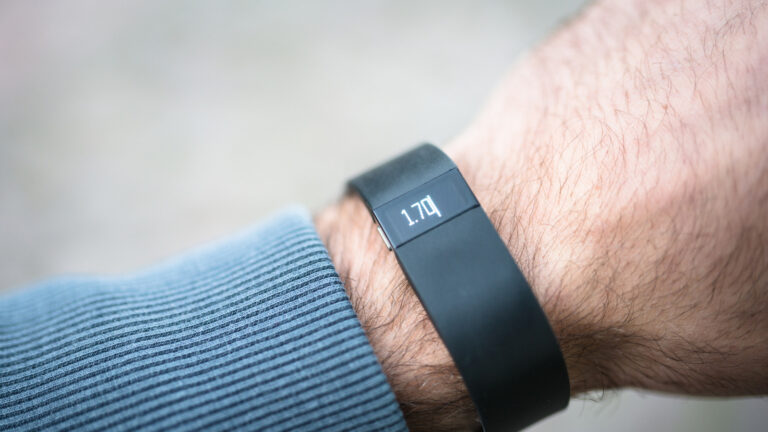
A wearable that lets you track your movements is a solid companion on your health journey. Your options are a fitness band or a smartwatch, and the best choice boils down to what you want to get out of it. A band like a Fitbit has a minimalist aura (both in terms of function and appearance) and can track your everyday fitness, but a smartwatch like Google Pixel Watch does all that and more, meaning it’s often better for more demanding users. However, there are other important factors to consider here.
Take battery life. When comparing the Google Pixel Watch to Fitbit, the latter will hold a charge for longer. After all, it has a smaller display (or none at all) and fewer bells and whistles, which translates to a more “potent” battery life. Reviewers claim a 7-day battery life for the Fitbit Air (which many users confirm is the case), while there are complaints from Pixel Watch owners about having to charge the wearable daily or even twice a day in some cases. Yet, despite the simplicity of the gear, many Fitbits tend to bite the dust fairly quickly. Some users hold on to theirs for upwards of 5 years, but most see theirs die after around just 18 to 24 months.
Though many believe there simply isn’t a need for a Fitbit anymore, they still have their place in the wearable space because they’re dirt cheap. For under $100, you get the basics and can squeeze 2 years out of them. A Google Pixel Watch 4 has, hands down, a better feature set, but lasts about 3 years, according to users. As such, it may not be worth your consideration if you’re in it for just the bare-bones fitness tracking.
What you lose out on with Fitbit versus a Pixel Watch
Does the longer battery life (and technically a longer lifespan when taking into account the dollar value) make Fitbit Air better than the Google Pixel Watch 4, considering both are Google’s latest outings in their respective categories? It’s complicated. For instance, it’s easy to assume that the Fitbit Air is a superior wearable in terms of raw fitness features while the smartwatch is better for all the extras, but that’s not necessarily the case. Sure, the battery will last for a full week (eliminating the hassle of constant charging), though you also lose out on some important sensors for tracking your workouts.
Fitbit Air includes a skin temperature sensor, pulse oxygen (SpO2) sensor, accelerometer, optical heart rate monitor (HRM), and a gyroscope. Fair, but the Pixel Watch 4 has all of those (its HRM is more robust too, and its accelerometer is 3-axis), plus a continuous electrodermal activity (cEDA) sensor, an ECG function, an ambient light sensor, and a magnetometer, altimeter, barometer, and a compass. More importantly, it utilizes dual-band GPS for location tracking, which Fitbit Air lacks – meaning that you won’t have to have your phone nearby during workouts. This isn’t to say a Fitbit is useless. It’s just that a smartwatch gives you more precise workout tracking but also raises the bar with features like Loss of Pulse and Satellite SOS.
Ultimately, it’s up to you. The Pixel Watch 4 is fully repairable (and the battery is replaceable) so it can last you an extra few years if you take care of it well. If you need something that works in a pinch? Fitbit will get the job done and hold 7 days of charge, all without breaking the bank — a solid deal, all things considered.