
Asia-Pacific countries convene to advance green agricultural value chains and forest protection


Asia-Pacific countries convene to advance green agricultural value chains and forest protection

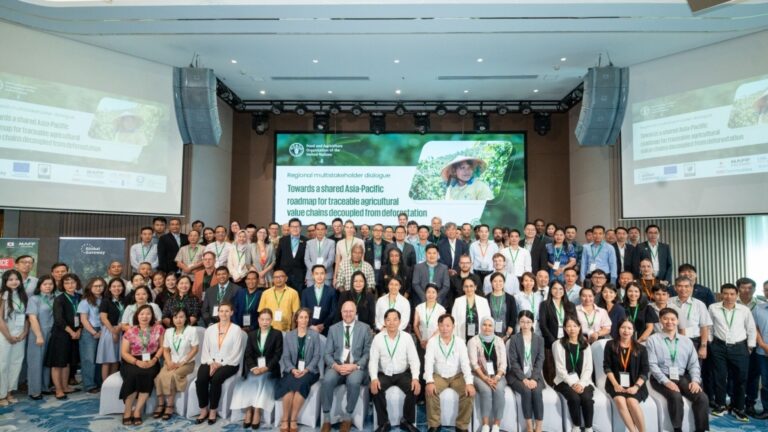
The four-day regional exchange, held in Hanoi from June 23 to 26 and hosted by the Vietnamese government, is jointly organised by the Food and Agriculture Organisation of the United Nations (FAO) and the Team Europe Initiative on Deforestation-free Value Chains.

The event comes at a time of growing regional and global attention to the links between agricultural production, trade and forest conservation. Across Asia-Pacific, commodities such as coffee, natural rubber and palm oil support the livelihoods of millions of farmers and contribute significantly to national economies.

At the same time, unsustainable cropland expansion remains an important driver of forest loss in parts of the region, highlighting the need for approaches that can support both sustainable production and forest protection.

Countries across the region are leveraging supply and demand factors to incentivise the transition to agricultural value chains decoupled from deforestation. Public traceability systems are increasingly being explored as a practical tool to improve transparency across supply chains, strengthen value chain governance, support responsible sourcing and help producers demonstrate sustainable practices.

For many countries in the region, developing effective traceability systems also presents an opportunity to improve data, strengthen coordination among stakeholders and empower smallholder farmers by linking systems to incentives for more sustainable production models.

The event brings together around 100 participants from 10 countries – Cambodia, Indonesia, Japan, Laos, Malaysia, Papua New Guinea, the Philippines, Thailand, Timor-Leste and Vietnam – including governments, industry bodies, smallholder representatives, international organisations and development partners.

“Forests are essential to resilient agrifood systems in Asia-Pacific,” said Vinod Ahuja, FAO representative in Vietnam. “Traceability systems can help countries connect forest protection with more transparent, inclusive and sustainable agricultural value chains. But they must be designed in ways that respond to national priorities and bring benefits to smallholder farmers, not only to markets.”

“Vietnam is committed to encouraging a transparent and effective traceability system, contributing to halting deforestation and ensuring sustainable forestry development. We will continue to work closely with our partners to strengthen the capacity of farmers and businesses, and to advance deforestation-free value chains,” said Tran Quang Bao, general director of VNFOREST.

“The transition towards deforestation-free value chains and public traceability systems – which will be a focus topic of this workshop – cannot be achieved by any one actor alone. It requires collective action across borders and across sectors,” said Cyril Loisel, first counsellor of EU Delegation to Vietnam.

Discussions will focus on practical ways to strengthen agricultural value chains for key forest-risk commodities, including natural rubber, palm oil and coffee, while reducing pressure on forests. Participants will exchange experiences and lessons from across the region, with particular attention to national traceability systems and their role in supporting forest conservation and rural development.

Building on these discussions, the exchange aims to develop a shared regional roadmap for traceable agricultural value chains decoupled from deforestation. The roadmap is expected to identify priority areas for regional collaboration, including on smallholder inclusion, green production models, responsible sourcing, policy coherence, data systems and finance.

As the host country, Vietnam will share national experiences of its public traceability efforts and support a field visit to a coffee processing facility. The visit will offer participants a practical view of value chain operations and the opportunities and challenges involved in building more traceable and sustainable commodity systems.

The exchange builds on an earlier FAO-hosted regional workshop held in Bangkok in August 2025, which laid the groundwork for stronger regional collaboration on decoupling agriculture from deforestation.

The Hanoi workshop will carry this process forward by helping translate shared priorities into a concrete roadmap for action. It marks a key milestone towards the establishment of a new initiative for sustainable commodities in Asia-Pacific.

The event also marks the launch of a new FAO e-learning course on Agrifood systems solutions for halting deforestation, developed in the context of the Japan-funded BiG-CHANCE scheme. This free online course provides practical guidance and tools to help identify solutions to address the drivers of deforestation and forest degradation, enabling participants to continue building their knowledge beyond the event.

$250 million deal targets women-owned SMEs, sustainable agriculture $250 million deal targets women-owned SMEs, sustainable agriculture

The Asian Development Bank (ADB) and BIDV have signed a $250 million syndicated finance package to support sustainable agriculture and expand access to finance for women-owned businesses.

Agribank and AFD sign climate finance deal to boost green growth Agribank and AFD sign climate finance deal to boost green growth

Agribank and the French Development Agency have signed a climate finance credit facility, marking a new step in international financial cooperation to promote green growth in Vietnam.

MAE proposes amendments to 10 laws to cut red tape MAE proposes amendments to 10 laws to cut red tape

The Ministry of Agriculture and Environment is proposing to add the draft law amending and supplementing several articles of 10 laws in the fields of agriculture and environment to the national legislative programme.


Source link