
Some places frighten you when you arrive. Others spook you just reading about them.
In Atlas of Cursed Places, Olivier Le Carrer delivers for both types of people — those with a morbid fascination for macabre locations and those who want to stay as far as possible from them.
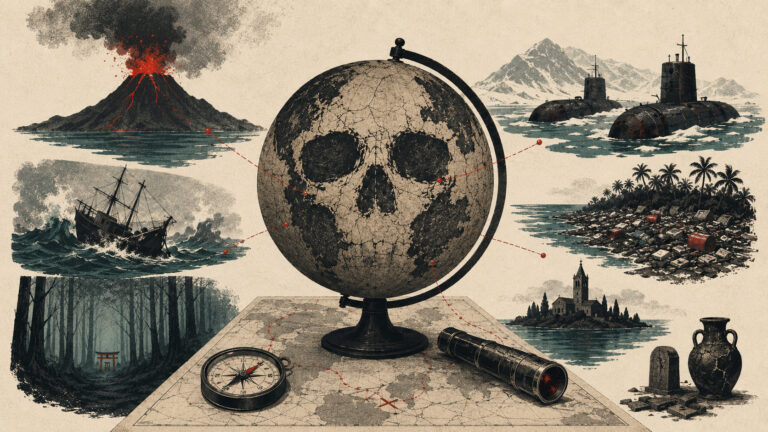
The destinations he mentions are not all haunted in the candlelit sense. The “curses” here come in many forms: natural hazards, industrial nightmares, religious terror, mass death, environmental ruin, and places where legend has grown over real suffering like moss on a wall.
“The honest traveller is surprised to observe that the red sand is ringed by snow-capped mountains and impenetrable forests populated by tetchy bears,” writes Le Carrer in a chapter on the so-called Nevada Triangle. Le Carrer adds that any offer of an excursion by plane should be politely refused.
The reason is simple: thanks to the turbulence generated by the rugged landscape, more than 2,000 aircraft have gone missing there over the past five decades — more than that of the fabled Bermuda Triangle.
The author’s white-knuckle ride across America and around the globe features 40 stops ranging from Golgotha, the site outside Jerusalem of Christ’s crucifixion, to the Japanese suicide venue, Aokigahara Forest, and Australia’s Cape York, where crocodiles noted for explosive attacks approach speeds of 30 km/h.
The result is a travel guide in reverse: a gazetteer of places where the curious should keep one hand on the emergency exit. Here are just ten ‘cursed’ places I picked from the book.
1. Jharia, India


Were it not for the people going about their business, Jharia might look like a place recently shelled. Smoke rises from cracks in the ground while the earth sags. The landscape has the exhausted look of a battlefield.
Except here, as Olivier Le Carrer notes, the fire “does not come from the sky.” It comes from below.
For more than a century, old coal seams beneath this district of Jharkhand in India have been burning. Such fires are not rare in abandoned mines, but Jharia is home to roughly half a million people. They live above or beside what Le Carrer calls a “steadily expanding underground inferno,” made up of dozens of separate blazes.
At first, residents even found uses for it. Steam from fissures could cook a pot. But the seeping coal fumes weren’t so useful when some houses split and roads started to buckle, all in an atmosphere of toxic fumes.
2. Zapadnaya Litsa, Russia


At the edge of Russia, near the Norwegian border, the Kola Peninsula first offers the usual northern temptations. There’s the never-ending tundra, the lovely fjords, and the frigid terror of polar night.
Then the Soviet ruins come into view.
Zapadnaya Litsa has no shortage of abandoned barracks, broken factories, smashed windows, and military debris. Le Carrer gives it a harsher title: “the antechamber of hell.” The true horror lies lower down, in the fjords, where the retired monsters of the Northern Fleet wait.
Dozens of decommissioned, Cold War-era vessels — including massive Typhoon and fast Alfa class submarines — were abandoned here, left to rust and decay while awaiting complex and hazardous dismantling processes. Le Carrer mentions the old nuclear submarines sit “like harmless museum exhibits,” although they are anything but. The base once served a superpower. Now it keeps watch over radioactive fuel in quantities Le Carrer describes as “thirty times greater than that of the Chernobyl reactor.”
3. Thilafushi, Maldives


The Maldives sells the dream of a flawless lagoon. Thilafushi receives the bill.
Le Carrer labels it “The Toxic Lagoon,” a grim counterpoint to the country’s postcard image of overwater villas and transparent seas. In 1992, authorities began turning this narrow island near Malé into a landfill, a dump for all the garbage produced by the archipelago.
As the number of tourists to the Maldives skyrocketed, trash arrived by the ton. Migrant workers at the site burned what they could. Heavy metals, batteries, and chemicals seeped toward the water. When the island ran out of space, waste sometimes spread into the shallows, creating drifting rafts of garbage in a lagoon marketed to the world as paradise.
Le Carrer calls the result the “highly visible abscess of the infection.” Apparently, even Eden produces rubbish, and someone has to stand downwind of it
4. Poveglia, Italy


From Venice, Poveglia is almost insultingly close: a small green island in the lagoon, overlooked by a bell tower and abandoned buildings.
It might look charming but Le Carrer calls it the “Island of Death,” and the legends have done much of the work. In Veneto, Le Carrer writes, people say that “when a bad man dies, he wakes up on Poveglia.”
Stories claim plague victims and lepers were exiled there and thousands of bodies lie beneath the soil. A psychiatric hospital later added a second layer of horror. In the most lurid versions, a mad doctor tortured patients and threw himself from the campanile.
The archives confirm a quarantine station, later care homes, and then closure in 1968, but not every bloody detail the internet now repeats.
More recently, Poveglia (often called the world’s most haunted island) turned into a bizarre real estate battle. In 2014, the Italian state offered a 99-year lease on the island at an auction. A Venetian citizens’ group, Poveglia per Tutti, crowdfunded to buy it for public use, but a businessman named Luigi Brugnaro won the auction with a €513,000 bid. The deal eventually stalled, keeping Poveglia locked in a bureaucratic and spectral limbo.
5. Sunda Strait, Indonesia


The Sunda Strait is beautiful in the way a sleeping dragon is beautiful.
Between Java and Sumatra, the sea route carries ships through shallows, oil installations, new school pirates, and one of the most famous volcanic hot spots on Earth: Krakatoa. In 1883, after months of eruptions and tremors, the volcano exploded with such violence that its sound reportedly traveled thousands of miles. To this day, it’s considered the loudest thing in history. Tsunami waves smashed into nearby coasts. The official death toll reached about 40,000.
Krakatoa did not vanish after the disaster. Its offspring, Anak Krakatoa, rose from the sea in the 20th century and has continued to remind the strait that geology works on its own schedule.
Indonesia sits along one of the world’s most active tectonic regions, where subduction feeds volcanoes and tsunamis. To build, sail, and live there is to negotiate with forces that predate every port, bridge, and shipping lane.
6. Cape Horn, Chile


Le Carrer calls Cape Horn the Sailor’s Nightmare.” In less than two centuries, some 800 ships wrecked near this dark rock at the end of South America, taking perhaps 20,000 lives with them. The region is blanketed by gray sea, cold rain, poor visibility, brutal wind, and “always the feeling that one’s troubles are only just beginning.”
Nobody came here for romance. Sailors came because commerce told them to. Before the Panama Canal, rounding the Horn was part of the long Atlantic-to-Pacific ordeal. Ships clawed their way through the Roaring Forties and Furious Fifties (strong, continuous westerly winds circling the Southern Hemisphere) that whip around the planet and the sea. With almost no land to stop them, the winds grew monstrous.
In 1914, the canal cut thousands of miles from the voyage and spared many ships the old punishment. Cape Horn, Le Carrer writes, “got what it deserved.”
Still, the place keeps its talent. It merely torments fewer people now.
7. Houtman Abrolhos, Australia


The Houtman Abrolhos islands sit off Western Australia, low and reef-ringed, a trap disguised as an archipelago.
In 1629, the Dutch East India Company ship Batavia struck the reefs with more than 300 people on board. The wreck should have been the disaster. It became only the opening scene.
While a rescue party left for Java, assistant merchant Jeronimus Cornelisz took control of the survivors. What followed can only be described as organized murder. Cornelisz, a failed apothecary turned company official, began arranging resources by his own twisted arithmetic. Those he considered useless were sent to islands without fresh water, drowned quietly, or killed more openly once his intentions became impossible to miss. His men murdered “by whatever violent means” they had available. Women were spared only to be abused.
Rescue arrived from Java after more than two months. Cornelisz and six accomplices were hanged. Nearly 200 others were already dead.
The reef wrecked the ship. The crew did the rest.
8. Kasanka National Park, Zambia


Can a wildlife sanctuary suffer from too much nature? Kasanka National Park is one of Africa’s smallest reserves. Driven to the brink by poachers, conservationists successfully revived the park, reintroducing elephants and hippos. But nobody expected the sky to turn black. Every October, five million straw-colored fruit bats descend on a tiny forest within the park. Le Carrer describes the phenomenon as the “African remake of one of Alfred Hitchcock’s most unsettling films”.
These aggressive mammals strip the trees, devouring 330,000 tons of fruit annually. The massive swarm also attracts predators. Pythons, crocodiles, and birds of prey crowd the area, feasting on fallen bats. Ecologists study this colossal migration to understand shifting global wildlife patterns, yet the bats’ final destination remains unknown. The site remains a terrifying spectacle for anyone brave enough to visit.
9. Aokigahara, Japan


Aokigahara lies at the foot of Mount Fuji, where beauty and dread share the same trees.
The forest is often called a suicide forest. It covers barely fourteen square miles, yet it claims around one hundred lives each year.
Le Carrer describes a dense, dim “sea of trees,” where the ground is uneven, mossy, and broken by crevasses. Paths are scarce and people can easily get lost. More painfully, many have gone there intending not to return. Authorities and volunteers have tried to intervene, but people looking to end their lives still venture here, as if lured by a siren call.
Pop culture has been blamed, notably Seichō Matsumoto’s 1960 novel Black Sea of Trees, where two lovers end their lives at Aokigahara forest. But locals insist the forest’s dark appeal predates modern literature. They believe the “yuurei — the ghosts of the departed who wander the earth in search of paradise — are well acquainted with Aokigahara”. Historically, families practiced ubasute here, abandoning elderly relatives to die.
10. The Tophet of Carthage, Tunisia


In modern Carthage, amid villas, cypresses, and bougainvillea, one of antiquity’s darkest arguments lies underfoot.
The Tophet of Carthage, also known as the Salammbo, has yielded twenty thousand funerary urns, many containing the remains of very young children. Ancient writers accused the Carthaginians of sacrificing children to the gods Baal and Tanit. Some modern scholars have argued instead that the site may have served as a cemetery for infants who died naturally.
Ancient Carthaginian families allegedly offered their firstborn males to secure the gods’ favor. Despite these gruesome rituals, Carthage ultimately fell. The Romans destroyed the city in 146 BCE, and according to myth sowed the ruins with salt such that nothing would grow there. Le Carrer asks rhetorically if the city fell because “the earth of the tophet was never able to digest all that blood”.
