
Southeast Asia – More Than Just a Side Issue in the Indo-Pacific : The Strategic Importance of the Region for German Foreign Policy


The Federal President’s trip in mid-June 2026, which took him to Indonesia and the Philippines, among other destinations, has once again signalled the growing awareness within German foreign policy of the importance of Southeast Asia. However, when it comes to Germany’s relationship with the Indo-Pacific, Northeast Asia and India have so far received greater attention. Relations with Southeast Asia remain comparatively underdeveloped and driven by economic interests, with the primary aim of reducing dependence on China. Beyond its economic potential, however, the region has strategic significance in its own right: as an arena of great-power rivalry, a hub for global supply chains, and an increasingly vocal presence in multilateral forums. To strengthen its long-term interests in stability and a rules-based internatio­nal order in the Indo-Pacific, Germany must deepen its cooperation with Southeast Asia – particularly as numerous actors are competing for influence there.

Just over a year after the new coalition government took office in Berlin, the Federal President, the Foreign Minister, and other high-ranking representatives of the Federal Government have already visited Indonesia, Singapore, Brunei, Malaysia, and the Philippines. This continues the upswing in Germany’s political engagement with Southeast Asia. Between 2022 and 2024, high-ranking representatives of the then “Ampel” (traffic light) coalition government travelled to the region 13 times, compared with just four visits under the two preceding governments. This active diplomatic engagement signals a growing awareness of the importance of Southeast Asia as a cornerstone of a diversified German foreign policy towards the Indo-Pacific. Never­theless, Germany’s partnerships with the region have so far remained limited in depth beyond trade-related issues.

Southeast Asia in Germany’s Indo-Pacific policy

Germany’s Asia policy has long focused on China. With total trade amounting to around 252 billion euros, the People’s Republic was Germany’s top trading part­ner in 2025 (as it had been consistently from 2016 to 2023). This one-sided orienta­tion has proved to be a strategic vulnerability since Sino-American rivalry has intensi­fied and trade dependencies on Beijing are being deliberately instrumentalised. With its 2020 Indo-Pacific Guidelines, the Federal Government therefore initiated a recali­bration of its foreign and economic policy towards the region. However, as part of these diversification efforts, the focus has been on deepening cooperation with coun­tries in Northeast Asia, above all Japan, as well as with India and increasingly Aus­tralia. By contrast, Southeast Asia has played only a marginal role in Germany’s Indo-Pacific policy.

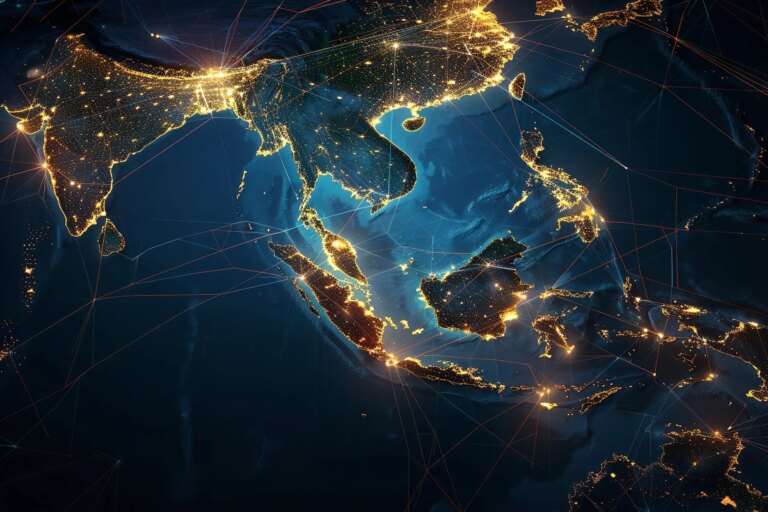
Yet this region is of great geopolitical significance. This is not only due to its proximity to key Asian markets such as China, Japan, and South Korea, but also to the sea lanes that run through the region, including the Straits of Singapore and Malacca, which are critical arteries for global trade. This geography makes South­east Asia a key arena of great-power rivalry, meaning that developments in the region have a direct impact on stability and region­al order throughout the Indo-Pacific. The South China Sea is one of the world’s key transit corridors, but it is also a flashpoint of Sino-American rivalry, as Beijing seeks to enforce illegitimate territorial claims there through increasingly escalatory measures. Any conflicts along these routes would have “serious consequences” for German and European interests, as Foreign Minister Johann Wadephul noted during a visit to Singapore in February 2026.

The Association of Southeast Asian Nations (ASEAN) is the central multilateral organisation in Southeast Asia. It serves as the primary platform for economic and political cooperation in the region, as well as an institutional anchor for multilateral forums such as the East Asia Summit and the ASEAN Regional Forum. For Germany and other actors, ASEAN is therefore an important gateway for engaging with other stakeholders in the Indo-Pacific. Accordingly, the Indo-Pacific Guidelines describe it as the region’s “most influential” organi­sation.

There is also interest in new partnerships within Southeast Asia itself. ASEAN member states have traditionally sought to preserve their foreign policy autonomy. Although they differ in their geopolitical orientations, they generally strive to maintain stable relations with both China and the United States, with which they have close trade and investment ties. There is growing con­cern in the region that the strategic com­petition and zero-sum politics between Washington and Beijing could soon force countries to choose sides.

To counter this pressure, many ASEAN members are seeking partners among third countries that can help them to diversify their relations and reduce strategic depend­encies. Uncertainty over US tariff policy towards the region – for which the United States is one of the most important export markets – has further intensified these efforts. Indonesia and Thailand have applied for OECD membership, while some capitals are seeking closer cooperation with the BRICS grouping of Brazil, Russia, India, China, and South Africa. These developments signal that Southeast Asian states are actively seeking new partners and frameworks to safeguard their interests in an uncertain international environment.

Partners for de-risking

This also opens up new opportunities for Germany to cooperate with the region in areas of shared interest, including sustainable development, the preservation of the rules-based international order, and the strengthening of multilateralism. So far, however, Germany has only made limited use of these opportunities.

At the regional level, Berlin has sought to build institutional ties with ASEAN. In 2020, for instance, Germany acceded to the Treaty of Amity and Cooperation in South­east Asia, which was intended to lay the “foundation” for deeper security-policy cooperation. However, apart from Germany’s admission as an observer to the ASEAN Defence Ministers’ Meeting Plus (ADMM+), this objective has yet to be realised.

Although Berlin allocated a total of 22.6 million euros to ASEAN initiatives in 2024, this amount remains modest com­pared with bilateral development assistance. In the same year, Germany provided more than 231 million euros to Indonesia, the region’s largest recipient, whereas the Philippines and Vietnam received 39 million and 59 million euros, respectively. It is also telling that it was the Minister of State at the Federal Foreign Office, rather than the Foreign Minister, who travelled from Berlin to Brunei for the EU–ASEAN Foreign Min­isters’ Meeting in April 2026. Such gestures are particularly significant in the ASEAN context, as the quality of partnerships there is measured not only by concrete outcomes but also by sustained engagement and personal exchanges at the leadership level. Germany’s relations with the region have so far been limited to cooperation with indi­vidual member states and have been driven primarily by economic interests.

Southeast Asia is regarded as the epicentre of economic growth in the 21st century. Taken together, the countries in the region are expected to become the world’s fourth-largest economy by 2030. With a total population of around 684 million people, they also offer a vast consumer and labour market. Southeast Asia could therefore play a central role in Germany’s efforts to reduce its one-sided dependencies on China – in other words, to “de-risk”.

With a trade volume of around 83 billion euros in 2025, the region is already a sig­nificant economic partner for Germany. These relations are likely to gain further importance through new free-trade agree­ments. Last year, the EU added an agreement with Indonesia to its existing trade agreements with Vietnam and Singapore. Spurred on by US tariff policy, the nego­tiations that had lasted almost a decade were concluded within a few months. Similar agreements with Thailand, Malaysia, and the Philippines are expected to follow shortly.

Several countries in the region are also positioning themselves specifically as alternatives to China within global supply chains. The development of regional capa­city in strategic sectors is particularly rele­vant to German interests. Malaysia and Vietnam have emerged as major centres for semiconductor production, as underlined by recent investments by German firms such as Infineon and Aixtron. In the field of e-mobility, Thailand is establishing itself as an emerging production hub, benefiting from Chinese foreign direct investment in electric-vehicle manufacturing. The country is also becoming increasingly important to German carmakers as a production and export base. Indonesia possesses the world’s largest nickel reserves and, like several other countries in the region, is striving to play a more significant role in critical raw-material supply chains.

Country-specific strategies

However, the “de-risking” approach reduces Southeast Asia to a secondary factor in Germany’s China policy and overlooks the region’s strategic significance in its own right. Yet the region is of direct relevance to Germany’s foreign and security policy in several key areas.

Partnerships with Southeast Asian coun­tries are indispensable for climate action. Indonesia is one of the world’s largest CO2 emitters, and its path to decarbonisation will be crucial to achieving global climate targets. At the same time, the region is a key arena for transnational threats – ranging from piracy and illegal fishing, which endanger critical maritime routes, to cybersecurity risks. Combating these security challenges is in Germany’s direct interest. Thanks to their cooperation in such areas, the ASEAN member states also have valuable experience from which Europe can learn. Further­more, emerging middle powers in the region such as Indonesia and Malaysia, as well as the influential city-state of Singapore – which likewise are committed to a rules-based international order – are potential allies in Germany’s efforts to reform multilateral institutions such as the United Nations and the World Trade Organization.

Given the region’s heterogeneity, how­ever, it is of limited value to adopt a one-size-fits-all approach to strengthening stra­tegic cooperation. ASEAN member states differ considerably in terms of political systems, geopolitical orientations, and economic structures. Levels of development range from Singapore, one of the world’s wealthiest countries, to Myanmar and Laos, which are classified as least developed countries. The relevance of individual states to German priorities therefore varies considerably. The littoral states of the South China Sea are more important for Germany’s maritime security engagement than landlocked Laos. In the raw materials sector, cooperation with Indonesia – one of the world’s leading mining nations – offers far greater potential than, for example, cooperation with resource-poor Singapore. Country-specific strategies that take into account both German interests and local priorities are therefore required. In this regard, Berlin faces several interlinked challenges.

Low visibility, fierce competition

From the perspective of countries in the region, Germany is a partner of limited weight. Existing initiatives, such as those aimed at strengthening defence cooperation with the Philippines and Singapore or supporting the energy transition in Indo­nesia and Vietnam, are important steps towards deepening strategic relations. However, they remain selective in scope and comparatively limited in scale. Consequently, Germany lacks visibility in the region. With around one billion euros in development aid, Germany lagged far behind other donors in 2023. Japan, for example, provided 3.8 billion euros to Southeast Asia in the same year.

These challenges arise within an increasingly competitive environment. A wide range of actors have recognised the region’s strategic importance. They are investing considerable diplomatic and financial resources, in some cases, to respond to local needs while advancing their own strategic interests. Above all, China has systematically expanded its footprint in Southeast Asia. The People’s Republic is now arguably the most influential external actor in the region, closely followed by the United States. Alongside the great powers, Russia, Japan, Australia, and other middle powers are competing for influence here. In light of this competition, Germany’s efforts to strengthen its partnerships in Southeast Asia should not be understood as a second­ary response to China’s rise. Rather, these efforts are a strategic necessity if Germany is to enhance its relevance and capacity to act in the Indo-Pacific over the long term.

About the author

Dr Pia Dannhauer is an Associate in the Asia Research Division at SWP.


Source link