Marian pilgrimage in Flores inspires care for creation


The Bishop of Labuan Bajo on the Indonesian island of Flores launches a weeks-long pilgrimage dedicated to Our Lady of the Assumption before the annual Golo Koe Festival in August. This year’s pilgrimage aims to link Marian devotion with ecological responsibility.

By Fr. Kasmir Nema, SVD –  Labuan Bajo, Indonesia

A Marian pilgrimage crossing the hills and villages of Indonesia’s Flores Island is inviting Catholics to deepen not only their devotion to the Virgin Mary but also their commitment to caring for creation.

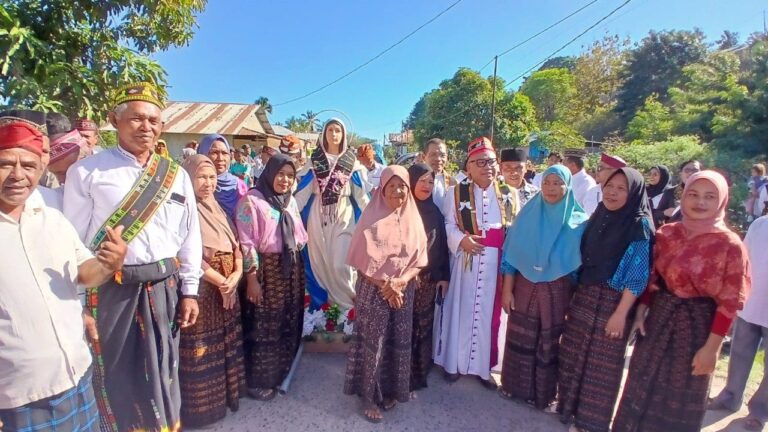
Bishop Maksimus Regus of Labuan Bajo on July 10 inaugurated the Great Procession of Maria Assumpta Nusantara at St. Joseph the Worker Parish in Lengkong Cepang, launching a weeks-long journey of the statue of Our Lady of the Assumption through dozens of parishes before the annual Golo Koe Festival reaches its climax in August.

This year’s pilgrimage carries a distinctive message. Under the theme “Communal Pilgrimage in Synergistic Communion to Care for the Integrity of Creation,” the Diocese of Labuan Bajo is linking Marian devotion with ecological responsibility, echoing Pope Francis’ call in Laudato Si’ for an ecological conversion rooted in faith.

A pilgrimage with an ecological mission

The environmental focus was already evident when the festival was officially launched on June 4, coinciding with World Environment Day.

Speaking at Sudamala Beach in Labuan Bajo, Bishop Regus said humanity is facing the challenges of climate change and environmental degradation, calling on people of every faith to embrace an ecological conversion that is expressed in concrete action.

The launch included a beach clean-up, the planting of coconut trees along the coast, and the release of doves as symbols of peace and care for creation.

West Manggarai Regent Edistasius Endi also encouraged participants to ensure that the festival’s ecological message becomes a lived commitment rather than merely a ceremonial theme.

A moment of the procession

A moment of the procession

A witness to fraternity

The pilgrimage also highlighted the region’s tradition of interreligious harmony.

As the Marian statue passed through the village of Nanga Lili, Muslim residents welcomed the procession with a traditional Manggarai dance, offering a gesture of hospitality that reflected the close bonds shared by different religious communities.

The statue was then carried in procession to St. Joseph the Worker Parish amid the praying of the Rosary and Marian hymns, where parishioners welcomed it with a traditional songket cloth, a local symbol of honor and respect.

“Mary always brings Christ”

During the opening Mass, Bishop Regus reflected on the Visitation, reminding the faithful that wherever Mary goes, she leads people to her Son.

Recalling Mary’s visit to Elizabeth, he said the pilgrimage invites families and communities to entrust their hopes to Christ, adding that Christians are likewise called to become bearers of hope, joy and love in the world.

The Eucharistic celebration was concelebrated by priests from the diocesan curia and the Wae Nakeng deanery.

Fr. Ivan Selman, chairman of the Golo Koe Festival committee, said the Marian pilgrimage forms the spiritual heart of the festival.

Before thousands gather in Labuan Bajo for the final celebrations, he explained, Mary first visits every parish, expressing the Church’s vocation to journey together in communion.

The procession

The procession

Faith, culture and care for a common home

Now in its fifth edition, the Golo Koe Festival has become one of Indonesia’s leading religious and cultural celebrations and has been included among the country’s Top 10 Kharisma Event Nusantara, a national tourism program.

Located near Komodo National Park, Labuan Bajo has experienced rapid tourism growth in recent years. The diocese sees the festival as an opportunity to unite faith, local culture and environmental stewardship, encouraging visitors to encounter not only the beauty of Flores but also the responsibility of protecting its fragile ecosystems.

The festival’s peak celebrations, scheduled for August 10–15, will include cultural performances, the traditional Manggarai Caci dance, a solemn Eucharistic celebration, and environmental initiatives involving young people, schools and local communities, including tree planting and beach clean-up activities.

Meanwhile, the statue of Our Lady of the Assumption will continue its pilgrimage through the deaneries of Wae Nakeng, Pacar and Labuan Bajo before arriving at the Holy Spirit Cathedral in early August for the Grand Marian Procession.

For Bishop Regus, the journey is above all a season of prayer and renewal—one that begins in the hearts of believers and extends outward in love for one another and for the common home entrusted to all.

The procession

The procession


Source link