
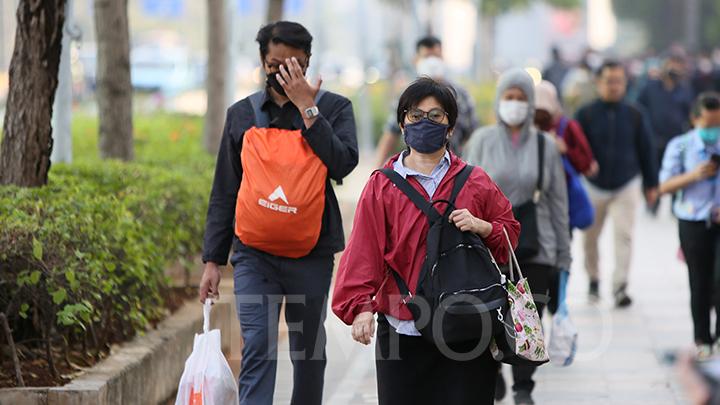
Wear a Mask, Jakarta Ranks Third for Worst Air Quality Worldwide


TEMPO.CO, Jakarta – Jakarta’s air quality on Thursday morning fell into the unhealthy category, ranking it third among cities with the worst air quality in the world.

According to data from the air quality monitoring website IQAir at 6:05 a.m. Western Indonesian Time (WIB), the air quality index (AQI) in Jakarta was at 161, categorized as unhealthy, with PM2.5 air pollution and a concentration of 57 micrograms per cubic meter.

This figure indicates unhealthy air quality for sensitive groups, as it can harm humans and sensitive animals, or damage plants or aesthetics.

The public is advised to avoid outdoor activities. If outside, they should wear a mask and close windows to avoid exposure to polluted outdoor air.

Meanwhile, good air quality is air quality that does not affect human or animal health and does not affect plants, buildings, or aesthetics, with a PM2.5 range of 0-50.

Next, the moderate category, which means air quality that does not affect human or animal health, but does affect sensitive plants and aesthetics, has a PM2.5 range of 51-100.

Furthermore, the very unhealthy category has a PM2.5 range of 200-299, meaning the air quality can be detrimental to the health of some segments of the exposed population. Finally, the hazardous category (300-500) generally refers to air quality that can seriously harm the health of the population.

The cities with the worst air quality are Kuwait City (Kuwait) with a score of 185, Delhi (India) with a score of 169, Kinshasa (Democratic Republic of Congo) with a score of 160, and Johannesburg (South Africa) with a score of 156.

Meanwhile, the Jakarta Provincial Government (Pemprov) and the Meteorology, Climatology, and Geophysics Agency (BMKG) are preparing an early warning system (EWS) for air quality to predict air pollution more accurately.

The development of the air quality EWS is part of the Jakarta Provincial Government’s long-term strategy to reduce the impact of air pollution and improve the quality of life for the community.

The existence of this early warning system can provide significant benefits, especially for groups vulnerable to the impacts of air pollution.

These groups include children, the elderly, pregnant women, and people with a history of respiratory diseases, such as asthma and other lung disorders.

With more accurate and easily accessible air quality forecast information, the public can take various preventative measures when air quality is expected to deteriorate, including wearing masks when outdoors, limiting physical activity in open areas, and reducing exposure to air pollution that can potentially harm health.

Read: Jakarta Air Quality Turns Unhealthy, People Urged to Wear Masks

Click here to get the latest news updates from Tempo on Google News


Source link