
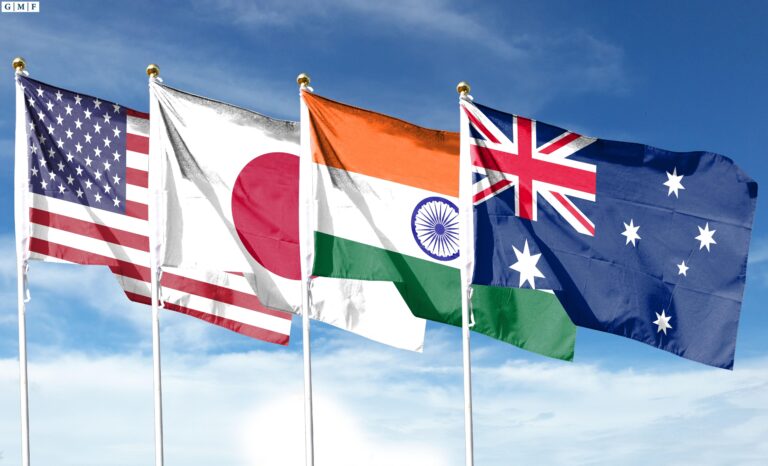
The Quad Is Back | German Marshall Fund of the United States


The recent Quad foreign ministers’ meeting in New Delhi tested whether the diplomatic minilateral remains a serious strategic platform or has been weakened by leader-level drift and US-India friction. The result is more encouraging than the surrounding anxiety suggests. 

The Quad still lacks a leaders’ summit, and the US-India relationship—the grouping’s most consequential bilateral leg—is still recovering from a series of recent setbacks. Yet despite recent hand-wringing on those issues, the ministerial showed tangible progress on maritime security, resilient supply chains, critical minerals, technology, and regional public goods.

At the gathering, US Secretary of State Marco Rubio framed the Quad as “a partnership of action”, not just a forum where four countries “discussed the problems of the world”. His Indian counterpart, S. Jaishankar, emphasized that the responsibilities of the four maritime democracies will grow. A joint statement, which Australia’s Penny Wong and Japan’s Toshimitsu Motegi joined, reaffirmed familiar principles of a free, open, and rules-based Indo-Pacific while noting threats to stability. The real development, however, was pairing principles with tangible operational initiatives. 

Substantive Strides

The latest Quad gathering produced a long list of outcomes detailed in a fact sheet and post-meeting remarks, but three takeaways deserve emphasis: the thinly veiled criticism of China; substantive deliverables, particularly in maritime security; and India’s growing willingness to lead.

On the first point, the joint statement pulled few punches on Beijing. It reaffirmed the rules-based order without explicitly naming China as a violator, but the target of the message was unmistakable. The ministers expressed serious concern about coercive and destabilizing behavior in the Sea of Japan and the South China Sea including dangerous maneuvers, obstructions to freedom of navigation and overflight, and militarization of disputed features. They also called out economic coercion, non-market practices, and cybercrime scam centers. As one former senior Indian official once privately remarked, China may not be in the headline, but China permeates the body copy. The Quad no longer needs to name Beijing to make clear it is organizing against bad Chinese behavior.

Regarding deliverables, the Quad expanded from joint diagnosis to coordinated action, most clearly in the area of maritime security. India recently completed the contract for maritime situational awareness tools needed to operationalize its Indian Ocean contributions to the Indo-Pacific Partnership for Maritime Domain Awareness (IPMDA). The Biden administration launched the Quad-led IPMDA, but Indian Ocean implementation lagged until New Delhi finally operationalized the partnership shortly before the ministerial. Rather than being a pure public good, which the Trump administration eschews, IPMDA is better understood as a “club good” that the Quad can selectively provide to like-minded partners and regional information centers. The partnership has created a network for identifying dark shipping, tracking suspicious vessels, and improving the capacity of Indo-Pacific states to monitor their waters.

The launch of an Indo-Pacific Maritime Surveillance Collaboration (IPMSC) also marked a significant security upgrade. The quartet pledged to “leverage each of our countries’ maritime surveillance capabilities” and “share real-time information” in the Indian Ocean. Public documents suggest an integrated network of national surveillance assets, new sensing technologies, and analyses merged into an accessible data stream. Wong characterized this as a means for freedom of navigation and strategic stability to be “operationalized”. Linking sensors, digital signals, and analysts into a common operating picture enabling civilian and military responses resembles a looser, unclassified maritime version of the “Five Eyes” network, which could be tested in a future exercise involving Quad partners.

The grouping’s maritime agenda extended to undersea cable security, logistics coordination, coast guard cooperation through the Quad-at-Sea Ship Observer Mission, and disaster-response planning. Developing standard operating procedures for multimodal logistics coordination within the Indo-Pacific Logistics Network sounds technocratic, but it is strategically important as a form of “covert balancing”. Such coordination can now support humanitarian assistance and disaster relief. In the future, the same plans, assets, and procedures could be adapted to military operational sustainment and staging, or maritime security operations. The Quad’s value lies partly in this dual-use institutionalization. It can remain politically palatable as a provider of regional resilience while quietly enabling four militaries to act together in crisis.

Beyond maritime security, the Quad announced progress on energy, critical minerals, infrastructure, and technology. The Quad Initiative on Indo-Pacific Energy Security seeks to coordinate efforts at regional resilience. A Critical Minerals Initiative Framework advances collaborative industrial strategy by diversifying supply chains, coordinating investment, aligning regulations, and expanding recycling and recovery to alleviate partners from being solely dependent on new mining and processing projects with long timelines. The framework’s stated goal of mobilizing up to $20 billion in public and private support should be treated cautiously since much depends on turning equity, subsidies, offtake agreements, and other policy tools into bankable projects. Still, this is a serious effort to reduce exposure to concentrated and coercive supply chains. The Quad also appears committed to developing critical infrastructure in the region, as reflected in an announcement of material support for port development in Fiji and an undersea cable network security for Pacific island nations.

Some observers lament that the ministerial devoted less attention to critical and emerging technology. That may reflect conflicting signals on technology competition with China, but many earlier efforts on AI and semiconductors may also shift to Pax Silica, a new grouping that includes all Quad countries and is expected to clarify its mandate in a summitstarting on June 25. The Quad, however, continued to pursue Open RAN deployments, next-gen telecommunications, interoperable digital identity standards, and research funds to support technology innovation for agriculture. Nothing was announced on biotech, and space and cyber appear to have slipped from the Quad agenda.

Finally, India was often seen as the cautious “pacing partner” in the Quad’s past, but its rising leadership deserves attention. The country just hosted one of the grouping’s most substantive meetings, proposed and lobbied for the Indo-Pacific Maritime Surveillance Collaboration, and committed to hosting the next Quad-at-Sea mission. All this activity conforms with private accounts noting that the Indian foreign ministry’s leadership wants the Quad to move faster and deliver quick results. New Delhi also appears more comfortable with the language targeting Chinese behavior, a notable shift since its ambivalence toward US Secretary of State Mike Pompeo’s entreaties in 2020. To advance its strategic interests, India appears willing and able to join and lead on substantive operational alignments—as it did when it joined the Combined Maritime Force that involve hard choices and tradeoffs. It is now likely to take the helm in 2027 of an important operational group, Combined Task Force 150, to lead maritime security operations in the Arabian Sea to counter illicit activity by criminal and terrorist organizations.

A Leader-less Quad?

Critics argue that without a leaders’ summit, “the Quad risks losing strategic coherence and punch”. Some analysts have speculated whether a foreign ministers’ meeting reflects a downgrade for the grouping. The concern is understandable. Leader-level meetings provide political energy, bureaucratic prioritization, and reassurance. India, for its part, would also see its status rise by hosting a summit of heads of state or government. It would signal New Delhi’s centrality in the Indo-Pacific order.

Still, the absence of such a summit should not obscure the ministerial’s substance. Rubio is no working-level functionary. He is arguably the most important US foreign policy decision-maker after President Donald Trump. His four days in India, including meetings with Prime Minister Narendra Modi, National Security Adviser Ajit Doval, and Foreign Minister Jaishankar (an estimated seven hours of discussions overall), signaled Washington’s prioritization of its relationship with New Delhi and the Quad. The grouping may yet evolve to function less through scripted summitry and more through quiet planning, resourcing, and action. If it produces maritime surveillance integration, critical mineral resilience, energy stability, and alternative infrastructure and technology assistance, it will help counter China even without leader-level fanfare.

A Looming Constraint

The deeper challenge for the Quad is whether US-India friction abates or persists. Tensions last summer over tariffs, Russian oil, and Washington’s handling of the May 2025 India-Pakistan crisis, put the Quad’s cohesion at risk. Rubio tried to repair some of the damage through his extended visit to four cities, extensive meetings, and repeated public references to India as a strategic ally.

Yet new challenges keep arising. Trade tensions may be fading as both countries near a deal, but energy and financial shocks stemming from the Iran war, fears among the Indian diaspora of new US visa and immigration restrictions, and Trump’s interest in an accommodation with Beijing all feed Indian worries about Washington’s reliability. The latest instance of Indian seafarers caught in the crossfire of American retaliation against Iran further complicate ties. This matters for the Quad because it cannot act faster than the trust between Washington and New Delhi allows.

The latest Quad ministerial should be assessed more as a moment of triumph than tribulation even if the four countries’ leaders do not engage in the political theater of summitry and US-India friction slows the pace with which initiatives can progress. Still, the grouping is making strides in the areas that matter most for Indo-Pacific competition: maritime security, critical minerals resilience, infrastructure and technology investment, and holding China accountable for its behavior. The Quad is not fading. It is assuming a practical, operational, and beneficial form.


The views expressed herein are those solely of the author(s). GMF as an institution does not take positions. 


Source link