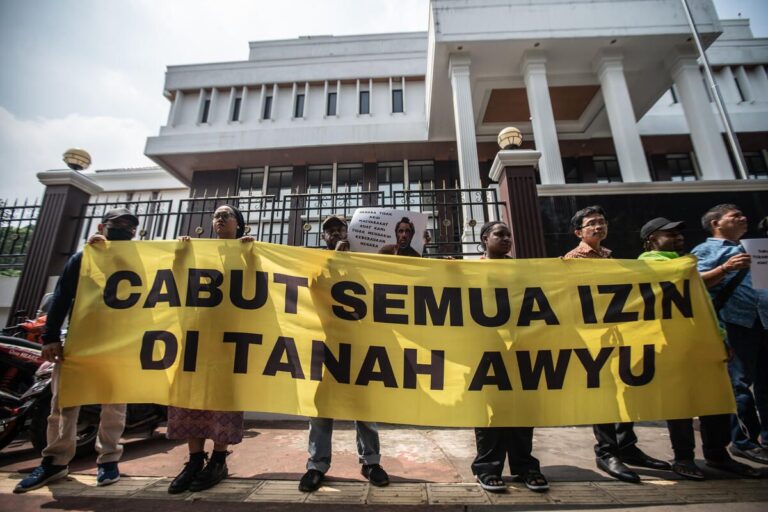
Courtesy of Greenpeace Indonesia
Indonesia is home to some of the largest stretches of tropical rainforest left on Earth — and to a growing community of people willing to put themselves on the line to defend it. But across the archipelago, environmental activists are increasingly finding that the sharpest threat they face isn’t out in the field. It’s in the courtroom.
In this episode, we’re looking at how the law itself is being turned against environmental defenders in Indonesia, especially through what are known as SLAPPs — strategic lawsuits against public participation. What are these suits, and what is the intention behind them?
To unpack this, I’m joined by Austin Jenish. Austin recently finished his studies, and his path into these questions didn’t begin in a lecture or a research program, but with a study abroad program that took him to Indonesia. He came to the country’s legal system and its environment out of genuine curiosity, and followed that interest far enough to start writing about it. So, we connected through an article Austin wrote for Earth.org on SLAPP, which can be found here.
Austin holds degrees in both law and genetics from Monash University and now works at a commercial litigation firm, but his engagement with environmental issues is a longstanding passion. He’s served as a conservation status assessor with the International Union for Conservation of Nature, contributed environmental law and policy work to NGOs, including the Institute for Criminal Justice Reform in Jakarta, and, through Monash’s law clinics, helped draft a framework for environmental litigation and supported the Cook Islands in the UN’s plastic pollution treaty negotiations.
In 2026, the Talking Indonesia podcast is co-hosted by Dr Elisabeth Kramer from the University of New South Wales, Tito Ambyo from RMIT, Dr Jemma Purdey from the Australia-Indonesia Centre, Dr Clara Siagian from the University of College London, and Dr Jacqui Baker from Murdoch University.