South Korea’s middle power diplomacy is shifting from a prestige project to a survival strategy, as Trump’s return, US-China rivalry and alliance dependence force Seoul to seek greater autonomy without abandoning the US security guarantee.
Debates about middle power diplomacy first emerged after the Cold War. Led by countries like Australia and Canada, middle powers were cast as supporters of the US-led liberal international order – both by complying with existing rules and by joining the ranks of norm-setters in new issue areas.
In South Korea, discussions of middle power diplomacy that emerged in the mid-2000s have since come to influence successive governments’ policies. While Seoul rarely labels its approach as ‘middle power diplomacy’, for some two decades it has nevertheless advanced visions and programs that stress South Korea’s contributions to regional and global norms-building, so as to enhance its status and influence.
During that time, the middle power agenda was peripheral to Seoul’s foreign policy, overridden by ‘hardcore issues’ of North Korea’s nuclear and missile programs and securing peace on the peninsula. Seoul placed primary focus on its alliance with the United States and on managing relations with Japan, China and Russia. Middle power diplomacy was viewed as a prestige project, not a matter of survival.
As US–China rivalry intensified from the mid‑2010s, the nature of Seoul’s middle power diplomacy began to change. The 2017–22 Moon Jae‑in administration’s diversification drive – especially the New Southern Policy which focused on improving ties with ASEAN and India – reflected concerns about excessive trade dependence on China. The 2022–25 Yoon Suk‑yeol administration aligned more closely with Washington’s Indo‑Pacific strategy by seeking linkages with US-led minilateral groupings. South Korean middle power diplomacy moved towards hedging – building networks and redundancy to cushion diplomatic shocks, while remaining firmly anchored in a US-led framework.
US President Donald Trump’s return to the White House in 2025 has shaken that foundation. The liberal order built and tended to by the United States is now being eroded by Washington itself. Under the banner of ‘America First’, Trump has imposed a starkly transactional approach in which even long‑standing allies are treated as counterparties in hard bargaining. Norms and values have faded from US rhetoric – power, interests and deals have come to dominate. What began as a gradual weakening of the liberal order under pressure from China and Russia now appears to be accelerating under the anomaly of Trump 2.0.
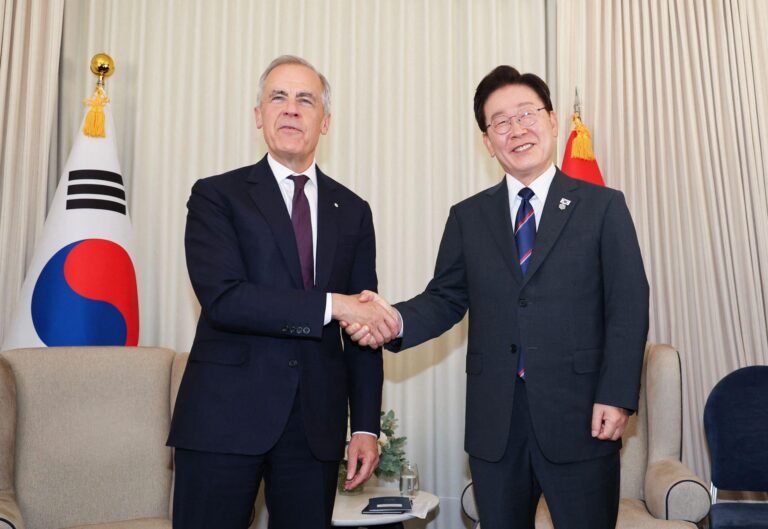
Middle power diplomacy is attracting renewed attention in this environment, with many hopeful that middle power coalitions can help defend and reconstruct the crumbling rules‑based order. At the 2026 World Economic Forum Meeting, Canadian Prime Minister Mark Carney articulated a vision for middle power solidarity in a world where the US role as a benign hegemon can no longer be taken for granted.
South Korea broadly shares this diagnosis of the role of middle power coalitions, though compared to Canada, it enjoys less room to manoeuvre. The US–South Korea alliance remains the backbone of Seoul’s security policy — in the face of an expanding North Korean nuclear arsenal, there is still no realistic deterrent strategy that does not rest on the US security guarantee. Economically, the United States accounts for roughly one‑sixth of South Korea’s exports – heavily concentrated in autos, semiconductors, petrochemicals and steel – leaving Seoul acutely vulnerable to shifts in US tariff policy and regulations.
The Lee Jae‑myung government has declared a policy of ‘pragmatic diplomacy centred on the national interest’ – holding the alliance as steady as possible while seeking to reduce overdependence on Washington and broaden South Korea’s autonomy.
On one front, Seoul aims to hedge against a less reliable United States by bolstering defence capabilities, industrial competitiveness and supply‑chain resilience. Greater capabilities and self-reliance are seen as essential to sustain an increasingly transactional alliance relationship.
On another front, Seoul is intensifying diplomatic diversification. In 2025, the National Policy Planning Committee set the goal of ‘realising a G7+ diplomatic power through contribution to and participation in the international community’ and the Ministry of Foreign Affairs identified ‘diplomatic diversification’ as a key objective.
In practice, this has meant active summit diplomacy beyond Washington and immediate neighbours. After visiting China and Japan in January 2026, President Lee travelled to Singapore, the Philippines, India and Vietnam, and hosted leaders from Italy, Brazil, Ghana, Indonesia, France and other countries in Seoul. The first South Korea–Central Asia Summit is planned for September 2026.
Still, Seoul’s efforts to build middle power coalitions remain tentative. Debate over joining the Quad or AUKUS Pillar 2 has largely subsided. The US–Japan–South Korea trilateral framework created at Camp David in 2023 has been overshadowed by Washington’s tariff threats and investment demands, which Seoul and Tokyo have mostly handled unilaterally rather than through coordinated responses. Seoul has also expressed its intention to join the Comprehensive and Progressive Agreement for Trans-Pacific Partnership but accession has stalled, in part because Japan continues to raise the issue of South Korean restrictions on seafood imports from Fukushima.
Seoul has responded selectively to proposals from its European partners that could underpin middle power cooperation. South Korea joined a UK and France‑led initiative to ensure safe navigation in the Strait of Hormuz in April 2026 and will likely attend the June 2026 G7 Summit at French President Emmanuel Macron’s invitation. But it remains non-committal on NATO’s request for participation in the Prioritised Ukraine Requirements List – perhaps wary of any further deterioration in its relations with Russia.
These patterns suggest that the Lee government favours issue‑by‑issue and interest‑based participation in international coalitions. Such selectivity is understandable for a country tightly constrained by alliance dependence and great power rivalry. But interests vary by issue and shift over time, making it difficult to build stable long‑term alignments on that basis alone.
South Korea’s middle power diplomacy stands at an inflection point. Conceived originally as a prestige strategy within a stable liberal order, it is now being asked to serve as a survival strategy within an increasingly uncertain world. What the moment demands from Seoul is creative and bold statecraft to widen diplomatic autonomy, even within the constraints of its alliance with the United States.
The need for middle power cooperation is greater than ever, but South Korea has only begun to take cautious first steps.
Republished from East Asia Forum
The views expressed in this article may or may not reflect those of Pearls and Irritations.