
Is Jakarta turning into Gotham? How viral crime panics become pretext for expanding military visibility


Kompas.com/Ridho Danu Prasetyo

A recent spate of violent robberies in Jakarta by motorcycle assailants, or begal, has unfolded amid deteriorating socio‑economic conditions under the Prabowo administration, as slowing growth, rising living costs, and tightening labour markets deepen everyday precarity.

These pressures have sharpened public sensitivities to perceptions of threats that might previously have remained localised.

Although reported begal incidents declined from February to May, emerging evidence suggests that these attacks are becoming less opportunistic and more closely tied to organised networks.

The online panic, however, quickly surged far beyond the scale of actual occurrences, fuelled by artificially amplified and misleading posts and the viral circulation of sensational footage.  Several viral TikTok videos were exaggerated, or in some cases wholly fabricated, such as the ‘burst boil’ hoax later admitted to have been staged for attention by a would-be influencer.

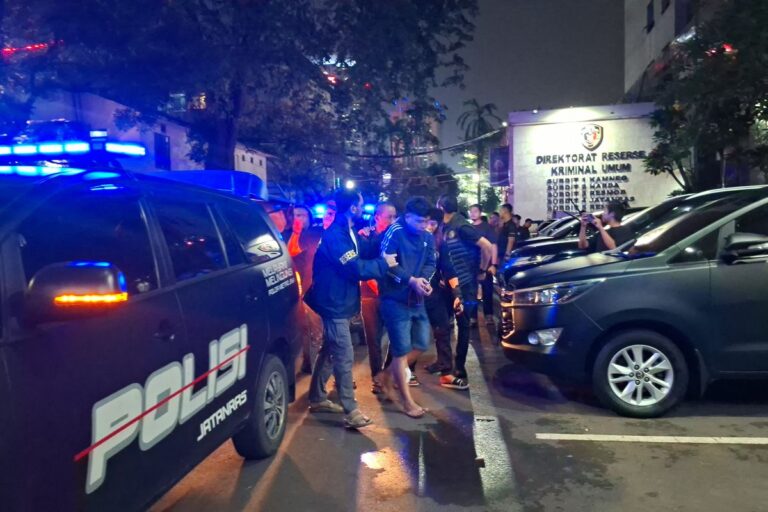
The waves of viral posts sparked the emergence of a ‘Gotham City’ meme and hashtag, framing parts of Jakarta as sites of social breakdown, crime and disorder. In a political environment increasingly shaped by viral‑driven policy responses, its rapid spread prompted a quick government reaction.

Jakarta police announced the formation of a dedicated ‘begal hunting team’, while Jakarta Governor Pramono Anung outlined renewed plans to integrate the city’s fragmented network of private and government CCTV under a centralised command.

It also prompted familiar calls for ‘uncompromising’ tegas (strict) measures to combat the begal surge, including ‘shoot on sight’ directives.

Moments of crime anxiety in Indonesia routinely trigger authoritarian nostalgia for Petrus‑style ‘shock therapy’. This is a reference to the early‑1980s ‘mysterious shootings’ campaign in which security forces carried out extrajudicial killings of thousands of alleged criminals as a projection of state authority.

Militarised deterrence and the politics of visibility

Extending the military’s role into everyday urban policing quickly became a central discursive theme in the panic’s aftermath.  This is not unprecedented. A similar begal panic in 2015 in Jakarta and West Java led to several weeks of heightened TNI (military) presence on the streets before it was discontinued.

A key difference today is the Prabowo administration’s massive expansion of the military, much of it through the so‑called ‘development infantry battalions’ and the enlargement of the  territorial command system that runs through a centralised hierarchy down to the village level.

TNI Chief of Staff Maruli Simanjuntak proposed joint military–police patrols as part of an expanded territorial role in routine crime control. After rebukes from lawmakers and civil society groups that it constituted illegal mission creep, he backtracked, insisting the TNI was not seeking to supplant the police. Yet, in what sounded like a euphemism for precisely that, he argued that a sustained military presence on the streets would itself deter would‑be offenders.

Rather than advancing an institutionalised policing role for the TNI, official language has consolidated around deterrence through increased visibility.  Defence Minister Syafrie Syamsuddin, meanwhile, claimed more troops in the streets would ‘create a sense of security’ while TNI Commander Agus Subiyanto declared that ‘the presence of soldiers on the ground makes everyone feel safer.’

Considering Jakarta’s already hyper‑securitised urban landscape—dense with police, private security, neighbourhood patrols, informal enforcers, municipal authorities, plus expanding CCTV and facial‑recognition networks—there is little pragmatic rationale for greater military presence to address a temporary crime spike.

It may nonetheless find a receptive audience. Research indicates that populations repeatedly exposed to crime shocks often prioritise crime control over other societal goals, including economic stability or basic rights.

In this context, government and military actors have much to gain from redirecting public anxieties about economic insecurity toward the spectre of crime, insofar as this reframing legitimises an expanded coercive presence.

The political economy of fear

The anthropologist James Siegel argued that under the New Order, criminality was not understood as a series of discrete acts. Instead, it was constructed as an ensemble of imagined forces, a diffuse, pervasive threat continually invoked to portray society as vulnerable and in need of coercive protection.

Sovereignty was explicitly, and corporeally, enacted through the elimination of illegitimate figures, marked as deviant, asing or foreign, or irredeemable.

This lingering sense of danger became a structuring element of everyday life, embedded in dense infrastructures of urban security. It served as a mechanism through which the state bound citizens to itself in lieu of populist consent.

The recent begal scare echoes this dynamic, not by transforming economic precariousness into a threat but by exploiting the risk sensitivity that precarity produces.

Unlike the New Order’s centrally orchestrated narratives, however, today’s escalation is driven by the recursive dynamics of digital platforms, algorithmic amplification, attention‑driven content economies, and the monetisation of fear. This produces a sense of menace that spreads laterally rather than hierarchically.

Government and military actors were not directing the viral surge in content, despite previous cases where online sentiment was manipulated, so much as responding to it. They joined a wider cast of opportunists seeking to capitalise on the attention economy surrounding the scare, from online scammers and aggrieved ex‑partners to would‑be influencers.

The realities of an expanded military presence on the streets of Indonesian cities, its supposed deterrent effect and its growing support role alongside the police, are already visible in Jakarta.

Recent student ‘Towards Indonesia’s Bankruptcy’ protests in the city centre saw soldiers positioned behind police lines, signalling the availability of a coercive reserve should demonstrations exceed tolerated limits, and underscoring the state’s willingness to blur the boundary between public‑order policing and military force.

The politics of fear, however, operates through a feedback loop rather than a one‑way manipulation of public sentiment. After the August 2025 protests and riots, authorities, including the military, depicted the unrest as a destabilising threat and launched mass arrests and intimidation. Prabowo subsequently labelled the events as treason, or makar.

Investigations by KontraS and Amnesty Indonesia found that this approach both reflected and intensified fear, constricting democratic space while revealing official anxiety about youth mobilisation and the prospect of renewed collective action.

In this context, the spectre of violent crime and the expansion of military visibility, framed as ‘security reinforcement’, serve a dual function. It redirects public anxieties toward a criminal threat, while discouraging the kind of large‑scale mobilisation that unsettled the government in 2025. What appears as a response to crime thus also reveals the state’s persistent anxiety about the masses as a reservoir of unpredictable political force.


Source link