
Indonesia’s ratification of fishing labor reforms will also boost conservation (commentary)


  • Indonesia’s formal ratification of the ILO Work in Fishing Convention is a historic milestone for workers and will boost the sustainability of the fishing industry, the writer argues.
  • Such reforms require a broad coalition beyond traditional labor actors and must include fisheries authorities, fishing companies, fishers’ organizations and conservation groups.
  • “Fishers working under safer and fairer conditions are more likely to engage in responsible fishing practices and support conservation measures,” the author writes.
  • This article is a commentary. The views expressed are those of the author, not necessarily of Mongabay.

Indonesia’s recent ratification of the ILO Work in Fishing Convention, 2007 (C188) is a historic milestone for the country’s fisheries sector. The ratification is expected to strengthen the protection of fishers; improve working and living conditions at sea; and enhance the competitiveness of Indonesian seafood products in international markets, where buyers increasingly require compliance with labor, human rights and sustainability standards.

One of the key lessons from Indonesia’s ratification of ILO Convention No. 188 is that fisheries labor reform requires a broad coalition beyond traditional labor actors. Because the convention directly affects the fisheries sector, successful advocacy depended on active engagement from fisheries authorities, fishing companies, fishers’ organizations and other sectoral stakeholders.Indonesia’s progress was driven by an inclusive “tripartite plus” approach, which combined collaboration among government, employers and workers, with advocacy and technical support from civil society organizations and international partners, including Greenpeace, the Freedom Fund, International Justice Mission and the Environmental Justice Foundation (EJF). These stakeholders played a critical role in raising awareness, generating evidence, strengthening engagement and building public support for ratification.

Over the years, various ILO-supported projects also created important momentum by facilitating dialogue, evidence generation and stakeholder engagement on labor issues in fisheries. A clear stakeholder mapping process helped identify the respective roles and interests of each actor, enabling more strategic advocacy and stronger ownership of the ratification process. The Ministry of Marine Affairs and Fisheries (MMAF) emerged as a critical partner alongside the Ministry of Manpower, demonstrating that labor protection in fisheries cannot be achieved without active participation from fisheries institutions.

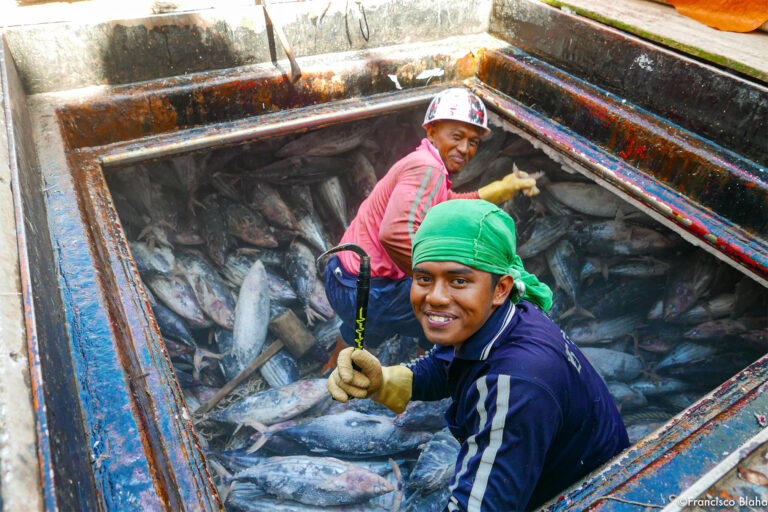
When workers are protected, trained, and treated fairly, fishing vessels can operate more safely and regulations can be followed. Image courtesy of Francisco Blaha.
When workers are protected, trained, and treated fairly, fishing vessels can operate more safely and conservation regulations can be better followed. Image courtesy of Francisco Blaha.

Another key milestone was the establishment of the Trade Union Network in the Fishing Sector, supported by ILO’s 8.7 Accelerator Lab Programme. The network brought together national trade union confederations and sectoral federations to focus specifically on the protection of fishers. This platform strengthened coordination among workers’ organizations and created a unified voice for policy advocacy. The ILO supported the establishment of a memorandum of understanding MoU between MMAF and the Ministry of Manpower, creating a stronger and previously unprecedented partnership to advance joint labor inspections and labor rights enforcement in the fisheries sector.

The advocacy movement was further strengthened by collaboration among national and international NGOs working on sustainable fisheries, environmental protection, and combating illegal, unreported, and unregulated (IUU) fishing. Despite their diverse mandates, these organizations shared a common commitment to responsible fisheries governance. Their engagement broadened the discussion beyond labor standards, highlighting that decent work, sustainable fisheries, and responsible seafood production are closely interconnected and are mutually reinforcing goals.

An important success factor was the growing collaboration between trade unions, NGOs, and fishing industry associations such as AP2HI (Pole & Line and Handline Fishing Association) and the Fisheries Committee of Indonesian Employer Association (APINDO). Through continuous dialogue and trust-building efforts, these groups increasingly recognized the economic and reputation benefits of ratification.

Cost-benefit analyses and discussions of market access helped demonstrate that compliance with international labor standards is not only a social obligation but also a business opportunity. As global seafood buyers increasingly demand proof that products are free from forced labor, child labor and exploitative working conditions, ratification became a strategic investment in Indonesia’s seafood competitiveness.

The commitment and leadership of national trade union leaders also played a crucial role. Their ability to engage policymakers and maintain direct communication channels with senior government officials ensured that the issue remained on the national agenda.

A significant turning point occurred when President Prabowo Subianto publicly announced during May Day 2025 that Indonesia should proceed with the ratification of C188. Following this political commitment, MMAF and the Ministry of Manpower accelerated preparations, developed the necessary policy papers, and conducted public consultations to build consensus and operationalize the ratification process.

Crew members from Southeast Asia work to unload fish on purse seiners in the Western Pacific Ocean in 2023.
A crew member works to unload tuna captured by a purse seining vessel in the Western Pacific Ocean in 2023. Image courtesy of Francisco Blaha.

These efforts culminated on May Day 2026, when a presidential decree formally ratifying ILO Convention No. 188 was issued. While the ratification itself is a major achievement, it should be viewed as the beginning rather than the end of the journey. The true test lies in effective implementation, including regulatory harmonization, institutional coordination, joint labor inspection, fisher organization and enforcement mechanisms across Indonesia’s vast fisheries sector.

The Indonesian experience demonstrates that meaningful reform in fisheries is possible when diverse stakeholders work together toward a common goal. The central lesson is clear: The collaboration of the ILO Tripartite Plus constituency government, employers, workers and civil society organizations was the key driver behind this success.

As Indonesia moves into the implementation phase, the challenge now is to translate legal commitments into real improvements in the lives of millions of fishers. For now, however, the ratification stands as an important example of what can be achieved through dialogue, partnership, persistence and collective action.

A key success factor was the effective collaboration between the Trade Union Network in the Fishing Sector and the Team 9 NGO Coalition, which demonstrated how sustained engagement, trust-building and collective action can drive meaningful policy change in the fisheries sector. The real work now begins.

Ratification contributes not only to improving fishers’ working conditions but also to promoting sustainable fisheries and marine environmental protection. By strengthening vessel oversight, crew documentation, and compliance with fisheries regulations, the convention supports efforts to combat illegal, unreported and unregulated (IUU) fishing, which is a major driver of fish stock depletion and marine ecosystem degradation.

The convention also reinforces the link between decent work and sustainable resource management. Fishers working under safer and fairer conditions are more likely to engage in responsible fishing practices and support conservation measures. As a result, ILO C188 can help protect marine biodiversity, strengthen fisheries governance and advance blue economy objectives by ensuring that the utilization of marine resources remains both environmentally sustainable and socially responsible.


Muhamad Nour is a Ph.D student at Kasetsart University Bangkok researching Indonesia’s blue economy.

Banner image: Crew members work to unload tuna captured by a purse seining vessel in the Western Pacific Ocean in 2023. Image courtesy of Francisco Blaha. 

See related coverage:

Sustainable fisheries can’t be built on exploited labor (commentary)

To help combat illegal fishing, 15 countries commit to sharing fisheries data


Worked to death: How a Chinese tuna juggernaut crushed its Indonesian workers


Source link