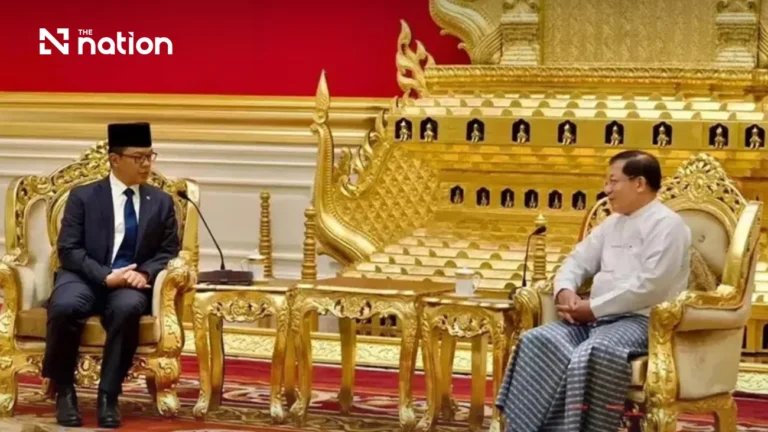
But with little progress achieved, some in the region are reconsidering how to engage Naypyidaw without easing pressure on the military leadership.
ASEAN Secretary-General Kao Kim Hourn has also addressed the issue, telling Reuters on May 8 that the bloc’s foreign ministers had agreed to a virtual meeting with their Myanmar counterpart.
Lin said ASEAN members increasingly recognise that the current approach has reached its limits.
“In this sense, engagement between ASEAN member states and the junta is increasingly being viewed not as a recognition of the new government, but as a practical necessity,” she said.
Analysts also noted that Indonesia has never fully disengaged from Myanmar.
Julia Lau, principal fellow at the ISEAS – Yusof Ishak Institute and coordinator of its Indonesia Studies Programme, said Sugiono’s language may have sounded softer, but did not necessarily indicate a fundamental policy shift.
“I do not see this as a significant change in tone from Indonesia,” Lau said.
She pointed to Indonesia’s activism during its 2023 ASEAN chairmanship, when then-foreign minister Retno Marsudi led extensive behind-the-scenes diplomacy with ASEAN members and external partners in an effort to move the peace plan forward.
“It is clear that there has been minimal progress on all of the 5PC’s conditions, but Indonesia likely still believes there is a chance it can play some role as a mediator or intermediary in finding some resolution to the stalemate that is Myanmar,” Lau said.
Dr Mustafa Izzuddin, a senior international affairs analyst at Solaris Strategies Singapore, said Indonesia deserved credit for continuing to seek a solution to the crisis.
“Whether in the end the outcome is fruitful, credit should be given to Indonesia for staying the course to find a resolution to the Myanmar conundrum,” he said.
“The driving impetus to solve the Myanmar conundrum stems from Indonesia positioning itself under Prabowo as a principled and pragmatic middle power that seeks to mediate conflicts as a humane internationalist.”
Some Indonesian observers believe Jakarta’s own political past may shape its thinking on Myanmar.
Teuku Rezasyah, a lecturer in international relations at President University in Cikarang, Indonesia, told ST that Myanmar could draw lessons from Indonesia’s post-1998 transition, when the military gradually withdrew from politics before former military figures later returned through democratic elections.
“President Prabowo is uneasy seeing the unsettled Myanmar issue and would like to make a breakthrough,” he said.
Still, the risks of engagement remain significant.
Lin warned that bilateral contact by individual ASEAN members could be misread as legitimising Myanmar’s military leadership if it is not matched by tangible progress on the ground.
“The most important concern is that such engagement could be perceived as conferring legitimacy on the military leadership without corresponding progress on the ground,” she said.
She added that ASEAN’s credibility could suffer if member states pursued separate bilateral approaches without common objectives.
Engagement could be useful if it advanced the Five-Point Consensus, but moves seen as normalising relations with the junta despite limited progress could raise questions about the bloc’s consistency and commitment to its own decisions.
Lau also cautioned that differing views among ASEAN members on how quickly Myanmar should be brought back into regional diplomacy could expose divisions within the bloc.
“The risk would be that ASEAN consensus may be seen as elusive or fragile, given the varying positions of each ASEAN member state regarding how soon to reintegrate Myanmar politically,” she said.