
June 19, 2026
JAKARTA – As controversy and pressure mount over President Prabowo Subianto’s flagship free nutritious meal program, some beneficiaries say they are willing to forgo the assistance intended to combat stunting if it allows the government to address the initiative’s shortcomings, even as operators and other stakeholders voice concerns over its continuity.
Nesti Nagari, 29, was shocked when she discovered that a free nutritious meal intended for her eight-month-old baby consisted of a portion of clumped white paste she could barely identify on Wednesday.
“What mother would want to feed her child food like this?” she wrote on social media Threads, adding that she fed the meal to her chickens instead. The post showing the food had garnered more than 11,000 likes as of Thursday.
The incident prompted the woman from Kediri, East Java, to reject the meals.
“I actually didn’t want to receive it because I can still prepare nutritious food for my child myself,” she told The Jakarta Post on Thursday.
She said she would support a temporary suspension of the program for evaluation, or even its termination, so that “the budget can be redirected to other urgent priorities, such as education and health care.”
Food quality has also become a major concern of Diah Farika, a breastfeeding mother in Semarang, Central Java, who had been enrolled in the program since May but repeatedly complained about the meals she received.
She said her concerns were met with dismissive responses from the nutrition fulfillment service unit (SPPG) responsible for preparing the meals, prompting her to decline them.
“If the meals were nutritionally balanced, I would take them. But over time, the menu became less and less appropriate,” she told the Post on Thursday, showing pictures of meals she had received, including an unripe orange and portions she considered too small.
Given the issues, Diah said she supported a temporary suspension of the program to allow the National Nutrition Agency (BGN), which oversees its rollout, to inspect all kitchens.
“In my opinion, the program is good, but everything depends on the kitchen that manages it,” she said. “I think the SPPG in my area needs to be evaluated.”
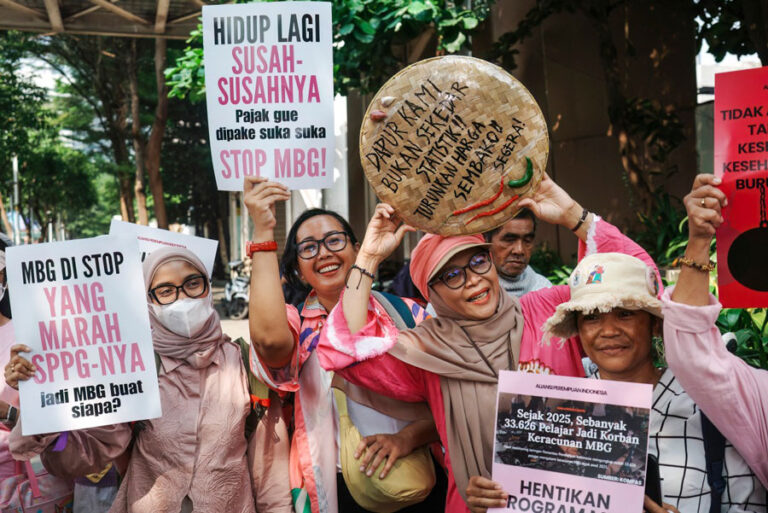
Similar calls have extended beyond beneficiaries. On Thursday, dozens of women and rights activists grouped under the Indonesian Women’s Alliance (API) staged a rally in Central Jakarta, urging the government to halt and review the program.
However, SPPG operators and other stakeholders have voiced concerns over the program’s future after a recent corruption scandal involving former BGN leaders led the agency’s new leadership to halt further expansion of the SPPG network, which currently stands at around 27,000 kitchens.
President Prabowo Subianto inspects the implementation of the free nutritious meals program at State Junior High School (SMPN) 111 Jakarta on June 2, 2026. (Courtesy of/The Palace’s Press Bureau (BPMI))
Last week, a group of investors reportedly visited the BGN office seeking clarity on the program’s future, saying they had invested hundreds of billions of rupiah in building SPPG and demanding assurances over the return of their investments should the facilities cease operations.
The concerns also come after several SPPGs reported temporary closures in early June due to delayed funding, although some have since reopened.
MBG Watch, an independent oversight platform established by civil society groups, said the mounting problems had further eroded public trust in the program.
“These issues have led parents and the public to ask: What is this multi-billion-dollar budget actually for and who does it benefit?” said Center of Economic and Law Studies (CELIOS) policy researcher Isnawati Hidayah, one of the initiators of MBG Watch, on Thursday.
The 2026 budget for the program was initially set at Rp 335 trillion (US$18.74 billion) before being trimmed to Rp 268 trillion as part of efficiency measures, following public scrutiny over the program’s hefty price tag and concerns about its implications for education funding.
Isnawati further said that beneficiaries’ perspectives should be central to any evaluation, as they are best placed to assess whether they need assistance and are the first to bear the consequences when problems arise.
A CELIOS study estimated that around 34 percent of current beneficiaries, around 61 million children and pregnant women, were not among the groups most in need of assistance, including households that were already economically secure or had adequate access to nutrition.
In response, the BGN has begun narrowing its beneficiary pool by removing recipients deemed capable of meeting their nutritional needs independently. As of Thursday, the agency had dropped 76 schools across Java from the program, affecting more than 39,000 beneficiaries.
“We are refocusing beneficiaries so the program can be delivered effectively to Indonesian citizens who truly need government intervention,” BGN deputy head and spokesperson Agustina Arumsari said during a televised briefing on Thursday.
The agency is also introducing austerity measures, including ending daily incentives for kitchens during non-operational periods and reviewing kitchens deemed to be underperforming.
