
Cambodia, Thailand Sit On Billions In Oil And Gas That’s Untouchable


In the Gulf of Thailand, diesel prices have climbed so high that fishermen are warning their boats may soon sit idle. The irony is hard to miss: beneath those same waters lies an estimated 12 trillion cubic feet of natural gas and 700 million barrels of oil. That reserve, worth roughly $300 billion, has sat undeveloped for a quarter-century—frozen by a border dispute that is escalating.

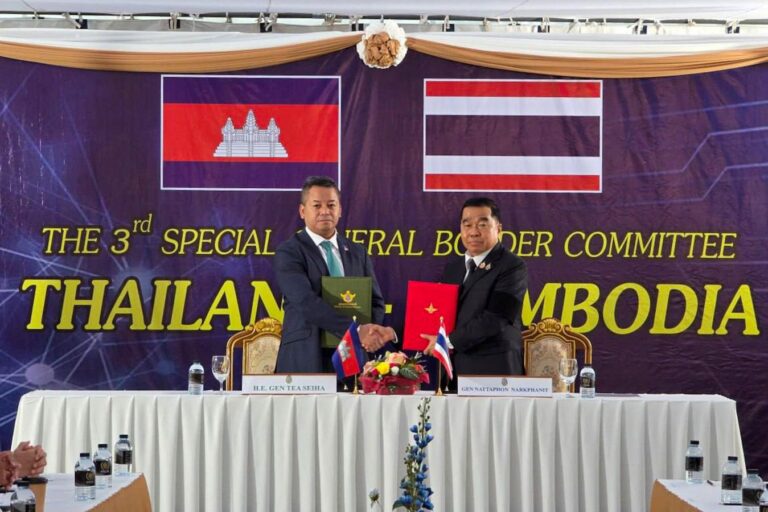
In May, Thailand’s government tore up the 2001 memorandum of understanding, the only working framework between Phnom Penh and Bangkok for settling their overlapping maritime claims. Cambodia responded by taking the matter to the United Nations, triggering a rarely used legal mechanism under the Law of the Sea treaty in hopes of forcing Thailand back to the table.

The theory driving Cambodia’s move is straightforward: the Strait of Hormuz crisis has revealed just how exposed Southeast Asia is to a single chokepoint thousands of miles away. Resolving a dispute—one that unlocks $300 billion in regional energy resources — should therefore be in both countries’ interest. Whether that logic actually moves Bangkok is an open question.

“Any potential discovery from this area would definitely provide economic and energy benefits to Thailand, Cambodia and the ASEAN region at large,” Cambodia’s Minister of Mines and Energy, Rottanak Keo, told me in an interview. “That is the reason why Cambodia has invested enormously for 25 years to try to resolve the issue peacefully with Thailand.”

The roots of the standoff go back to the early 1970s, when Thailand and Cambodia each unilaterally drew their own maritime boundaries through the Gulf of Thailand—and never agreed on where one ends and the other begins. The common space, known as the Overlapping Claims Area, covers roughly 26,000 square kilometers of sea, an area about the size of Moscow.

In 2001, the two countries agreed to a process, rather than a resolution. The MOU signed that June established a framework—built around a Joint Technical Committee—designed to simultaneously negotiate both the maritime boundary and a joint plan to develop the hydrocarbons underneath it. It produced neither. But it kept both governments talking through nine Thai governments and 14 Thai prime ministers and acting prime ministers, without a single shot fired over the maritime dispute itself.

Why Bangkok Walked Away

That changed this May, when Thai Prime Minister Anutin Charnvirakul’s cabinet withdrew from the 2001 MOU altogether—a move that followed a bloodier rupture on land. Armed clashes along the countries’ shared border in 2025 displaced nearly 650,000 civilians at the peak of the fighting, and as of June, roughly 36,000 Cambodians, including 12,000 children, remain in displacement camps.

Thailand’s withdrawal from the maritime MOU came amid a wave of nationalist sentiment tied to that border conflict, and Bangkok’s Senate has since recommended walking away from a separate land-border agreement as well.

With the bilateral framework gone, Cambodia notified the UN Secretary-General that it was initiating compulsory conciliation under the UN Convention on the Law of the Sea—only the second time in history that any country has invoked that mechanism. The first was Timor-Leste’s case against Australia in 2016, which culminated in a treaty two years later that resolved a similarly long-frozen undersea gas dispute. The countries’ conciliators will talk this month.

Cambodia is genuinely baffled by Thailand’s exit. “We are still trying to understand why they did it,” Keo says, noting that Phnom Penh repeatedly asked Thailand not to terminate the agreement.

Thailand’s public position, drawn from its own statements rather than from an interview for this story, points to a more calculated rationale. Bangkok has argued that 25 years and five rounds of formal talks under the 2001 MOU produced no real progress, and that the framework had simply outlived its usefulness.

More substantively, Thailand and Cambodia disagree on sequencing: Cambodia has pushed for immediate joint development, reportedly along the lines of a 50-50 revenue split. Meanwhile, Thailand said in June that talks should now focus on defining the maritime border—not on settling how the resources are shared.

There’s also a harder political reality underneath the legal argument. The cancellation of the MOU was a campaign promise of Anutin’s government, capitalizing on a nationalist mood hardened by the clashes over land borders. For Thai nationalists, any compromise on the maritime line looks like a concession to Phnom Penh at a moment when compromise is politically toxic.

“Thailand still stands by its principles, and there is nothing that puts the country at a disadvantage,” Thailand’s Prime Minister said in a speech, per Thai PBS World.

What If An Agreement Is Elusive?

The most likely alternative to a negotiated settlement isn’t conflict—it’s stagnation. According to concession data provided by Cambodia’s Ministry of Mines and Energy, the OCA is carved into four blocks: Areas I and II are held under a joint agreement between U.S.-based ConocoPhillips and Japan’s Idemitsu Kosan; Area III belongs to France’s TotalEnergies; and Area IV is held by the China National Offshore Oil Corporation, the Chinese state-owned major.

All four companies have largely sat on those rights since they were granted, awaiting a bilateral resolution before committing further capital. Minister Keo said the supermajors had privately urged him to push for a resolution. He sent along older news clips in which ConocoPhillips and TotalEnergies urged conciliation concerning the overlapping maritime claims in the Gulf of Thailand.

Cambodia, for its part, says it isn’t walking away from the table. “We are seeking peace; we are seeking shared prosperity,” Keo says, closing the interview. But he says the longer this drags on, the less incentive the oil majors have.

Companies are already allocating less capital to long-cycle offshore fossil fuel projects. Instead, they are eyeing deals tied to the energy transition. Meanwhile, the diplomatic fallout is showing up downstream: Thailand’s state-backed fuel retailer, PTT Oil and Retail Business, has disclosed a hit to 2026 earnings tied to scaled-back investment and the shuttering of stations in Cambodia.

Strip away the politics, and the case for resolution is, on its face, hard to argue against. More than 80% of ASEAN’s oil and gas imports come from outside the region, the bulk of it transiting the Strait of Hormuz—a prime chokepoint. Indeed, an International Energy Agency report identifies “major structural risks” across Southeast Asia’s energy sector, with Thailand singled out.

The economic case is compelling and should prompt a reconciliation. Whether it is enough to revive the talks is unclear. For now, the oil and gas stay exactly where they’ve been for 25 years: underwater, unclaimed, and unspent.

SEE ALSO:

Gulf Crisis Creates Green Lane For ASEAN Countries


Source link