
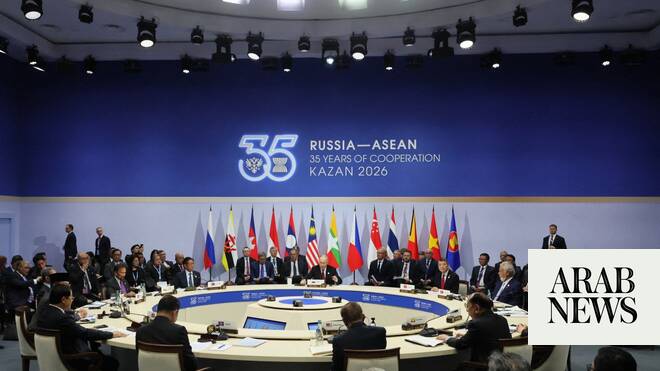
MANILA: The Association of Southeast Asian Nations and Russia have agreed to deepen energy cooperation, as the region works to secure supply amid the global crisis sparked by the US war on Iran.
Many Southeast Asian nations rely on the Middle East for crude oil imports, making them among the hardest hit by the energy supply crisis sparked by the closure of the Strait of Hormuz following the US and Israeli attacks on Iran that began on Feb. 28.
Russian President Vladimir Putin hosted Southeast Asian leaders in Kazan for the 11-member bloc’s first in-person summit with Russia in eight years on Wednesday and Thursday, as they marked 35 years of ties.
The summit concluded with several outcomes, including an agreement to “strengthen cooperation to secure and diversify energy supply, including through expanding trade, investment, and long-term commercial partnerships in oil, gas, liquefied natural gas, and electricity,” a joint statement read.
ASEAN and Russia expressed concern “over rising global energy insecurity driven by geopolitical tensions, supply chain disruptions, and market volatility,” and agreed to strengthen crisis preparedness, expand collaboration in energy transition, and work more closely in civilian nuclear cooperation.
ASEAN, which is chaired by the Philippines this year, has been coordinating closely as a bloc to cushion the growing economic and political toll of the US war on Iran.
The Middle East supplies around 60 percent of Southeast Asia’s crude oil imports, while almost half of the oil products refined or consumed in the region are derived from Middle East crude.
The disruption has led to supply shortages of liquefied petroleum gas used for cooking and fertilizers, while driving up prices of petrol in countries like the Philippines, which imports over 90 percent of its crude oil from the Gulf.
“Russia is ready to increase exports of high-value-added products to ASEAN countries, including fertilizer and medicinal products,” Putin said at a joint press conference with Philippine President Ferdinand Marcos Jr.
“Of course, we remain committed to supplying our Asian friends with food products and energy resources, which have been enjoying so much demand.”
ASEAN countries see Russia as an “important partner” to strengthen the region’s energy resilience, Indonesian Foreign Minister Sugiono said during the plenary session at the Kazan summit.
“We seek cooperation that diversifies our sources, strengthens our supply chains, and shields our region from external shocks,” he said.
For the emerging economies of Southeast Asia, Moscow “offers a new window on energy security,” said Prof. Chester Calabaza, founding president of the Manila-based International Development and Security Cooperation think tank.
“Crude oil (supplies) are significant chips to the booming industries of ASEAN, and the majority of countries in the region are practicing advanced hedging strategies with great powers,” he told Arab News.
“The recent Iran war, despite a temporary peace deal, even made Russian energy more palatable to the region. This drives the new currency of ASEAN ties to Moscow that even Beijing and Washington could not prevent their allies in the region to swarm under Moscow’s lucrative energy offers.”
