
A Cyclone Killed 7% of the World’s Rarest Great Ape


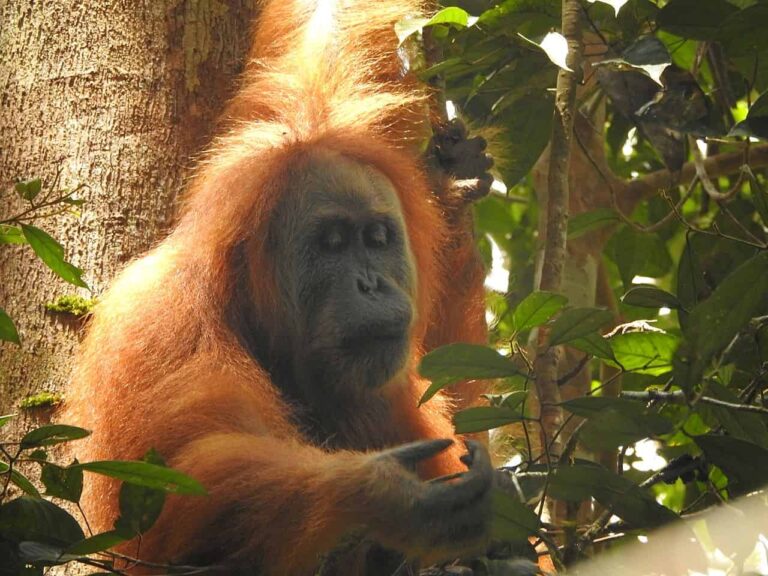
Tapanuli orangutan, Pongo tapanuliensis. Credit: Wikimedia Commons

A powerful storm tore through Sumatra, and the world’s rarest great ape lost a shocking share of its remaining population.

Cyclone Senyar, which struck Indonesia in late November 2025, triggered floods and landslides that killed an estimated 58 Tapanuli orangutans, according to a new study. With fewer than 800 of the apes left in the wild, the disaster wiped out about 7% of the species and showed how climate-fueled extreme weather can deepen a crisis already driven by habitat loss.

A Sudden Blow

Tapanuli orangutans live only in a small part of North Sumatra. Their main stronghold is the West Block of the Batang Toru ecosystem, a forest already squeezed by roads, farming, mining, palm oil plantations, and hydropower development.

To measure the cyclone’s toll, researchers studied satellite images of landslides, which showed exposed patches of rock, mud, and debris where forest had collapsed. They then compared those damaged areas with estimates of orangutan density.

The analysis found that landslides destroyed about 8,300 hectares (more than 20,000 acres) of key habitat. That amounted to nearly 12% of forest cover in the area.

The researchers estimated that 58 orangutans died. That equals about 11% of the local population and 7% of all Tapanuli orangutans on Earth.

“It is tragic to lose so many apes in this way,” Prof. Serge Wich, a primatologist at Liverpool John Moores University and a study co-author, told The Guardian. “In landscapes where populations are small and fragmented, this type of weather or climate event can have population-level consequences. It is extremely worrying for the future of this ape.”

The number may actually be conservative. The study did not fully include damage to the forest canopy, loss of food, or later effects on breeding.

“It could well be that up to 120 animals died during the landslide events,” said Erik Meijaard, the study’s lead author and managing director of Borneo Futures in Brunei, according to CNN.

When the Hillside Fell

Cyclone Senyar drenched northern Sumatra with extreme rain. Rainfall totals varied sharply, with one station recording 1,003 millimeters, or about 39 inches, between Nov. 23 and 28, while the affected West Block of the Batang Toru ecosystem received about 564 millimeters over the same period, according to the study.

The downpour soaked steep slopes until sections of forest broke loose. The Tapanuli orangutans, which spend most of their lives in the canopy, didn’t stand a change against the deluge of broken trees, hard mud, and rock sliding downhill together.

In Pulo Pakkat village, weeks after the cyclone, a humanitarian worker named Deckey Chandra found what he believed was a Tapanuli orangutan carcass half-buried in mud and logs.

“I have seen several dead bodies of humans in the past few days but this was the first dead wildlife,” Chandra said in an interview with the BBC. “They used to come to this place to eat fruits. But now it seems to have become their graveyard.”

Researchers later reviewed photos of the animal, and found signs of violent death.

Little Room for Loss

Young orangutan sitting on a tree branch among green leaves in the jungle.Young orangutan sitting on a tree branch among green leaves in the jungle.
Credit: Wikimedia Commons

Tapanuli orangutans reproduce slowly. Females usually give birth only every six to nine years, so the population cannot quickly replace adults killed in a disaster.

Previous research has suggested that annual losses above 1% could eventually lead to extinction. Cyclone Senyar appears to have caused roughly seven times that loss in one event.

The species was identified only in 2017. Its population is small, scattered and trapped in shrinking forest. That fragmentation makes every shock more dangerous. In a connected forest, survivors might move and recover. In a broken habitat, deaths can isolate groups and weaken future breeding.

The disaster also killed at least 1,200 people and damaged around 300,000 homes across Sumatra, according to Reuters.

Recovery Requirements

The storm has turned a long-running conservation dispute into a more urgent test: whether Indonesia can keep the Batang Toru forest intact before another shock arrives.

For now, the government has paused major industrial activity in the area, including mining, oil palm, and hydropower expansion. That pause gives scientists a chance to map the damage, assess which groups of orangutans survived, and identify the forest corridors they still need to breed.

But a pause is not a recovery plan. The study’s authors argue that Batang Toru needs permanent protection, not another round of short-term safeguards that end once public attention fades. The remaining habitat is already too small and too fragmented for a species that loses ground slowly and replaces lost adults even more slowly.

“The loss of an estimated 58 Tapanuli orangutans to a single climate-induced landslide event is a devastating demographic shock to the world’s rarest great ape,” Prof. Jatna Supriatna, a conservation biologist at Universitas Indonesia, told The Guardian.

“To prevent the first modern extinction of a great ape species, Indonesia must permanently protect the Batang Toru ecosystem, but our international partners must also meet their global commitments by providing immediate biodiversity-recovery financing.”

That is the narrow path left. Researchers say the surviving orangutans need three things at once: no further clearing, restored links between forest fragments, and conservation plans that account for heavier rain and landslides in a warming climate.

The cyclone did not create the Tapanuli orangutan’s crisis. It exposed how little room the species has left. Without stronger protection, another extreme storm could push the surviving orangutans past the point of recovery.

The study was published in the journal Current Biology.


Source link