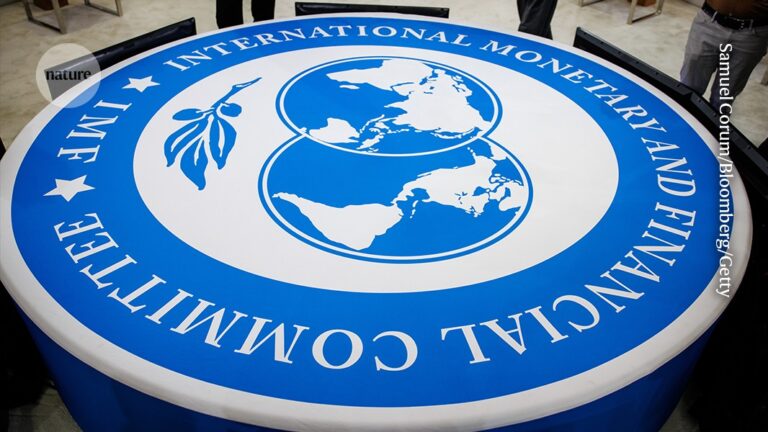
The authors of the Global Justice Report are calling for a UN-run central bank to replace the International Monetary Fund.Credit: Samuel Corum/Bloomberg/Getty
Ambitious. Utopian. Wacky. These are among the responses to the publication last month of the Global Justice Report by economist Lucas Chancel at the Paris-based World Inequality Lab and his 44 co-authors. The report, which is based on modelling studies, proposes ideas for how to create greater global equality and economic prosperity while remaining within planetary boundaries (see go.nature.com/4whtuzw).
How to end poverty and protect Earth: inside the debate tearing up economics
Such a task is urgent. Since 2020, poverty reduction around the world has either slowed down or is in reverse, whereas wealth inequality is expanding. At the same time, most planetary boundaries, such as climate regulation, species abundance and the availability of fresh water, have overshot what researchers say are ‘safe and just’ limits1,2.
But finding a way for people in all countries to access the most basic needs — quality education, meaningful work and affordable health care — has so far eluded all those who have tried, as the latest United Nations Sustainable Development Goals report attests (see go.nature.com/4pjrwtk). The challenge of achieving these within the bounds of Earth-system processes makes the task yet more difficult.
The science of inequality
Unsurprisingly, then, the Global Justice Report has a radical prescription: a planetary scale redistribution of wealth and income by increasing taxation on a global level, mainly affecting those with fortunes of hundreds of millions of dollars. The taxes would be collected by a new body, called the Global Justice Fund, which would redistribute the money to invest in climate, education, health and other causes through country dividends allocated on an equal per-capita basis. Investment returns from a further body, the World Sovereign Fund, would pay for the dividends. The authors also propose a new international reserve currency and a UN-run central bank to replace the International Monetary Fund in Washington DC.
If the recommendations were followed, the report estimates that, by 2100, per-capita income for all people across the world could be €5,000 (US$5,700) a month, with fewer hours being worked than today and with global warming held at 1.8 °C above pre-industrial levels. The authors say all of this can be achieved if there’s political will, but they rightly anticipate opposition, in particular from some of the wealthiest companies and countries. Indeed, their models suggest that their prescription could still achieve close to its desired result if the United States did not participate.
Why the world cannot afford the rich
The absence of a political road map to implementing these findings is one reason why this work has attracted the ire of some researchers. Also at issue is that the study directly challenges some conventions in the practice of economics, such as the idea that prosperity comes from economic growth measured by gross domestic product and that some degree of inequality is necessary to achieve growth.
The report is timely in asking some of the same questions being considered by many policymakers, especially in low- and middle-income countries. Taken as a group (but excluding China), those nations will collectively need to raise upwards of $1 trillion annually by 2030 to reduce their greenhouse-gas emissions, adapt to extreme weather and fund the costs of the losses and damages that many are already experiencing from global warming. So far, they have struggled to obtain even a fraction of the funds that were promised for this purpose by countries with historically much higher carbon emissions.
Reducing inequality benefits everyone — so why isn’t it happening?
Moreover, the Global Justice Report comes at a time when many countries are becoming concerned about inequality and looking to researchers for answers. Between 2000 and 2024, the richest 1% of people captured 41% of all new wealth created in the world, according to a report on the state of knowledge on inequality that was published last year under South Africa’s presidency of the G20 group of the world’s 20 largest economies (see go.nature.com/4wrehdz).
Mindful of the disagreements among researchers, the G20 report’s authors, led by economist and Nobel laureate Joseph Stiglitz, recommended the creation of an international panel on inequality similar to the Intergovernmental Panel on Climate Change (IPCC). When the IPCC was established in 1988, there was no consensus that humans had an influence on global warming. The effect of human-induced climate change was recognized from 19953, and later strengthened after thousands of researchers collaborated through the IPCC report process to assess the literature.
Inequality is bad — but that doesn’t mean the rich are
The inequality panel is expected to get the green light from the UN in September. Imraan Valodia, an economist at the University of the Witwatersrand in Johannesburg, South Africa, who is on the panel’s founding committee, says members will work on the causes and consequences of inequality, among other things. The founders want researchers representing diverse backgrounds to participate in the panel’s activities. Disagreement in research is healthy and often necessary. But with so much at stake, and with little time to lose, policymakers are asking the research community for the best available shared understanding.
The authors of the Global Justice Report could readily plead guilty to utopianism (or idealism), safe in the knowledge that they have made a significant contribution to an important debate. All those who have relevant knowledge need to engage with the work of the inequality panel and help to guide its conclusions. The alternative — sitting still amid mounting social, economic and environmental problems — is not an option, not least because it will be an injustice to future generations.