
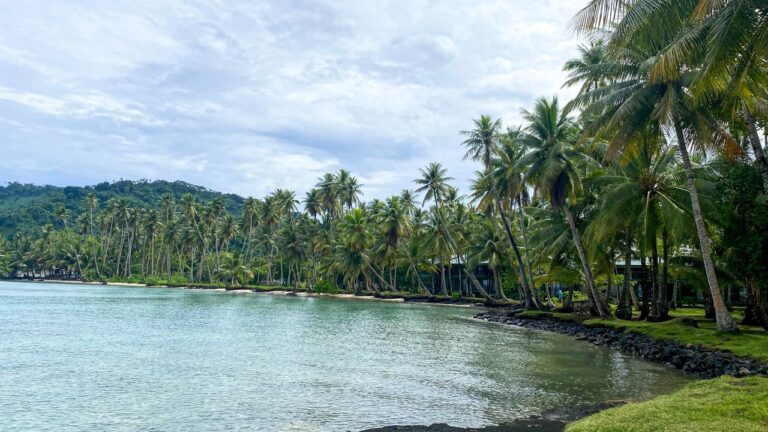
JICA has a long history of dispatching specialists to Micronesia. The educational, health-related, and other assistance they provide is more important than ever at a time when US foreign aid is being pulled back. A look at three Japanese volunteers on the ground in this island nation.
The Sound of Japanese in Chuuk’s Classrooms
Whenever Hatayama Takashi wants to get a haircut or to pick up something from the store, it is a major undertaking. He must hike about 9 kilometers along deeply rutted roads that skirt the edge of the lagoon until he reaches the largest town on the island of Chuuk. And then, after completing his transactions, he has to walk back to the school where he lives and works.
But 64-year-old Hatayama insists that the opportunity to teach the children who are the future of this remote Pacific atoll—one that has a long history with Japan—make his minor hardships more than bearable.
Originally from Aomori Prefecture, Hatayama is a Japanese language teacher at Xavier High School, which sits on a jungle-covered hilltop in the far northeast of Weno, the largest island in Chuuk, one of the four island groups that make up the Federated States of Micronesia.
And he is one of three Japan International Cooperation Agency volunteers helping to educate and improve the health of the people of Chuuk, along with 18 other volunteers across this scattered nation and 4 Japanese staff members at JICA’s country headquarters in Pohnpei, some 700 kilometers to the east.
Hatayama arrived in Chuuk in December 2024 after an extensive career in teaching, including at a high school in Osaka and two high schools in Jakarta.
“I wanted to live overseas and see other countries, and I also thought that it would be good if my experience could help other people, so I joined the JICA Volunteer program,” Hatayama tells Nippon.com.
Xavier High School is widely regarded as one of the best in Micronesia and attracts students from across the country and further afield, including Palau, the Philippines, Fiji, and Hawaii. It is in a renovated building that was formerly a military communications center built when the island was under Japanese military control in the 1930s.
“Students at Xavier High School live with hope for their future,” says Hatayama. “They have many dreams. For example, they want to earn riches, become lawyers, or work in the entertainment industry.
“What impresses me most is that many students do not only want success for themselves; they strongly want to succeed in order to make their families happy.”

Xavier High School students display their origami creations. (© Julian Ryall)
As well as instructing his young charges in the language, customs, and culture of Japan, Hatayama sees himself and the other JICA volunteers as unofficial ambassadors of their nation.
“The activities of JICA and volunteers like us help to make friends in other countries,” he says. “We also try to help people trust Japanese people. Through this, trust can grow between Japan and other countries, and peaceful relationships can be created. I hope this trust and peace will spread around the world through this form of grassroots diplomacy.”
Hatayama’s time in Chuuk is due to come to an end in January 2027, and he hopes he has helped to shape his students’ futures.
“My happiest memories are, of course, the smiles of my students and the days I spent with them,” he says. “These include teaching classes and playing softball together on the field. These memories are very precious to me.”
Enhancing Healthcare with Japan’s Help
Nonaka Toshikazu oversaw JICA’s grant aid programs and technical cooperation projects across Micronesia from 2022 until his departure from the Pohnpei office at the end of March 2026. He says his personal view is that there is a long and close history between Japan and the people of Chuuk, which was a Japanese territory from 1914 to 1945, pointing out that there are still many Japanese family names on the islands.
“It is not only the Mori and Hashiguchi families,” he says, noting two common names in the country. “Many others have Japanese relatives, and I see many examples of Japan influences in their language, food and culture. I believe we share a special bond, and I believe they view us favorably.”
Also a former teacher, in his home prefecture of Ehime and with JICA in Zambia, Nonaka says the organization has worked closely with Chuuk authorities on a number of key projects, including the extension in 2002 of Weno Harbor after it sustained extensive damage in a series of typhoons and the training of locals in sustainable solid waste management projects.
The government agency that oversees the majority of Japan’s official development assistance, JICA began cooperation with the Micronesian government in 1979 by inviting technical trainees to Japan to study fisheries. To date, 480 JICA volunteers have been involved in projects across the country with the aim of improving “human security and quality growth.”
One of the projects to which Nonaka has been most committed is the development of a health education system across Chuuk.
“This project focuses on public health, particularly maternal and child health, through outreach to remote islands,” he explains. “As a pilot project, we are procuring portable ultrasound machines from Japan and deploying them on remote islands. We’re creating an environment where we can collect data through perinatal checkups for mothers.
“Rather than requiring high-performance ultrasounds, we are procuring them at an affordable price that can be incorporated into the state government budget, while still providing minimal functionality and taking into account the islands’ unique repair environment.”
Training the Local Teachers of Tomorrow
Koike Tsukasa has been deployed to use his professional skills at the state government’s Department of Education, where he is training mathematics teachers from local elementary schools across the archipelago.
Originally from the city of Niigata, the 67-year-old Koike arrived in Chuuk in August 2024 and says his ambitions are quite straightforward: “My goal is to improve the math abilities of students across Chuuk state by working with their teachers to improve their abilities.”

Koike Tsukasa at the Chuuk State Department of Education headquarters. (© Julian Ryall)
Koike conducts workshop sessions with teachers from some of the most remote outer islands, assisting 686 teachers at 60 public elementary schools. Part of his task is to equip children with the skills they need to find well-paying employment, for which they often have to go abroad, to Guam, Hawaii, or the mainland United States.
“In the time I’ve spent here, the people have been very kind and friendly,” he says. “And when I have to leave later this year, I think the best memories that I will take with me were when teachers who attended my workshops say they have learned something new and they want to join another one. That sort of response makes me very happy.”
(Originally written in English. Banner photo: An idyllic tropical scene on Chuuk, where Japanese specialists are helping in fields from education to public health. © Julian Ryall.)

