
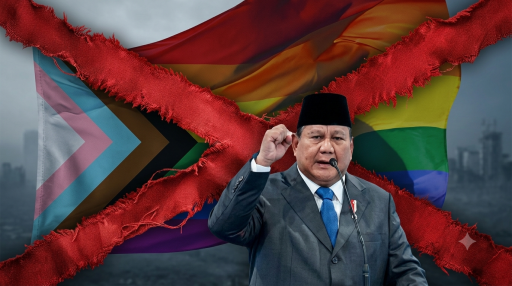
Prabowo classifies LGBTQ as nonmilitary threat in new defense policy


Presidential regulation places LGBTQ alongside terrorism and separatism, drawing criticism from rights advocates and legal experts.

President Prabowo Subianto has designated the spread of LGBTQ culture as a nonmilitary threat under Indonesia’s 2025–2029 National Defense Policy, as stipulated in Presidential Regulation (Perpres) No. 111 of 2025.

The regulation defines nonmilitary threats as organized, non-armed activities that could endanger national sovereignty, territorial integrity and security. It classifies the spread of LGBTQ culture as a socio-cultural threat that could contribute to the erosion of nationalism.

The category is grouped alongside terrorism, separatism, online gambling, the spread of prohibited ideologies, human trafficking, piracy, large-scale theft of natural resources and narcotics trafficking. The regulation also states that LGBTQ-related issues will be addressed using approaches applied to extraordinary crimes.

Rights advocates question policy

LGBTQ rights activist Echa Waode, secretary-general of Arus Pelangi, criticized the regulation, arguing that it could intensify stigma and discrimination against sexual and gender minorities.

“It shifts public anger that should be directed vertically, toward the state, into horizontal conflict,” Echa said.

She warned the policy could increase bullying and persecution, particularly against transgender people, and urged the government to uphold the rights of all citizens regardless of gender identity or sexual orientation.

Legal basis questioned

Separately, Joeni Arianto Kurniawan, a law lecturer at Airlangga University, said the regulation marks the first national-level policy to explicitly identify LGBTQ as a national defense threat.

He argued the provision lacks a sufficient legal basis because Law No. 3 of 2002 on State Defense does not authorize such restrictions through a presidential regulation.

“Norms that restrict citizens’ rights may only be regulated through legislation, not through a presidential regulation,” he said.

Joeni also warned the regulation could be misused to justify intimidation and discrimination against LGBTQ individuals, noting that Indonesian law does not explicitly prohibit people from identifying as LGBTQ.


Source link