Woody Brown discusses his debut novel and the challenges those with nonspeaking autism face today.
:quality(75)/https%3A%2F%2Fassets.lareviewofbooks.org%2Fuploads%2FUpward%20Bound.jpg)
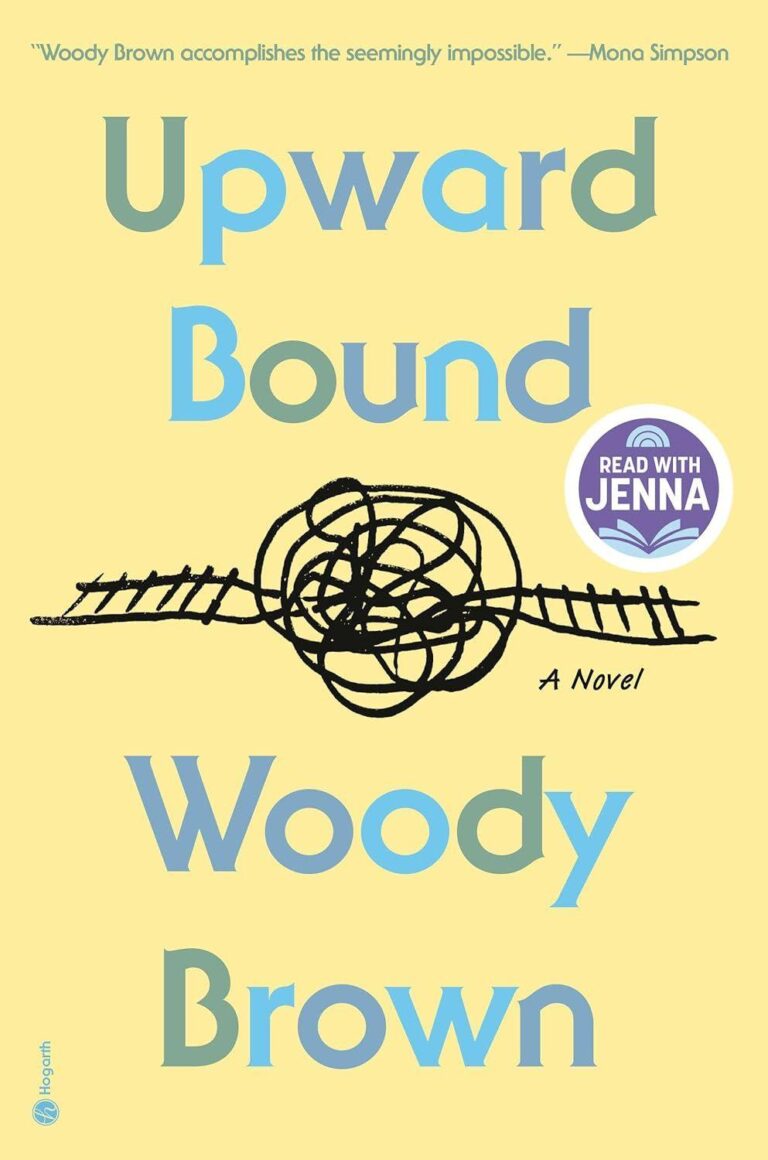
Upward Bound by Woody Brown. Hogarth, 2026. 208 pages.
Did you know LARB is a reader-supported nonprofit?
LARB publishes daily without a paywall as part of our mission to make rigorous, incisive, and engaging writing on every aspect of literature, culture, and the arts freely accessible to the public. Help us continue this work with your tax-deductible donation today!
UPWARD BOUND (2026) is a kaleidoscopic novel that illuminates the lives of various characters inside the titular daycare facility for disabled adults. The author, Woody Brown, is the first person with nonspeaking autism to graduate from Columbia University’s MFA program and to publish a work of fiction with a Big Five press. Because of its unique nature, Upward Bound has attracted significant media attention—and, in some corners, controversy from those who cannot seem to accept that an individual who manifests so many autistic traits can write so beautifully.
Woody and I first met two years ago, toward the end of his time at Columbia, where both of my parents teach. I reached out after seeing a news clip detailing Woody’s undergraduate experience at UCLA because I, too, am a nonspeaker who types to communicate. We developed an instant rapport based on our shared experience of inhabiting a world that often ignores or dismisses those of us with nonspeaking autism.
This interview took place over email because it would be physically impossible for us to talk to one another in person. Each of us typed out our comments using a letterboard—a simple piece of technology that consists of the alphabet printed on a laminated piece of cardboard. Our communication partners then entered our correspondence into the computer for us. All the words that you see below, however, are entirely our own.
It is not typical for contributors to LARB to feel the need to assert that they are, in fact, the authors of their own work. But such is the controversy surrounding the legitimacy of communication by those of us with nonspeaking autism that we feel compelled to take this extraordinary step. The assumption on the part of a few seems to be that people like Woody and me are incapable of learning how to type to communicate and that we are mere ventriloquists’ dummies manipulated by others. Neither of us believes we should have to prove that we are doing the typing—our words are our proof. But for those who need more evidence, consider the articles in scientific journals that demonstrate the legitimacy of typing for nonspeakers with autism. A 2020 study showed that typers track with their eyes when they point to the letterboard, demonstrating that it is they—and not the person holding the board—who control the process. An article that appeared earlier this year in Autism Research concluded that typing possessed “the potential to result in greater access to effective communication and better quality of life for more nonspeaking autistic people.”
The techniques referenced in these studies are distinct from facilitated communication, a process in which the communication partner touches the speller, potentially influencing their results. Our critics rarely pick up on such nuances and instead lump together typing and facilitated communication in ways that are decidedly unhelpful. It is also more than a little frustrating to Woody and me that so much of the discussion about our work focuses on the narrow question of authorship. The larger issue, which has become obscured in the debate over the use of typing by nonspeakers, is that communication ought to be viewed as a fundamental human right. Those who call our typing into question have the unintended effect of silencing the tiny percentage of nonspeakers who have managed to break out of their silent cages and communicate their hopes and dreams to the world.
Woody and I encourage you to visit the Communication 4 ALL website to learn more about typing as a mode of communication for individuals with nonspeaking autism.
¤
JASON JACOBY LEE: We autistics are everywhere nowadays in popular culture, so much so that we have almost become a stock character: the quirky loner, almost always male, who is incapable of picking up on social cues. To what extent did you feel the presence of this stereotype as you were writing your novel Upward Bound?
WOODY BROWN: May I say that I never consider stereotypes when I write because that would mean I was being as shallow and clichéd as a sitcom. My job as a literary writer is to depict characters with complexity and nuance. Autistic characters are just as complex as neurotypical ones, perhaps even more so because of the challenges they face. I hope that neurotypical readers grasp this in my book because I want them to see that we are more alike than different from each other.
I feel as if I am constantly confronting stereotypes about autism in my own writing. Many people have celebrated you as the first nonspeaker with autism to publish a novel. Viewed from this perspective, your career is unprecedented. But surely you must have drawn on other writers for inspiration. Who are some of your favorite writers and why?
I am lucky that I learned to type when I was a small child, so I grew up with a few people who believed in my intelligence, even if some doubted it. You learned later in life, meaning that you had many more years of frustration and isolation. Maybe the haters make me mad, but they don’t change me or my abilities. Haruki Murakami has inspired me greatly. He also writes in a unique voice, although no one has had the gall to question his authorship. I have been knocking down barriers since I was very young, and I guess I have to keep doing it. Hopefully the naysaying will have died down by the time you have published your debut book.
In Upward Bound, the character of Walter is, I am assuming, loosely based on you. One of the most poignant features of Walter’s life is the absence of his father. Yet in reality, your father is very much alive. I know that your novel is distinct from your lived experience, but I was curious why you made this particular narrative choice.
My book is fiction, and fiction requires plot points that instigate the conflicts of a story. Think about Bambi or Finding Nemo. If one of their parents hadn’t perished, the movies would be void of adventure. Walter’s parents didn’t want him to go to Upward Bound, so a cataclysm was required to impel him to go. Walter needed Mom to type, so Dad had to die.
Fiction contains many tragedies that the heart cannot withstand in reality. In real life, I would be bereft if my father was no more. My dad wasn’t too pleased to be killed off, I can tell you that. Fiction has needs, and so does Dad.
Your poor father. At least he only vanished from your novel, not from your life. One other prominent feature of Upward Bound is the use of multiple perspectives. Why did you select this approach rather than a more unified narrative told in a singular voice?
Walter is my alter ego, but he would have had no way of seeing into the minds, hearts, and backstories of the other characters. Each person at Upward Bound has a different reason for being there, and they all deserve to have their stories told. I also enjoyed seeing the same moment or event from different perspectives, in a Rashomon-like way. Avery’s experience at Target is vastly different from Tom’s or Ann’s. It gave me the chance to write both disabled perspectives and nondisabled ones. My next novel has a single narrator.
There is a violent encounter with the police at the heart of Upward Bound, something far too common for those of us who are disabled. Several times, police have intervened when I have been out in public with my parents and have had a meltdown. Have you had any similar encounters? And why did you decide to make this such a key element of your novel?
I am so sorry that you have had negative encounters with law enforcement. I haven’t experienced it personally to that degree, but I have had security guards harangue me for looking weird in the wrong places. The incident in the book came from a newspaper article from several years ago. The idea that disabled people are highly vulnerable to dangerous encounters with police is probably a surprise to many in the public. Who would draw a gun on a disabled person? But when law enforcement doesn’t understand the nature of your disability, there can be dire consequences. That climactic event in my book was basically the instigation for the novel. I wondered if such a thing could ever happen to me, and I fear that it could.
One of the most salient features of our disability is that we often find ourselves thrust into being the first in any given situation. In your case, you were the first person with nonspeaking autism to graduate from Columbia’s MFA program. What did you feel that you learned there? How was it to be in a program with people who had likely never encountered someone like you before?
When you say that we nonspeakers are the first through the door in a given situation, you mean that a nonspeaker has busted down a door that was previously shut against us. I was a first at UCLA, I was a first at Columbia, and now I’m the first nonspeaking novelist to debut on The New York Times Best Seller list. It’s not easy or comfortable to be a trailblazer, if that’s what I am. School was challenging because people were confounded by me, but my work spoke for itself, and eventually there was some acceptance. The public world of publishing is a mixed bag. Many love my debut novel, but some unfortunate souls are convinced that I couldn’t have written it, that I am a puppet for the actual author, who is supposedly my mother. No one at Columbia questioned my authorship, but then they saw my typing up close and in person. Strangers smear me, which is offensive and ableist. I hope that being the first to be thus wrongly accused will make things easier for the nonspeaking writers who come after me. Like you, Jason.
The outside world is so unused to people with nonspeaking autism that they have trouble understanding how we communicate, even when we do so right in front of them. I recently did a presentation with our friend Elizabeth Bonker at Teachers College for practitioners of special education, and I was struck by how unfamiliar they were with typing as a modality of communication for nonspeakers. We have a lot of work to do in the years to come. Speaking of the future, what are you hoping it holds for you, both personally and professionally?
I’m looking forward to writing my books and having people read them. I hope that doubts about my typing fade into dust that clears to show the bright light of my work. I hope that many nonspeakers find their way to a method of communication that feels good to them. I wouldn’t mind a girlfriend, but I never want to lose the precious friendships that I enjoy, like ours.
I, too, treasure our friendship a great deal. I feel lucky that we found one another and have managed to stay in touch after you graduated from Columbia. Of course, one of the most painful stereotypes that so-called autism experts have promulgated is that we nonspeakers are “mind blind” and incapable of forming real relationships. I like to think that with so many of us learning to type, we are forcing such misconceptions to change. Do you have any feeling that the paradigms surrounding autism may be shifting because of your work?
I would love to imagine that compassionate readers will take something from my book and be less hasty in judging us on our appearance and behavioral differences. I think it’s a broader movement than just me and my debut novel. Every typer who makes it to college or speaks truth to power or enlightens their community is adding another piece to our bridge from social isolation to belonging. Change may be gradual, but I’m pleased to be a small part of it. Let’s continue building this bridge with our powerful words.
:quality(75)/https%3A%2F%2Fassets.lareviewofbooks.org%2Fuploads%2FJason%20Jacoby%20Lee%20with%20Woody%20Brown.jpg)
Jason Jacoby Lee (left) and Woody Brown. Courtesy of Jason Jacoby Lee.
¤
Woody Brown is a graduate of UCLA and Columbia University’s MFA program. He lives in Los Angeles.
LARB Contributor
Jason Jacoby Lee’s work has been published in The Nation and the San Francisco Chronicle. He attends Passaic County Community College.
Share
LARB Staff Recommendations
-
Carol Roh Spaulding reviews Marie Myung-Ok Lee’s “Hurt You.”
-
Travis Chi Wing Lau discusses two recent books on autism and literary studies.