
Buduk is a picturesque, typical Bali village filled with homes, a traditional temple, a row of tourist villas and fields of rice paddies.
Located just north of Canggu, it has become increasingly popular with visitors looking to avoid the island’s crowded hotspots.
But rising from the middle of the village is a massive mound of rubbish.
The mound of rubbish suddenly appeared a few months ago. (ABC News: Tim Swanston)
The abundance of waste snakes back tens of metres and features torn garbage bags, a mess of food scraps, plastic bottles and dumped household items.
And underneath the pile is even more waste that has been covered by dirt and soil.
The pile of rubbish snakes back tens of metres in Buduk. (ABC News: Tim Swanston)
Locals told the ABC they had been dumping trash at the site for months, despite it not being designated an official, permanent landfill area.
They said they had paid a small monthly fee to the village to do so.
But when the ABC sent the local regency questions about the dumping site last week, officials quickly directed the area to be cleared of rubbish.
The waste was set to be taken to the island’s main landfill, Suwung.
Loading…
The Buduk saga is a symptom of what many describe as an unfolding waste crisis on the Island of the Gods.
Bali wants to handle its waste more sustainably, but right now it is caught in a period of upheaval and transition.
The closure of Bali’s trash mountain
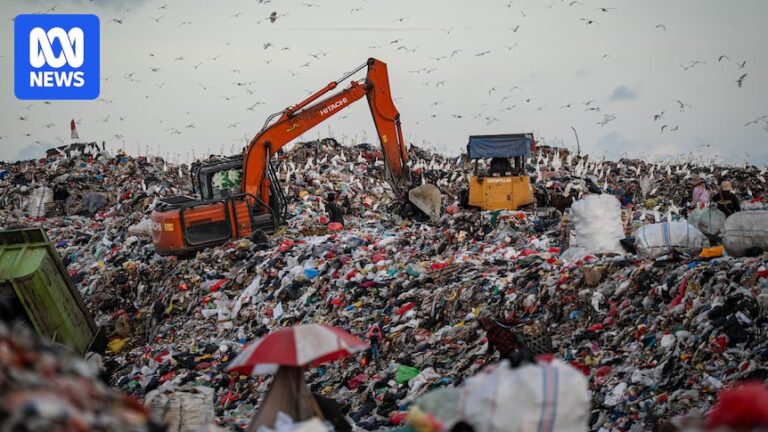
In Bali’s south-east lies the sprawling Suwung landfill, a monument to consumption on the tourist haven.
Bali’s Suwung landfill is massive. (ABC News: Tim Swanston)
Suwung is up to 10 storeys high, taking in trash from Bali’s two largest regencies: the tourist heavy Badung, which includes Kuta and Canggu, and the city of Denpasar.
Officials have wanted to shut Suwung for years, in keeping with a push by Indonesia’s central government to end open-air dumping, but they repeatedly pushed back the deadline for its closure.
The site is an environmental headache, producing large amounts of methane and leaching contaminated liquid into nearby waterways.
It also once caught fire for more than 20 days, sending large plumes of smoke into the air.
In April, the news came that Bali’s provincial government would finally close it to organic waste.
Residents and regencies were encouraged to manage waste themselves.
The Suwung landfill produces large amounts of methane. (ABC News: Ari Wu)
Organic waste has largely been barred from Suwung. (ABC News: Tim Swanston)
Bali’s landfill restrictions are causing rubbish to pile up on the island. (ABC News: Tim Swanston)
Urban biologist Buya Azmedia Istiqlal said what followed was chaos.
“The current condition is a crisis,” he told the ABC.
“People are burning trash, waste is left on the side of the road, waste is thrown into rivers, behind ravines.
“All kinds of things, and that is certainly not good for the environment in Bali.”
Residents burning trash, setting off ‘unpleasant fumes’
In June, Bali’s provincial government partially backflipped on the closure, re-opening Suwung to organic waste for two days of the week.
But that has done little to stop the chaos.
Gary Bencheghib, co-founder of environmental NGO Sungai Watch, said his teams had found more rubbish around the island as a result of the confusion created by the landfill’s closure.
Gary Bencheghib is one of the co-founders of Sungai Watch, a prominent environmental organisation and non-profit in Bali. (ABC News: Tim Swanston)
“Bali is going through an unprecedented time,” he said.
“There’s a lot of questions as to where residents can dump their waste. A lot of people really don’t know what to do.”
Anecdotally, Mr Bencheghib and Buya Azmedia Istiqlal said they had noticed more people also burning their waste.
Residents have reported smelling “unpleasant fumes” as a result of rubbish being set on fire on the island. (ABC News: Tim Swanston)
“So many residents around the island have been sending us messages for help, saying ‘I want you to come and clean up these dumps,'” Mr Bencheghib said.
“But people have been burning nonstop … people have been complaining about the smells.
“When you’re driving around on your motorbike, you’re experiencing really unpleasant fumes.”
The trash mound in Buduk village was not the only massive pile of rubbish the ABC found while in Bali.
In the south of Denpasar, Bali’s main city, a massive pile of rubbish sat near the city’s reservoir, having been dredged out of the river.
Bali faces environmental challenges linked to growing tourism and a rising population. (ABC News: Tim Swanston)
Denpasar is just one area in Bali experiencing issues with waste. (ABC News: Tim Swanston)
Bali needs to reduce the amount of rubbish it creates. (ABC News: Tim Swanston)
A local council worker told the ABC that it was a week’s worth of rubbish, about to be moved to the nearby landfill.
Denpasar City’s environment department head Ida Bagus Putra Wirabawa told the ABC that while violations of illegal waste dumping did still occur, “from day to day they are declining”.
“We in the Denpasar City Government actively conduct supervision,” he said.
“[We] conduct surprise inspections at places where waste violations frequently occur, and have installed CCTV to remind the community not to repeat illegal waste dumping.”
Introduction of plastic changed everything
At the heart of Bali’s waste problem are traditional practices and waste management systems that have not kept pace with the island’s growth.
An Indonesian man attempts to clear a pile of rubbish in Bali’s Denpasar. (ABC News: Tim Swanston)
Foreign visitors to Bali have almost tripled in the past 15 years, with almost 7 million foreign tourists visiting the island last year. More than 1.5 million of them were Australian.
Bali also received 9 million domestic tourists, with tourists generally creating far more waste than the average resident.
About 3,500 tonnes of waste is being created on the island every day, with about 65 per cent of that organic waste and 15 per cent plastic.
Mr Bencheghib said in the past, many residents were used to consuming products that were inherently biodegradable.
“Back in the 70s, 80s, everything was organic [and] the throwing away mindset was so normal for people, everything was wrapped in banana leaves,” he said.
“You would dump it in the back of your house and it would degrade organically.”
But since the introduction of plastic, which is used to package groceries and many household items, Mr Bencheghib said there had been a big awareness gap.
“People weren’t told about the bad effects of plastic pollution,” he said.
Bali is commonly referred to as the Island of the Gods, but recently it has been known by another name, “Island of Trash”, according to Mr Bencheghib.
“[That is] … largely due to the plastic waves that wash up on Bali every rainy season,” he said.
In February, Indonesia’s President Prabowo Subianto said foreign leaders had complained to him about Bali being dirty.
“They said, ‘Your excellency, I just came from Bali. Oh it’s so dirty now, Bali is not nice,'” Mr Prabowo said in a speech before thousands of Indonesian regional leaders.
His comments kicked off a major clean-up drive in tourist areas of the island, including Bali’s beaches.
A group of volunteers clean up a river filled with rubbish in Bali. (ABC News: Tim Swanston)
A rubbish barrier set up in a river in Bali’s Denpasar. (ABC News: Tim Swanston)
But this issue goes beyond cleaning up rubbish.
Buya Azmedia Istiqlal said Bali’s residents and businesses had become too reliant on unsorted waste being sent to the Suwung landfill.
“We’ve been accustomed to the old system, which in the end only piles up waste at the landfill, with negative effects on the environment and society.”
Solving Bali’s waste problem
One solution to Bali’s waste crisis touted by the central government is a proposed waste to energy facility that would be built near Suwung.
The facility is expected to divert 1,500 tonnes a day of waste from landfill when finished.
Bali’s Budung regency covers some of its most heavily populated tourist regions, including Kuta, Seminyak and Canggu. (ABC News: Tim Swanston)
Indonesia’s environment minister estimates it will be complete in two to three years.
In the meantime, the provincial government is tossing up whether to keep the overflowing, environmentally harmful Suwung open or to close it and force alternative solutions, or to live with something in between.
There has already been a significant push by local regencies to sort waste, ban single-use plastics and better recycle plastics, and much of this has accelerated since the partial closure of Suwung.
Progressively stronger single-use plastic bans have been introduced since 2019, although single-use bags are still common on the island.
Development manager Ni Luh Putu Ratih Pravitha at Griya Luhu, an environmental and recycling NGO based in Gianyar regency in Bali’s north-east, said Bali’s problem was twofold.
“We’re not only talking about household waste, but also waste coming from tourism,” Ratih said.
“[The regulations] have been implemented optimally in several places, but we also cannot close our eyes to certain situations like in the markets, [where] single-use plastics are still used.”
Ni Luh Putu Ratih Pravitha is Griya Luhu’s development manager. (ABC News: Tim Swanston)
A group sorts through plastic bottles at a recycling centre. (ABC News: Tim Swanston)
NGOs and regencies have been looking at more local solutions to the issue, opening waste banks and sorting facilities within communities to better encourage residents to sort their waste properly.
“The biggest challenge is certainly changing the mindset, or behaviour. It is not something that can be changed in a short time,” Ratih said.
“We cannot simply say ‘let’s sort waste’ and expect the community to immediately follow what we say.”
Buya Azmedia Istiqlal has also begun a composting business, which takes organic waste from popular businesses, restaurants and households, to create compost used by community farms.
Buya Azmedia Istiqlal says the current waste situation is a crisis. (ABC News: Ari Wu)
“The landfill was the one and only place for waste that the community in Bali relied on. When it was closed, it was like a decisive blow,” Buya Azmedia Istiqlal said.
“We received an extremely drastic surge in customers [afterwards].”
Mr Bencheghib believes one positive to emerge from Bali’s rubbish crisis is that it is now on the radar of residents, regencies and the government.
“Over the last two months we’ve seen a lot of chaos, but what that has created is a lot of push to create conversations around waste,” he said.
“Now more than ever Bali is conscious … we’re so hopeful, everyone is talking about trash, people are segregating waste, that’s a giant win for everybody.”
