
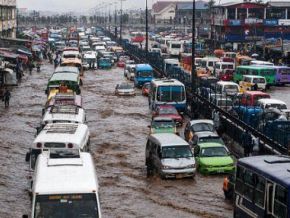
- Flood recovery is putting growing pressure on road infrastructure budgets across West Africa.
- Rising reconstruction costs could delay new highway and transport projects.
- Governments are increasingly treating climate resilience as a core infrastructure investment.
Weeks of heavy rainfall across Lomé, Accra, Lagos, and other cities along West Africa’s Atlantic coast have triggered widespread flooding, damaging roads, bridges, drainage systems, and other transport infrastructure. As governments begin assessing the destruction, another challenge is coming into focus: the cost of rebuilding could force countries to divert funds originally earmarked for new infrastructure projects.
Previous disasters offer a glimpse of the financial burden ahead
According to the World Meteorological Organization’s (WMO) State of the Climate in Africa 2023 report, African countries lose between 2% and 5% of GDP each year to climate-related hazards. In some cases, governments must redirect up to 9% of their public spending to disaster response. Over the longer term, the continent faces substantial adaptation costs.
The WMO estimates that sub-Saharan Africa will need to invest $30 billion to $50 billion annually over the next decade—equivalent to 2% to 3% of regional GDP—to strengthen its resilience to climate change. Transport infrastructure will account for a significant share of that investment. A report published by the Coalition for Disaster Resilient Infrastructure (CDRI) in September 2025 estimates that natural disasters cause an average of $12.7 billion in damage to African infrastructure every year.

Reliable estimates of flood damage to road networks remain limited in West Africa. Most available figures relate to reconstruction projects undertaken after major disasters.
In Nigeria, for example, rebuilding the Mokwa Bridge, which was destroyed by flooding in Niger State in May 2025, is expected to cost 16.7 billion naira (about $12.1 million). In Ghana, the 2026 budget allocates 3 billion cedis (about $260.5 million) for road infrastructure repairs. Following recent heavy rains, several analysts have called for that allocation to be increased.
Beyond West Africa, recent examples illustrate the scale of the challenge. The World Bank estimates that climate-related events cost Malawi’s road network about $163 million each year, or roughly 1.3% of GDP. In Mozambique, flooding in January 2026 damaged more than 5,000 kilometers of roads across nine provinces, with repair costs estimated at nearly $3.5 billion.
Road expansion plans could slow
Repairing damaged roads, bridges, and drainage infrastructure is typically an immediate priority for governments. Prolonged disruptions to road networks can affect trade, supply chains, urban transport, and the movement of goods to major economic centers.
As a result, rising reconstruction costs could leave governments with less fiscal room to finance planned road expansion projects.
The pressure comes at a time when funding for routine road maintenance already falls well short of what is needed.
In Nigeria, Minister of State for Works Bello Goronyo recently said the country requires about 880 billion naira each year to maintain its road network, yet available funding covers only about 20% of that amount.

Against that backdrop, the additional cost of repairing flood-damaged infrastructure could force governments to make difficult spending decisions. Some may have to choose between restoring existing roads and moving forward with new highway projects, while others could seek additional financing from international development partners. Although these trade-offs are unlikely to derail infrastructure investment altogether, they could slow the rollout of planned projects.
Climate resilience is becoming the new benchmark
As extreme weather events become more frequent, international financial institutions are increasingly encouraging governments to build climate resilience into infrastructure projects from the outset.
That means strengthening drainage systems, designing culverts and bridges to withstand heavier rainfall, using more durable construction materials, and carrying out more comprehensive hydrological studies before construction begins.
These requirements raise the upfront cost of road projects, but they are increasingly viewed as a way to reduce recurring reconstruction expenses and protect long-term investment in transport infrastructure.
Henoc Dossa
