El Niño has returned. The recurring climate pattern, marked by unusually warm waters in the tropical Pacific, typically emerges every two to seven years and can disrupt rainfall and temperatures around the world. This year’s event is expected to strengthen in the months ahead, renewing concerns about wildfire risk across the Amazon.
Memories of the 2023–2024 fire crisis — marked by extreme drought and fires of enormous scale — remain vivid in a region increasingly vulnerable to the combined effects of climate change and forest degradation.
In this humid forest biome, where natural fire is rare, wildfires pose a growing threat to the climate, human health, livelihoods and the integrity of ecosystems. Managing that risk, however, requires a clearer understanding of fire itself.
For many Indigenous Peoples and local communities across the Pan-Amazon — including traditional, farming and riverine communities — fire is part of knowledge systems, food production, territorial management and cultural practices developed over generations. It is used to prepare small agricultural plots and in domestic, ceremonial and subsistence activities. Fire is woven into community life.
The challenge, then, is how to manage fire better.
This question was central to FUTERRA (“Fire and Territory: Traditional Knowledge for Fire Management in the Amazon”), a project led by Landscape Alliance under the Global Fire Management Hub. Through analysis of initiatives in Bolivia, Brazil and Peru, alongside workshops and exchanges across the region, FUTERRA examined how stronger fire management could be built around prevention and the knowledge of those who live in these territories.
From firefighting to fire governance
Public policy on fire across the region has long focused on suppression: detecting fires, mobilizing brigades and putting them out. That response is essential when fire threatens lives, forests or infrastructure — but it is insufficient without preventive action alongside it.
Integrated Fire Management (IFM) offers a different framework. Rather than treating fire only as an emergency, IFM addresses it as part of a broader ecological and social reality. This means acting before, during and after fires through prevention, planned use, rapid response, restoration and the strengthening of local capacities.
The goal is to distinguish wildfires from traditional or controlled practices that form part of territorial governance, while preventing the indiscriminate use of fire.
This distinction matters enormously for policy. When laws treat all uses of fire as a threat, they can weaken prevention, render traditional practices invisible and undermine collaboration with the people who know the territory best.
What communities already know
Across the Amazon basin, communities have developed their own systems for fire use: burning calendars attuned to seasonal conditions, observation of wind and humidity, mosaic management, selection of the time of day, collective control and the intergenerational transmission of knowledge.
These are not improvised practices. They respond to specific ecological, social and cultural conditions. In some contexts, low-intensity traditional burning helps reduce the accumulation of dry biomass, maintain diverse landscapes and prevent fire from escalating into large-scale wildfire. In others, it is inseparable from family farming, food security and cultural continuity.
Problems arise when these practices are carried out under increasingly extreme climate conditions — without technical support, without institutional coordination or under economic pressures that push communities towards burning at higher-risk moments.
FUTERRA’s research emphasizes that integrating Indigenous and community knowledge is a strategic component of IFM. Without the active participation of those who know and inhabit the territories, effective prevention is difficult to build.
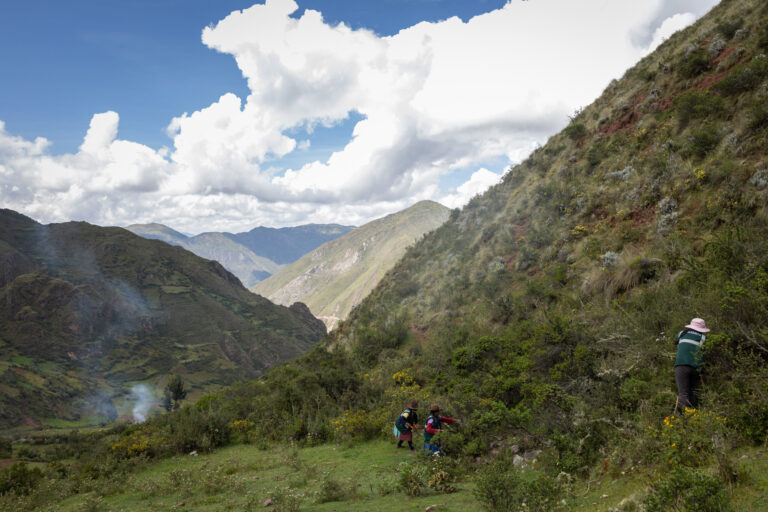
In Peru’s Ene River basin, Asháninka community members and brigade members strengthen their capacity to prevent and respond to wildfires as part of the PAAMARI strategy. Photo by CARE.
Lessons from three countries
From the Ene River basin in the Peruvian Amazon to the Chiquitano dry forest in Bolivia, the experiences documented under FUTERRA show that IFM is taking root across the region and generating concrete results.
In Bolivia, community fire management programmes have combined participatory burning calendars, local brigades, alert systems, community mapping and coordination with subnational governments. The result has been greater local capacity to prevent fires and respond quickly when they start.
In Brazil, Indigenous brigades supported by federal policy have consolidated a co-management model between environmental institutions and Indigenous Peoples. Longer contract periods for brigade members have made it possible to strengthen prevention throughout the year, moving beyond an approach driven purely by emergencies.
In Peru, the PAAMARI initiative — led by Asháninka communities in the country’s central Amazon — has integrated ancestral knowledge, satellite monitoring, Indigenous surveillance and ecological restoration to reduce fire risk and strengthen territorial governance.
Although these experiences respond to different contexts, they share the same premise: prevention works better when it is built from the territories up. The initiatives reviewed through the project also show that combining traditional knowledge, accessible technologies and public policies can strengthen governance, expand operational capacity in remote areas and generate more legitimate and sustainable responses to fire.
Four priorities for a more resilient Amazon
Despite this progress, significant barriers remain to consolidating IFM across the Pan-Amazon, including restrictive legal frameworks, insufficient funding, institutional fragmentation and limited formal participation of territorial actors in decision-making.
Fire risk in the region also remains high and transboundary. Although fires decreased in 2025 compared with the record levels of 2024, the region’s underlying vulnerability remains high.
FUTERRA’s research points to four priorities for the path ahead:
- Recognize the cultural use of fire. Integrate ancestral knowledge and traditional practices into policies and programmes, clearly distinguishing between wildfires, prescribed burning and cultural uses of fire.
- Strengthen management in the territories. Promote participatory planning, local brigades and the combination of traditional knowledge with monitoring systems and early-warning tools adapted to each context.
- Invest in prevention, not only in emergencies. Ensure permanent funding for prevention, ecological restoration and community capacity rather than concentrating resources in disaster response.
- Promote Pan-Amazonian cooperation. Strengthen coordination among countries, communities, institutions and organizations through interoperable monitoring systems, information exchange and joint decision-making.
The region has an opportunity to move from seasonal crisis response towards integrated fire governance — one capable of bringing together traditional knowledge, communities, institutions and technical tools around a shared goal: living better with fire in order to reduce its risks. Without that shift, forest degradation and other pressures on forests will continue to create the conditions for new crises.