
Buddhistdoor View: The Grandeur of Diversity—Surveying Buddhism in Malaysia


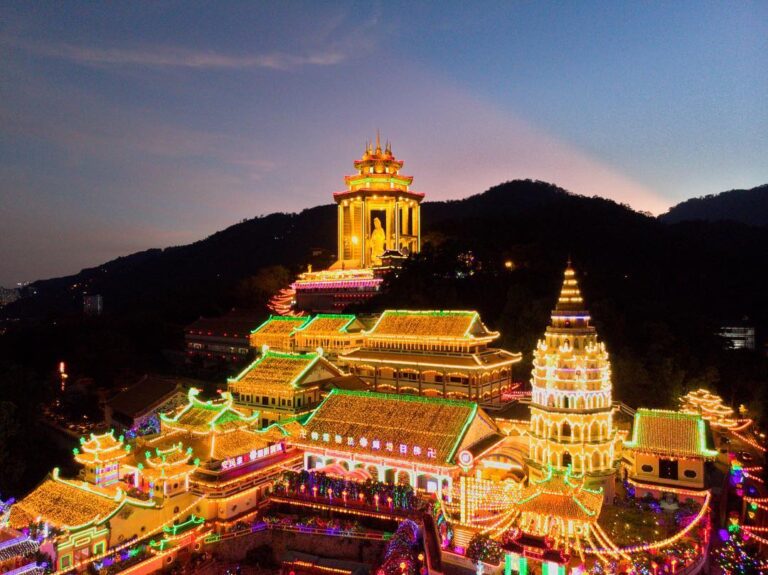
Kek Lok Si in Penang. From hotel.burmahtel.com

Southeast Asia is perhaps Asia’s true melting pot of religions and cultures. The region is one of the most important regions for what Prof. Richard K. Payne, Dean and Yehan Numata Professor of Japanese Buddhist Studies at the Institute of Buddhist Studies at UC Berkeley, characterizes as the “Buddhist cosmopolis.” It forms a critical realm of diffusion connected to the Buddhist world’s networks of praxis. Southeast Asia has at times slipped under the radar of Anglophone coverage, although this has shifted in recent decades, especially with a renewed interest in the history and current situation of Buddhism in Myanmar, Cambodia, Laos, and Thailand. Indonesian Buddhist affairs and historical discussions have also prominently featured in BDGl. The Federation of Malaysia is also a critical hub of the Dharma’s diffusion, a longtime hub of multiculturalism and interfaith coexistence since ancient times.

Buddhism arrived in what is Malaysia today in the third century CE through maritime trade routes connecting India, Sri Lanka, and Southeast Asia. Archaeological finds in Bujang Valley (Kedah) confirm a Buddhist presence from the 3rd–5th centuries, including Sanskrit inscriptions and Buddha statues. The Langkasuka Kingdom, which flourished in the seventh century, was a Buddhist polity in which monastic communities practiced Mahayana Buddhism alongside indigenous animism. Other royal courts also patronized Mahayana and Hinduism.

The Chola dynasty (c. 9th–13th centuries) of southern India launched devastating naval invasions of the then-dominant Srivijaya Empire (c. 671–1025) in Malaysia in 1025, and again 1068. Buddhism was already weakened by Shaivite Hinduism when the Malacca Sultanate’s rise in the 15th century marginalized Buddhism completely, with Malay rulers and populations embracing Islam. Somewhat ironically, the mass immigration of Chinese communities during British colonial rule in the 19th and 20th centuries re-established Buddhism in urban centers. Today, around 18.7 per cent of Malaysia’s population—the vast majority of them ethnically Chinese—identify as Buddhists, with communities concentrated in Penang, Selangor, Kuala Lumpur, Johor, and Perak.

The developer of the NORBU Buddhist AI, Lim Kooi Fong, told BDG that outsiders might feel that Buddhism was in a strong position, given the presence of Sunday Dhamma Schools across the nation and the proliferation of Buddhist youth groups. Lim has noted that Malaysia’s Buddhist development has been in reality fragmented and uncoordinated, especially compared to the strategic approach of Buddhist groups in Indonesia. One example is how Buddhism in post-independence Indonesia had to adjust to the government’s demands for professing a belief in a supreme being. This resulted in a vision of “Pancasila Buddhism” and ekayana (One Vehicle) that Buddhists could unite around and, critically, pitch to non-Buddhist countrymen as being authentically “Indonesian.” This, again somewhat ironically, helped to secure Buddhism’s position in the country.

Dharma Realm Guan Yin Monastery in Kuala Lumpur, a branch of Dharma Realm Buddhist Association. From cttbusa.org

Rather, Malaysia’s Buddhist institutions have had to bear with indifference and government neglect, which in some cases might be worse than active suspicion or intervention. The Muslim majority’s indifferent attitude includes an Islamic government that has no religious strategy beyond securing the Malay vote across its 13 states and three federal territories. Unlike the Indonesian government, it cares little about collaboration with Buddhist institutions as it sees no ideological value in reaching it. Lim has gone so far to suggest that in 2026, the golden age of Malaysian Buddhism can already be said to be over. This period had begun in the 1970s and continued until the early 1990s, with momentum gathering thanks to the formation of Federation of Malaya Buddhist Youth Fellowship (FMBYF) on 24 December 1958 by Ven. Sumangalo (1903–63).

Ven. Sumangalo (born Robert Clifton) was an American monastic who mobilized youth participation in the post-independence Buddhist movement. His memorial hall is in Georgetown, Penang. Like his fellow American—and in a sense, missionary predecessor—Col. Henry Steel Olcott (1832–1907), Ven. Sumangalo saw meeting the evangelical Christian challenge with a robust, renewed pride in Buddhist affiliation as a priority.

This flourishing was assisted by another crucial personality: Sri Lankan monk Ven. K. Sri Dhammananda (1919–2006), who was not only charismatic and offered a refreshing teaching style, but also published prolifically for mass distribution. However, the reach of Buddhist publishing houses would be compromised by the Ministry of Home Affairs’ 1986 directive—and various state-level enactments—to require non-Muslim publications to add disclaimers stating “For Non-Muslims” or “Not for Muslims.”

Other drivers of a “Malaysian” approach include lay Buddhist Piya Tan (formerly Ven. Piyasilo), who now resides in Singapore. During his time as a monk, he co-founded the Young Buddhist Association of Malaysia (YBAM) in 1970, with his prolific writing forming a kind of “philosophical” foundation for Buddhism in Malaysia. The YBAM sees Ven. Sumangalo as its spiritual predecessor, and the country’s strong showing of youth groups, including the Buddhist Gem Fellowship (BGF), remains one of the Malaysian Buddhist world’s abiding strengths.

Kuala Lumpur. Image courtesy of BDG

The renaissance had slowed down by the 1990s due to intellectual trajectories that led to more individualistic practices being favored over community building. Buddhism’s development in post-independence Malaysia was successful but fragile, and the rapid economic development of the 1980s and 1990s would lead to a corresponding individualism—especially among younger people—that has influenced how certain forms of Buddhism began to be prioritized over others. For example, one could look at the way the Sayadaw tradition of Vipassana, strictly focused on meditation and mindfulness, became in vogue and was sometimes seen as more authentic than the community-focused yet syncretic Chinese Buddhist traditions. 

Finally, the hope for a truly “Malaysian Buddhist” identity has been gradually weakening in the face of international Buddhist groups vying for influence in Malaysia, including Fo Guang Shan and Tzu Chi. Many local Malaysians and foreigners believe that groups from elsewhere project an aura of prestige and global influence—and larger war chests—that homegrown Malaysian groups find difficult to match. It is also impossible to overlook how popular Vajrayana Buddhism has become. It could be anecdotally said to have surpassed the scale and activities of many older groups, with many Vajrayana organizations setting up Malaysian branches and being plugged into wider international networks in the Himalayan world. The overall charisma, reach, and influence of Vajrayana teachers also far surpass that of Malaysian Buddhist leaders.

As a whole, Malaysian Buddhists believe that the time is ripe for intellectual revitalization. With no Ven. Dhammananda-like figure to rally around, it is not immediately clear what one means by “Malaysian Buddhism,” even as activities and events in the country paradoxically continue to remain vibrant. Much of the Buddhist news that makes headlines concern women’s positive progress in various sanghas, or conversely, perceived controversies in communities—although sometimes the scandals can be real and involve alleged abuse or harmful conduct. In other words, there is plenty of energy, but it has little direction, and therefore is not sure where it is headed. Old dichotomies and debates must be transcended so that the ground may be cleared for newer, more contemporary priorities.

Related features from BDG

Migrating Beliefs: Chinese Buddhism in Penang
The Many Buddhas of Malaysia

Related news reports from BDG

Buddhist Women: 19th Sakyadhita Conference Commences in Sarawak
Buddhists Debate Korean “DJ Monk” After Controversy in Malaysia
Malaysian Buddhists Seek Ban on Korean DJ for Dressing Like a Monk
First Malaysian Theravada Bhikkhuni Sima established at Kwasa Damansara


Source link