
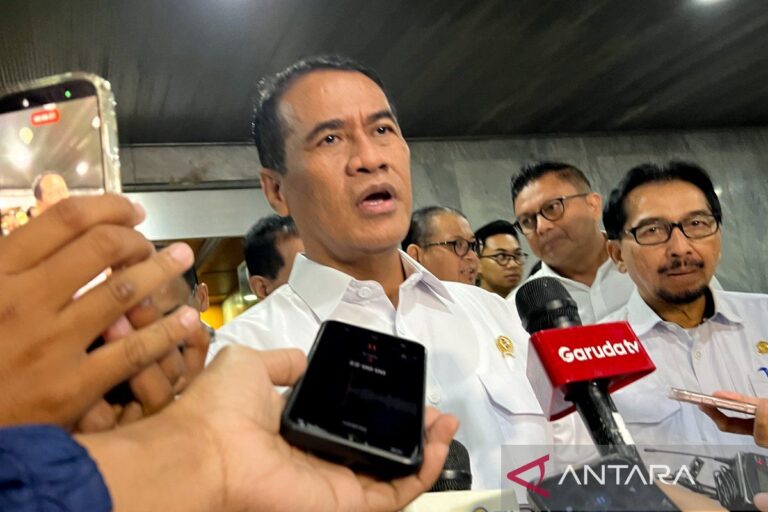
“We must act before the drought spreads. We must not let farmers lose their planting season,” said Minister of Agriculture Andi Amran Sulaiman in a statement on Friday.
The acceleration of the pumping program is a key mitigation measure in the face of the potential El Niño phenomenon, which the Meteorology, Climatology, and Geophysics Agency (BMKG) forecasts will likely be weak to moderate in intensity.
By expediting the distribution of water pumps, rehabilitating irrigation networks, and optimizing available water sources, the government aims to ensure farmers can continue planting, sustain national food production, and support Indonesia’s food self-sufficiency target.
Sulaiman stressed that the ministry is taking preventive measures before drought conditions intensify, emphasizing that past El Niño events have demonstrated the importance of early mitigation.
“That is why we are accelerating a range of mitigation measures, including the pumping program, to ensure water remains available and food production stays secure,” he said.
Beyond the pumping initiative, the government is also speeding up irrigation rehabilitation, land optimization programs, and the adoption of agricultural technologies to strengthen the resilience of national food production.
“We cannot wait until a crisis occurs. Our principle is upstream mitigation. Water must remain available, irrigation systems must function properly, and farmers must be able to continue planting. In this way, national food production can be maintained despite climate challenges,” Sulaiman explained.
The ministry considers climate adaptation increasingly crucial as the government intensifies efforts to achieve food self-sufficiency.
Several policy interventions have already produced encouraging results, as reflected in rising national food production.
Government rice reserves have reached a historic high of 5.1 million tons, and the Food and Agriculture Organization (FAO) projects that Indonesia will have the highest rice production increase in the world in 2025–2026.
The pumping program is one of the ministry’s principal climate adaptation measures, enabling farmers to continue irrigating drought-prone farmland even when rainfall declines.
The Ministry of Agriculture will continue monitoring climate developments across the country while accelerating mitigation measures based on conditions in each region.
Through close coordination between the central government, regional administrations, and farmers, the government remains optimistic that national food production will stay resilient and that Indonesia’s food self-sufficiency target can be achieved despite increasingly dynamic climate challenges.
Related news: Indonesia rice reserves sufficient until May 2027: Minister
Related news: Minister urges regions to prepare for El Nino risks
Related news: Govt optimises 843 feed banks ahead of El Nino
Translator: Arie Novarina
Editor: M Razi Rahman
Copyright © ANTARA 2026
