
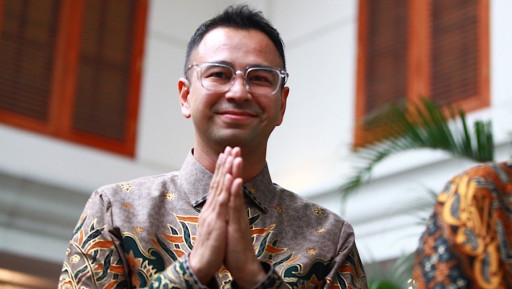
From celebrity to power: How Raffi Ahmad’s expanding network reached Indonesia’s strategic industries


Appointment of presidential envoy’s longtime aide as commissioner fuels renewed scrutiny over Indonesia’s political-business networks.

The appointment of Mufli Budi Ananda, a longtime aide to presidential special envoy and celebrity entrepreneur Raffi Ahmad, as commissioner of PT Krakatau Posco has reignited public debate over governance standards at companies linked to state-owned enterprises.

Unlike appointments involving seasoned executives or industry veterans, Mufli’s public professional profile has been associated primarily with his role as Raffi Ahmad’s personal assistant. Until his name appeared on Krakatau Posco’s official board structure, little publicly available information indicated experience in Indonesia’s steel industry or corporate governance.

His appointment has therefore shifted attention beyond Krakatau Posco itself, raising broader questions about how political proximity, celebrity influence and business expansion increasingly intersect within Indonesia’s state-linked corporate landscape.

State-backed steel giant

PT Krakatau Posco is not privately owned by an individual. The company was established in 2010 as a joint venture between state-owned steel producer PT Krakatau Steel (Persero) Tbk and South Korean steelmaker POSCO, representing one of Indonesia’s largest industrial investments, with an initial value of approximately US$2.66 billion.

The integrated steel plant began commercial production in 2014 using blast furnace technology and has an annual production capacity of around 3 million tonnes, supplying industries including construction, automotive, shipbuilding and energy.

Because Krakatau Steel remains a state-controlled enterprise, appointments within companies under its corporate umbrella inevitably attract public scrutiny over governance, transparency and merit-based recruitment.

From entertainer to political insider

The appointment has also renewed attention to Raffi Ahmad’s own trajectory.

Over the past decade, Raffi has transformed from one of Indonesia’s most recognizable television personalities into a businessman with expanding political access.

During President Joko Widodo’s administration, Raffi frequently appeared alongside the former president in interviews, national campaigns and government-related events. Although he held no formal government position during Jokowi’s presidency, his visibility within official circles steadily increased.

Meanwhile, his business empire expanded rapidly. Beginning with YouTube content production, RANS Entertainment evolved into a diversified business group spanning digital media, production houses, sports clubs, music labels, animation, fashion, beauty, food and beverage, gaming, live events and other ventures.

Its expansion coincided with numerous collaborations involving ministries, state-owned enterprises and other public institutions.

Following the 2024 presidential election, Raffi openly supported the Prabowo Subianto–Gibran Rakabuming Raka ticket.

After Prabowo took office, Raffi was appointed Special Presidential Envoy for Youth Development and Arts Workers, marking his transition from celebrity entrepreneur to state official.

Throughout that period, Mufli remained one of Raffi’s closest aides, regularly accompanying him during both business activities and official government engagements.

Business growth attracts attention

The rapid growth of the RANS business group has long attracted public attention.

Within just a few years, the company evolved from a content creator into one of Indonesia’s largest celebrity-backed business groups, with dozens of subsidiaries and investments across multiple sectors.

Its expansion has prompted recurring speculation on social media regarding the scale and sources of its financing.

However, no Indonesian law enforcement agency has accused, investigated or charged Raffi Ahmad, RANS Entertainment or any of its affiliated companies with money laundering or other financial crimes.

As such, allegations circulating online remain unsubstantiated speculation rather than established fact.

IPO places ownership under spotlight

Public attention has intensified further as the RANS group prepares to enter Indonesia’s capital market.

Its IPO prospectus has drawn attention to the company’s shareholder composition, which includes several politically connected figures alongside Raffi Ahmad and Nagita Slavina.

Among the names disclosed are Kaesang Pangarep, the youngest son of former president Joko Widodo, and Dony Oskaria, chief operating officer of Indonesia’s sovereign investment holding Danantara.

Their presence has fueled discussion over the increasingly overlapping networks linking business, politics and state institutions.

No regulation prohibits politically connected individuals from investing in private companies.

Nevertheless, governance experts have long argued that growing intersections between political elites, state officials and private businesses warrant greater transparency to prevent actual or perceived conflicts of interest.

Governance questions remain

Against that backdrop, Mufli’s appointment has become more than an isolated personnel decision.

Critics argue that the central issue is not merely who occupies a commissioner seat, but whether appointments at companies linked to state-owned enterprises are based on professional qualifications, transparent selection processes and sound corporate governance principles.

As of publication, Krakatau Posco had not publicly explained the rationale or selection process behind Mufli Budi Ananda’s appointment.

Without such clarification, the appointment is likely to remain part of a broader public conversation about political patronage, corporate governance and the increasingly blurred boundaries between Indonesia’s business elites and political establishment.


Source link