
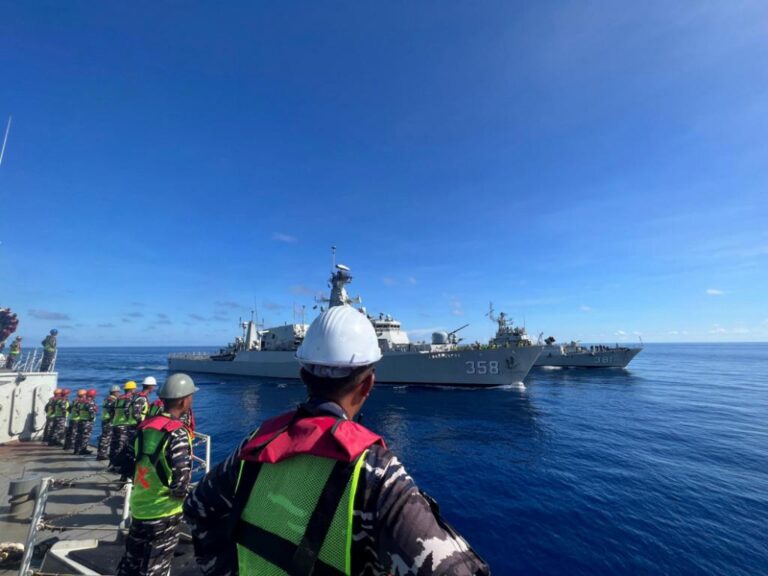
Photo from www.tnial.mil.id
This month, Indonesia’s Tuna block oil in the North Natuna Sea enters a new phase of natural gas and crude oil exploitation. Russia’s oil and gas company, Zarubezhneft, is set to resume the project.
The Tuna block project is a strategic oil and gas field located in Indonesia’s Exclusive Economic Zone, only 14 kilometres from Vietnam’s border. But for a long time, it has faced significant geopolitical pressure because it overlaps with China’s illegal nine-dash line.
The fast-growing need for energy sources driven by the crisis in the Middle East means energy exploration and exploitation have become increasingly important for the region. However, geopolitical risks may follow, given the Tuna Block’s location in a contested maritime area.
Resource-rich, contested block
Before Zarubezhneft took over the entire project this month, it jointly conducted the exploration and exploitation of the Tuna Block with British Harbour Energy (formerly Premier Oil).
However, due to intensifying US sanctions on Russia following the Russia-Ukraine war, Harbour decided to withdraw and sell its operating interests in two blocks in Indonesia, including a 50% stake in the Tuna Production Sharing Contract. This left Russia fully in charge.
Due to its strategic location and abundant energy resources, the Tuna block has faced several pressures over the years, particularly from China, which has considered it part of its territory. Indonesia does not recognise the Chinese nine-dash line because it has been ruled illegal by an international tribunal, but Beijing has persistently put pressure on Jakarta to acknowledge its claim.
In 2021, for instance, China lodged an unprecedented protest against exploration and exploitation in the Tuna block. At the time, China demanded Indonesia halt drilling on a temporary offshore rig because it was located in Chinese maritime territory. Indonesia refused to accept China’s claim because it was clearly located within Indonesian territory, and that claim was ruled illegal under international law by the 2016 South China Sea arbitration.
There have also been were many reports that China sent a research vessel, Haiyang Dizhi 10, and a Chinese coast guard vessel to manoeuvre near the Tuna block exploitation rig in 2021. This was seen as a threat to Indonesia’s sovereign rights to exploit energy resources. In 2016, there were also incidents where Indonesia’s law enforcement shot at Chinese fishing vessels in the Indonesian EEZ.
Under President Joko Widodo (2014-2024), Indonesia developed closer economic ties with China. However, it also maintained a firm commitment to protecting its sovereign rights to oil and gas exploration in the North Natuna Sea.
Russia vs. China in the Tuna Block?
This strong stand against Chinese intervention in the Natuna Sea, took an unexpected turn after President Prabowo Subianto came to office.
During the new president’s first official visit to Beijing, he and President Xi Jinping issued a joint statement that recognised Indonesia’s overlapping claims with China and aimed to promote their joint development. However, it remains unclear whether ‘joint development ‘includes oil and gas exploration.
It is also unclear how this unprecedented step by an Indonesian president to recognise an overlapping claim with China will affect oil and gas explorations in the North Natuna Sea – and especially whether there will be another project with China.
So far, Indonesia’s decision to grant a concession to the Russian oil and gas company, Zarubezhneft, rather than to a Chinese company, suggests that the 2024 joint development proposal between Indonesia and China has not yet materialised.
However, given increasingly close ties between Beijing and Moscow, it remains to be seen whether China will continue its intrusions and protests against Russia’s Zarubezhneft, as it did when Harbour Oil was involved.
Vietnam and China
Another important issue is how this will affect the oil exports to Vietnam in 2026. In 2018, Indonesia committed to exporting oil to Vietnam this year. The two countries also signed a maritime delimitation agreement in December 2022. However, the DPR, the Indonesian national legislature, has still not ratified the treaty.
This is interesting because the agreed EEZ delimitation between Indonesia and Vietnam in the North Natuna Sea also overlaps with China’s nine-dash line, and China has been openly objecting to the agreement.
It is unclear why Indonesia has not yet ratified the treaty. Is it because Indonesia, under Prabowo, has recognised an overlapping claim with China? In normal circumstances, it would be rare for the DPR to take over two years to conclude a straightforward maritime boundary delimitation treaty.
Sending Signals
The recent developments in the North Natuna Sea are very important, given recent geopolitical shifts that have severely disrupted the global economy.
Energy self-reliance has become increasingly vital due to the Hormuz crisis, so how Indonesia deals with the Tuna Block will inevitably send geopolitical signals about its positioning as regards the great powers.
Amid this geopolitical contestation, Indonesia should firmly support the 2016 South China Sea arbitration tribunal and should not back down in the face of China’s intrusions into Indonesia’s part of the North Natuna Sea.
