
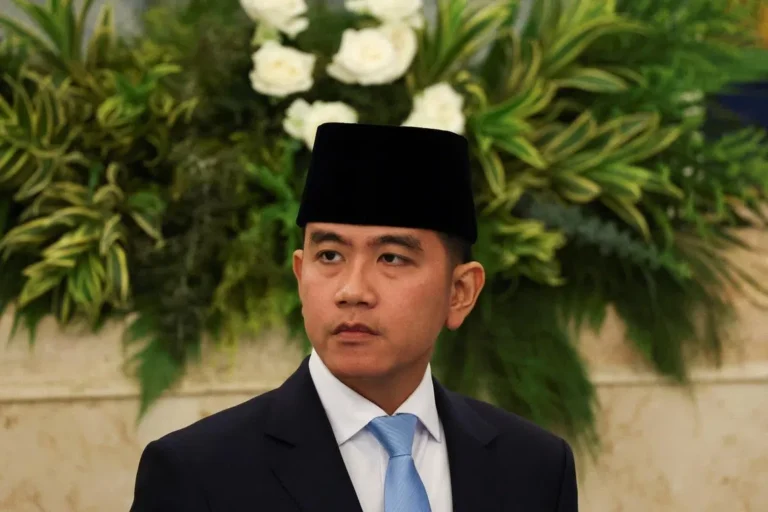
Jokowi’s son Gibran’s outreach to student protesters puts focus on his role in government


Just days after taking to the streets of Jakarta to demand changes to government policy, five university students found themselves boarding a plane with Vice-President Gibran Rakabuming Raka for a working visit to eastern Indonesia on June 18.

The trip came three days after Gibran held a closed-door meeting with student representatives who had been protesting against two of the government’s most ambitious and controversial initiatives – the free meals and Red and White Cooperative programmes, the latter a plan to establish thousands of village-run businesses across Indonesia.

In a statement issued by the Vice-President’s Office after the meeting, Bung Karno University student leader Muhammad Abdi Maludin said Gibran had responded positively to the students’ concerns and research findings on the issues.

“The Vice-President is open and receptive to the results of the study. He will audit and consolidate them. He will inform the leadership, especially President Prabowo Subianto,” he said.

But not everyone was convinced. Reactions to Gibran’s Instagram post about the meeting were mixed, with some commenters questioning the choice of students invited to the palace.

The students were from Bung Karno University and Mohammad Husni Thamrin University, which are private universities in Jakarta that are less well known than campuses that have traditionally been at the forefront of Indonesia’s student protests.

One commenter, @wahyu3sunu, wrote that involving students from Indonesia’s more prominent universities would have made the engagement appear more genuine. “At least it would look organic,” the commenter said.

Another commenter, @tomy_hanta, described the meeting as a “show”.

The outreach to the students has thrust the 38-year-old Vice-President into the spotlight at a time when student-led protests have spread across parts of Indonesia and scrutiny of the government’s flagship programmes has intensified.

“The persona on display is that of a communicative vice-president willing to engage with students and ordinary citizens – a small win he is cultivating early by capitalising on current momentum,” said Nicky Fahrizal, a researcher at the Jakarta-based Center for Strategic and International Studies (CSIS).

“The clear political target is the 2029 election window,” added Nicky, referring to Indonesia’s next presidential election.

Some have speculated that Gibran may run again, even though he has not publicly stated that he intends to do so.

While Gibran’s moves are unlikely to result in major policy changes, given the vice-president’s limited authority and the programmes’ established place in the government’s agenda, analysts say they could help raise his profile and build influence.

By engaging directly with critics, analysts say Gibran is seeking to position himself as a bridge between public concerns and government policy while carving out a more distinct role within the administration ahead of future potential political moves.

The government’s free meals programme has faced growing scrutiny following corruption allegations at the National Nutrition Agency (BGN).

Earlier in June, agency chief Dadan Hindayana was replaced and later arrested alongside two former deputies as part of an investigation into alleged procurement irregularities.

While visiting a primary school in East Nusa Tenggara on June 18 during his four-day trip, Gibran acknowledged shortcomings in the free meals programme and called for improvements to its governance following the recent scandal.

He also instructed officials to accelerate the programme’s implementation in areas where supporting infrastructure had already been completed, and promised to follow up on local concerns.

Gibran’s actions seem to be a “deliberate strategy” to assuage the public’s anger, said Edbert Gani Suryahudaya, a researcher at CSIS’ Department of Politics and Social Change.

He added, however, that it is unlikely they can lead to much change.

Since taking office alongside Prabowo in October 2024, the eldest son of former president Joko Widodo has often struggled to define his role.

Despite being linked to high-profile assignments such as Papua’s development and the new capital Nusantara, he has largely remained on the sidelines of major policy decisions, analysts say.

Unlike some of his predecessors, he has not been given a major policy portfolio, while many of the government’s flagship programmes are overseen directly by ministries, agencies and officials who report to the president.

In the case of the free meals and Red and White Cooperative initiatives, the analysts ST spoke to agree that Gibran’s actual influence over the programmes remains limited.

The BGN reports directly to the president, while the Red and White Cooperative initiatives are coordinated by several ministries and agencies as a presidential priority programme.

Irman Lanti of Padjadjaran University said Gibran’s growing visibility around the two initiatives does not necessarily mean he played a significant role in shaping them.

“All indications show that Gibran has not been involved in the free meals and cooperative programmes, which are apparently more under the control of the military and the police,” said Irman.

Irman said the Vice-President’s latest moves appeared aimed at demonstrating his relevance. “Gibran is trying to prove his worth by riding on the students’ demonstrations during the past few weeks,” he added.

He also questioned whether the engagement with students represented a genuine attempt to engage critics.

On June 23, local news outlet Kompas reported that a student leader from Bung Karno University who attended the meeting with Gibran had admitted receiving 20 million rupiah (S$1,440) afterwards.

Separately, another outlet TribunNews reported that day that other students who attended the meeting had acknowledged receiving sums ranging from 2 million rupiah to 2.5 million rupiah.

The source and purpose of the money remain unclear, and the Presidential Palace has said it is investigating the claims.

“It was apparent that Gibran’s move was carefully orchestrated,” Irman said, noting that the students invited to the palace did not represent Indonesia’s largest campuses.

Noting how public criticism has recently been directed at the government and everyone involved in it, CSIS researcher Edbert said the Vice-President appeared to be relying on relatively “simple” ways of attracting public attention.

“For him, the strategy is to stay relevant and keep the public’s attention by using the ‘lowest-cost’ options,” he said. “This performative act with the students is relatively easy for him to get people’s attention.”

The approach has drawn comparisons with the “blusukan” style popularised by Widodo, a form of grassroots outreach involving impromptu visits to communities and direct engagement with ordinary Indonesians.

Analysts have said that this political style of direct engagement with citizens and a carefully cultivated image of accessibility helped propel Widodo from a low-ranking politician to the mayor of Surakarta in 2005, governor of Jakarta in 2012, and to the presidency in 2014.

Edbert said Gibran’s political standing remains heavily tied to his father.

Gibran’s candidacy to the vice-presidency became possible after a controversial court ruling in 2023 created an exception to the minimum age requirement for presidential and vice-presidential candidates, allowing elected regional leaders under 40 to run.

He was later picked as Prabowo’s running mate, with Widodo widely seen as backing the pair despite his party’s support for a rival candidate.

“I believe his political currency is still largely based on the image and legacy of his father, rather than his own capacities,” Edbert said.

“Additionally, he hasn’t been able to establish his own political base.”

While the comparison between father and son is understandable, Nicky said that Gibran lacks the long track record in public office that had underpinned his father’s credibility.

“But he can shape public perception of these programmes, spotlight implementation problems and apply informal pressure on those carrying them out,” he added.

“That kind of influence is real but bounded – it is the soft power of communication, not the hard power of executive authority.”


Source link