
Resource curse: perhaps the most appropriate term to describe the current situation in Papua New Guinea (PNG). Because how can a country that is one of the richest lands of natural resources in the Asia Pacific still live below the poverty line? Papua New Guinea has reserves of gold, copper, nickel, and Liquefied Natural Gas (LNG) that are the backbone of its exports, but that wealth seems to flow upward without reaching those at the bottom layer.
The World Bank notes that nearly 40% of Papua New Guineans live in poverty, while only about 20.9% have access to electricity. This figure reflects structural failures that have persisted for decades.
With a population of around 10.76 million, Papua New Guinea continues to grapple with persistently high levels of poverty and inequality. On paper, indeed, economic growth in Papua New Guinea is somewhat increasing, as it is projected to reach 4.7% in 2025.
However, the benefits are not yet felt equally by the community; about 85% of the country’s population lives in rural areas and remains heavily dependent on the agricultural sector, which is unproductive and high-risk. This condition reflects that Papua New Guinea is still unable to optimize its billions of dollars worth of natural resources for the welfare of its people.
This situation is very concerning, as many people in Papua New Guinea still do not benefit from their natural resources. Although the extractive sector (gold, copper, nickel, LNG, petroleum) only accounts for around 28.6% (mining sector 12.2%, the oil and gas sector accounts for 16.4%) of the Gross Domestic Product (GDP) by 2025, this sector is still the main driver of the country’s exports and foreign exchange.
While this may sound impressive on paper, it is a testament to how vulnerable PNG’s economy is. When the price of gold or LNG in the global market falls, the entire country’s fiscal wheels sway. This is not just a technical risk; this is a systemic threat to the lives of millions of people who have never once enjoyed mining on their own land.
The economic growth that has occurred confirms that the main problem of poverty in Papua New Guinea is not the lack of resources, but inadequate and ineffective management. The GDP figures that the government has long used to deflect scrutiny, in fact, have no impact on small communities in the interior.
When the government boasts of increasing GDP, children in villages are still malnourished, have not received a proper education, and even always live below the poverty line. This is not a new cycle, but Papua New Guinea has been living in the same cycle for decades: commodity prices rise, state revenues soar, reform agendas are relaxed, and when prices fall, the government scrambles to borrow and sacrifice social spending.
Economic diversification has always been the number-two agenda item discussed in international forums but has never really been a budget priority. This is a conscious political choice, the consequences of which must be borne by millions of people who have never been invited to vote.
The pairing of abundant natural resources with corrupt governance is a well-documented pattern across the developing world, and Papua New Guinea is no exception. Transparency International’s Corruption Perceptions Index (CPI) 2025 gave Papua New Guinea a score of just 26 out of 100, placing it 142nd out of 180 countries worldwide.
These figures show that Papua New Guinea is perceived as one of the most corrupt countries in the world, even the worst in the entire Pacific region. Not surprisingly to those who closely observe PNG, it remains a damning indictment of a country that, for years, received billions of dollars in mining royalties and international development aid.
Unlike most countries that commit corruption in a clandestine and covert manner, Papua New Guinea openly misappropriates its budget. The entrenched corruption in Papua New Guinea is evident in infrastructure projects that are never completed, regional budgets that disappear without a trace, and mining contracts that benefit foreigners far more than the local communities whose land is taken.
This must be addressed urgently if we are to change the fate of the majority of the people and shift the global perspective on Papua New Guinea.
Agriculture Potential that continues to be ignored
The problem facing Papua New Guinea is not one without a way out; the fastest and biggest solution, other than reducing corruption in this country, has existed since the beginning: namely, agriculture.
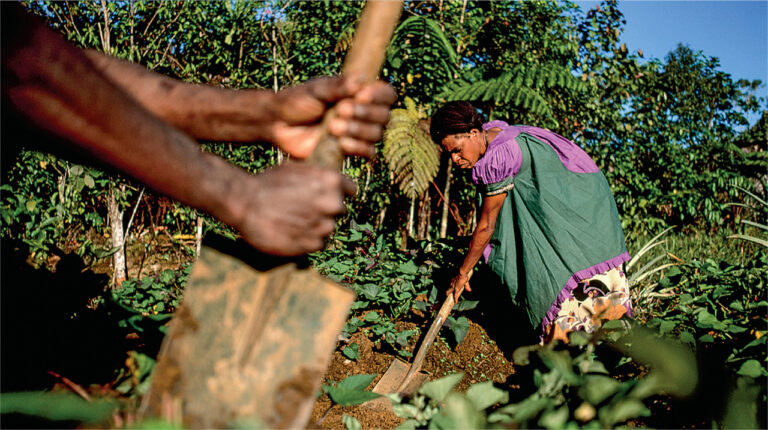
Agriculture is a strong sector for Papua New Guinea, but it has been neglected. Papua New Guinean coffee is known in the world specialty market as one of the best; cocoa from Bougainville and East New Britain has the premium qualities that European buyers are looking for; Oil palm thrives on large land.
However, all this potential has been exported as raw materials, allowing the real added value to be enjoyed by the processing industry in other countries.
The World Bank in its Papua New Guinea Economic Update 2025 states that the agricultural sector, which is the lifeblood of at least 85% of PNG’s population, has significant potential to support economic growth and address various development challenges, from job creation and increased exports to poverty reduction.
The growth of the non-resource sector in 2024 will be driven by increased agricultural production and rising commodity prices, especially cocoa, coffee, and copra oil. This is empirical confirmation that agriculture-based diversification is not just a discourse, but a proven path that works. Ironically, this growth is happening not because of well-planned policies, but because of upward pressure on global market prices.
Imagine how big the impact would be if it were supported by adequate infrastructure, affordable access to financing, and regulations that favor smallholders.
The Papua New Guinea government is actually not lacking in vision. Vision 2050 is an ambitious, comprehensive document that articulates the country’s ideals for structural transformation. However, the gap between the vision document and the reality on the ground remains wide. The ideal development vision often clashes with weak policy implementation, limited institutional capacity, and unresolved governance issues.
Ultimately, Papua New Guinea’s biggest challenge is not just formulating the future, but ensuring that that vision is truly realized in people’s daily lives.
Papua New Guinea’s economic diversification is not a development agenda that can be postponed. Diversification is a must, with a deadline. The shift that is needed now is no longer only at the level of technical policy, but at the level of the mindset of decision-makers who have grown too comfortable profiting from a structurally fragile system.
Papua New Guinea must stop treating the agricultural sector as a secondary concern, because it has proven great potential to develop the country; do not make the agricultural sector only a viable subsistence sector for the periphery.
The construction of roads, bridges, post-harvest processing facilities, and digital connectivity is not a luxury; it is a prerequisite for smallholder farmers to participate in the market economy in real terms. Without adequate infrastructure development, the agricultural sector cannot operate optimally in the field and becomes just a policy document with no practical impact.
Agriculture should receive more attention as one of the main growth engines that deserves serious investment and supportive regulation, including ensuring that smallholders have direct access to export markets without going through exploitative middlemen who capture most of the margin.
Papua New Guinea’s coffee and cocoa already have a reputation for premium quality in the international market, but its biggest added value, namely processing, packaging, and branding, has been abroad. This is what also makes it difficult for Papua New Guinea to break the cycle of poverty.
Therefore, the government must have the courage to establish policies that require domestic processing before export for strategic commodities. This policy will definitely be opposed by corporations that have been enjoying the ease of exporting raw materials, but the short-term political pressure must be borne for the sake of long-term interests.
Papua New Guinea’s neighbor, Indonesia, once took the same path with a ban on the export of crude nickel ore, resulting in the growth of the domestic processing industry and the creation of thousands of new jobs. So, Papua New Guinea does not need to create a new model; it can simply learn from its neighbors.
Smallholder empowerment is also important through agribusiness partnerships and real, on-the-ground access to microfinance. Partnership programs between agribusiness companies and smallholders, along with affordable microfinance services, are the fastest path to lifting the majority of the population from subsistence to commercial productivity.
This scheme is not new in the world, but what Papua New Guinea has to do is run it with strict oversight and ensure the benefits actually flow downwards, not stop at the program management level.
Furthermore, systematic governance reform and accountability in the extractive sector are also needed. That doesn’t mean the mines should be closed, but rather ensuring that every dollar of royalties and taxes that come in is actually reinvested to build a non-extractive economy.
However, there will be no successful economic diversification as long as Papua New Guinean political officials still see public office as an opportunity for personal enrichment. Governance reform is not a side agenda to be addressed later; it is the foundation of everything. Fiscal transparency and strengthening the Extractive Industries Transparency Initiative (EITI) framework are minimum steps that can no longer be negotiated.
Transparency is support for good reform. So that all programs, every fund, and every goodwill from international development partners will not continue to meet the same end: ending up without a meaningful impact on those who need it most.
Papua New Guinea has no shortage of resources. These diversification measures are not new and have been proven to work in various contexts in other developing countries.
In its implementation, what will make the difference later is whether Papua New Guinea has the courage and honesty to run it efficiently and consistently, so as not to continue benefiting a handful of multinational companies. Papua New Guinea must prioritize the resilience and well-being of its people above all else.
*The views presented in this article are the authors’ own and do not necessarily reflect the views of The Diplomatic Insight.
Marleon Aristokrat Wijaya
Marleon Aristokrat Wijaya is a student in the International Relations program at Universitas Kristen Indonesia (UKI) in Jakarta, Indonesia. His research interests are international political economy, development and governance, climate politics, energy transition, and the role of the Global South in contemporary international relations. He can be reached at marleonaw@gmail.com
