
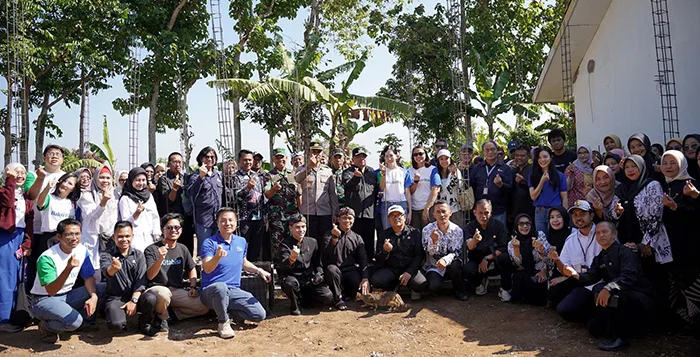
Garut, IO – Guided by the commitment of its founders, the Barito Pacific Group, through its philanthropic foundation, Bakti Barito, consistently prioritizes environmental conservation, education, and community development. Recognizing that Indonesia’s future relies heavily on the interconnectedness of these vital sectors, Bakti Barito actively designs and supports measurable solutions that create long-term positive impacts to address significant social and ecological challenges in the country, including the waste problem.
As an innovative approach to tackling Indonesia’s waste crisis, Bakti Barito officially held a groundbreaking ceremony for the construction of a new school building at SDN 3 Sukanegla Garut Regency, utilizing plastic bricks made from residual plastic waste. Not only are the bricks a key component, but all structural elements—including floor panels, ceilings, roofs, pipes, as well as window and door frames—are also made from plastic waste. This groundbreaking project will convert 15 tons of plastic waste into two classrooms and two comfortable toilets for the students.
This important initiative specifically targets low-value plastic waste that currently accumulates in local landfills. Unlike other types of plastic, such as PET (Polyethylene Terephthalate), which is commonly used in beverage bottles, PP (Polypropylene) for food containers, and HDPE (High-Density Polyethylene) used for shampoo bottles, the waste from instant noodle wrappers and sachets has no economic value in the recycling market. As a result, this type of routine waste is often ignored by scavengers and informal sector workers, as it cannot be resold to commercial recycling plants. By creating alternative uses for this overlooked waste, this project successfully diverts tons of plastic from the ecosystem and opens a new chapter in the circular economy.


During her presentation, Fifi Pangestu, the Executive Director of Bakti Barito, emphasized that environmental innovation must provide positive impacts and direct, tangible benefits for residents. She commended the Garut Regency Government for taking the initiative to adopt this innovative solution. “This plastic waste allows us to build something valuable for future generations. Through collaboration with the local government and technology partners, we are proving that plastic waste can help build spaces for children to learn while reducing the environmental burden. Change can occur when residents, innovators, the government, and the private sector work together.”
Through this collaboration, Garut has once again demonstrated its role as a pioneer in supporting downstream solutions to the waste problem. The Regent of Garut was present at the inauguration, underscoring this ongoing commitment. Garut is at the forefront of finding innovative solutions for waste management.
Two years ago, the region successfully implemented asphalt made from plastic, followed by exploring the concept of schools constructed from recycled plastic. Today marks a concrete step in Garut’s commitment to a circular economy through the construction of schools using plastic waste. It is hoped that this innovation can be expanded throughout Garut, not only for schools but also for broader housing and infrastructure projects in the future.
Bakti Barito hopes this initiative will serve as a catalyst for broader change across Indonesia, inspiring other regions to address waste issues through the development of environmentally friendly infrastructure. The construction of the school is targeted for completion soon, with its official opening scheduled for July 2026, at the beginning of the new academic year. (est)
